<?xml version="1.0" encoding="utf-8"?>
<?xml-stylesheet type="text/xsl" href="/xsl/atom.b306ba01d9ecf655488ea3a6e9e1eb63c48fedfcd3aa3c393477201d683a3306.xsl" media="screen"?>
<feed xmlns="http://www.w3.org/2005/Atom">
  <id>https://nothingradical.blog/</id>
  <title>Nothing Radical</title>
  <updated>2024-06-04T20:49:00Z</updated>
  <author>
    <name>Frawley</name>
    <email>frawley@duck.com</email>
    <uri>https://nothingradical.blog/about/</uri>
  </author>
  <link rel="self" type="application/atom+xml" href="https://nothingradical.blog/feed/"/>
  <link rel="alternate" type="text/html" href="https://nothingradical.blog/" hreflang="en-us"/>
  <generator uri="https://gohugo.io/" version="0.119.0">Hugo</generator>
  <icon>/images/logo-transparent.webp</icon>
  <logo>/images/logo-card.webp</logo>
  <rights>© 2020–2024 Frawley CC BY-NC-SA 4.0</rights>
  <subtitle>A blog about queer stuff and neurodiversity</subtitle>
  <entry>
    <id>urn:uuid:957b43d9-e981-42e6-86e4-33e785bb7ce3</id>
    <title>Next to Normal: How a musical about bipolar disorder broke me</title>
    <updated>2024-06-04T20:41:14Z</updated>
    <author>
      <name>Frawley</name>
      <email>frawley@nothingradical.blog</email>
    </author>
    <content xml:lang="en-us" type="html">
      <![CDATA[<p><em>Content warning: bipolar disorder, medical trauma, suicide, electroconvulsive
therapy.</em></p>
<p><em>This review contains spoilers for</em> Next to Normal <em>and</em> One Flew Over the
Cuckoo&rsquo;s Nest.</p>
<p>I recently watched a local production of <em>Next to Normal</em>, a 2008 musical about
Diana, a mother who has had bipolar disorder for 16 years. I walked out during
the intermission, after the end of the first act. I don&rsquo;t know how the story
ends, and I&rsquo;m not sure I want to.</p>
<p>The musical was actually quite good. It also don&rsquo;t think it was bad
representation, like I had feared going in. The story of Diana actually
articulates something I&rsquo;ve been thinking about ever since I got my diagnosis.</p>
<p>In the opening scene we&rsquo;re introduced to Diana&rsquo;s family. And despite her
complicated family dynamics, she&rsquo;s thriving. She&rsquo;s getting the housework done
and then some, she&rsquo;s initiating and enjoying sex with her husband for the first
time in months, she&rsquo;s staying up until the early hours of the morning just to
see her son get home safely…</p>
<p>She&rsquo;s having a manic episode.</p>
<p>Her husband Dan recognizes the symptoms, and takes her to see her
psychopharmacologist.</p>
<p>Diana starts a new medication regimen. She tries medication after medication,
slowly titrating up and down, the sessions dragging on for weeks, meanwhile each
time she reports to her doctor that her depression and anxiety persist, while
the side effects only get worse. There&rsquo;s a surprisingly hilarious musical number
where they list off all the horrible side effects of the meds commonly
prescribed for bipolar. At the end of the scene, Diana reports that she doesn&rsquo;t
feel anything, she&rsquo;s numb. Her doctor confidently declares: &ldquo;The patient is
stable.&rdquo;</p>
<p>I chuckled.</p>
<p>This story resonated with me. I have a great deal of frustration and distrust of
the field of psychiatry—not in the sense of distrusting modern medicine, but
because:</p>
<ol>
<li>Prescribing psych meds is more throwing-shit-at-the-wall than it is an exact
science. That isn&rsquo;t for lack of expertise on the part of doctors—we just
don&rsquo;t know how these meds work, why these meds work, why they work for some
people and not others, or how to choose which meds will work best for a given
person. You just try one drug after the other and hope one of them sticks.</li>
<li>The process is agonizingly slow. Titrating up on a new medication takes weeks
or months. And there&rsquo;s no telling how many drugs you&rsquo;ll have to try before
you find one that helps, if ever. Meanwhile, you&rsquo;re suffering. It can be
difficult to see a light at the end of the tunnel.</li>
<li>When it comes to bipolar, cessation of symptoms is often your healthcare
provider&rsquo;s primary goal—not your quality of life. Diana achieved &ldquo;stability,&rdquo;
but at what cost? She couldn&rsquo;t feel anything; she was numb to her emotions.
No happiness, no joy. I see a lot of bipolar people who report having this
experience on meds.</li>
</ol>
<p>That last point in particular is where a lot of the anger comes from. When the
news media reports on a high-profile case of some famous bipolar person having a
breakdown, or even hurting someone, the question is always, &ldquo;Why weren&rsquo;t they
taking their meds?&rdquo; As if it&rsquo;s like taking your daily vitamins. In &ldquo;You Don&rsquo;t
Know,&rdquo; Dan tries to empathize with her, assuring her that he understands, Diana
lashes out—and rightly so—telling him he couldn&rsquo;t possibly understand the pain
she&rsquo;s going through.</p>
<p>These meds are <em>brutal</em>. They make you obese and sedated and unable to focus,
they kill your libido, they make you lose your memory, they make your hair fall
out. Lithium can outright kill you if you&rsquo;re not diligent about getting your
blood work done every three months. And as in Diana&rsquo;s case, they often numb your
emotions, robbing you of your happiness. Bipolar people often describe it as
being turned into a zombie.</p>
<p>Diana eventually flushes her meds down the toilet, and I deeply empathize,
because I&rsquo;ve been there. In &ldquo;I Miss the Mountains,&rdquo; she sings about how she
misses the peaks, and even the valleys. Mania is a hell of a drug; it was one of
the most challenging and scary experience of my life, and I miss it every day.
Having the self-confidence I always wanted, having no shortage of energy for
hobbies and personal projects, feeling like I could do anything… I don&rsquo;t judge
her for quitting her meds. People tell you to take your meds, but they don&rsquo;t
know what they&rsquo;re robbing you of. They&rsquo;re also not the ones who have to live
with the side effects.</p>
<p>That being said, mania doesn&rsquo;t just affect you, but the people around you, the
people you love. During her episode, Diana experiences psychosis, and her family
has to deal with the consequences. You take your meds, and unless you&rsquo;re one of
the lucky ones who finds a regimen that works for you (I&rsquo;ve been remarkably
lucky in this regard), they can make life a living hell. You don&rsquo;t take your
meds, and you can hurt people. This is the bipolar experience; having to make an
impossible choice about what sacrifices you&rsquo;re willing to make to protect the
people you love. It&rsquo;s not fair.</p>
<p>Eventually Diana faces the consequences of her decision to stop taking her meds:
she tries to end her life. This isn&rsquo;t something medication can always
prevent—these medications are generally much less successful at treating
depression than they are at treating mania—but in Diana&rsquo;s case, this was a risk
she took so she could experience happiness again, and people got hurt because of
it.</p>
<p>While in the hospital, her doctor recommends electroconvulsive therapy (ECT), an
operation in which electric current is passed through the brain to induce a
seizure. It&rsquo;s used as a last-resort intervention for medication-resistant
depression and bipolar disorder, and it commonly results in permanent memory
loss. When the treatment is proposed, Dan and their daughter Natalie are both
horrified, surprised that the the procedure is even still carried out.</p>
<p>However, Diana&rsquo;s doctor eventually convinces Dan, who is required to give his
consent to the procedure in addition to Diana. From there, Dan pressures Diana
into going through with it. This scene in particular was the breaking point for
me. The decisions bipolar people have to make—the sacrifices they have to
make—to protect the people they love. For Diana to have her agency and bodily
autonomy stripped away by her husband and the medical system, pressured to
undergo to a procedure that will change her life in ways nobody can predict.</p>
<p>What are humans besides a collection of memories? When those are gone, what&rsquo;s
left?</p>
<p>Ernest Hemingway once said to his biographer:</p>
<blockquote>
<p>Well, what is the sense of ruining my head and erasing my memory […] It was a
brilliant cure but we lost the patient.</p>
</blockquote>
<p>ECT did not save Hemingway&rsquo;s life.</p>
<p>I left the theater because I didn&rsquo;t want to know what happened next. Would the
ECT &ldquo;work&rdquo; and alleviate her symptoms, tacitly condoning it as an effective
method of treatment? If that was going to be the message, I didn&rsquo;t want to stick
around to hear it. Would the ECT leave her lobotomized, her memories gone, a
shell of her former self? I didn&rsquo;t want to bear witness to that, even in
fiction.</p>
<p>Clearly Diana saw the latter outcome as a real possibility. She compares herself
to McMurphy from the classic novel One Flew Over the Cuckoo&rsquo;s Nest, who is
forcibly lobotomized at the end of the book; a fate portrayed by the book as
worse than death, given how the story ends with the main character murdering him
as an act of mercy.</p>
<p>In the end, Dan convinces her to go through with the procedure. She signs her
life away to protect the people she loves from getting hurt.</p>
<p>My friend held me as I choked back sobs. I left the theater in tears while they
comforted me. I can&rsquo;t recall the last time a piece of media made me cry.</p>
<p><em>It&rsquo;s not fair.</em></p>
]]>
    </content>
    <link rel="alternate" type="text/html" href="https://nothingradical.blog/2024/06/04/next-to-normal-review/" hreflang="en-us"/>
    <summary xml:lang="en-us">
      A bipolar person reviews a musical about bipolar disorder.

    </summary>
    <category term="neurodiversity" label="Neurodiversity"/>
    <published>2024-06-04T20:41:14Z</published>
    <rights>© 2020–2024 Frawley CC BY-NC-SA 4.0</rights>
  </entry>
  <entry>
    <id>urn:uuid:9080d490-e4b6-451b-b071-1b7e377f2f77</id>
    <title>How the kink community taught me that sex doesn&#39;t exist</title>
    <updated>2023-11-12T16:17:16Z</updated>
    <author>
      <name>Frawley</name>
      <email>frawley@nothingradical.blog</email>
    </author>
    <content xml:lang="en-us" type="html">
      <![CDATA[<p><em>This post was written for the <a class="link" href="https://sildarmillionjournal.wordpress.com/2023/09/28/call-for-submissions-october-2023-carnival-of-aces-asexuality-sex-erotic-contact-and-physical-intimacy/"  target="_blank" rel="noopener"
    >October 2023 Carnival of
Aces</a>,
where the theme is “Asexuality, Sex, Erotic Contact, and Physical Intimacy.”</em></p>
<p><em>Content warning: This post discusses sex and kink, though not in graphic
detail.</em></p>
<p>When I first came out as ace, I had this specific idea in my mind of what sex
is, and I knew it wasn&rsquo;t for me. It still isn&rsquo;t. So I labeled myself asexual.
Later on, I began to realize there are some forms of sexual play that I <em>do</em>
enjoy, and I joined my local kink community as a way to explore them. I&rsquo;ve come
to appreciate the kink community for providing a space where explicit
negotiation about expectations and desires and limits is the norm (and, indeed,
mandatory), which makes negotiating play much easier as an asexual person.
There&rsquo;s a strong culture of working together to plan a scene that everyone will
enjoy, without judgement. Nobody looks at me strange for having limits around
certain kinds of sexual contact, and I have in fact met many asexual people in
the community.</p>
<p>Most folks think of sex as this concrete, definable thing, just like I did when
I first came out as ace. But kink challenges that notion. The more experiences
I&rsquo;ve had in this community, the more I&rsquo;ve come to realize that the distinction
between &ldquo;sex&rdquo; and &ldquo;not sex&rdquo; is entirely arbitrary. It doesn&rsquo;t exist. You can
probably imagine at least one activity that is definitely sex, and at least one
that is definitely not sex, but there&rsquo;s an infinite field of gray space in
between. A fun thought experiment you can practice is to list decreasingly lewd
acts to try and tease out exactly when sex becomes not-sex. I&rsquo;ll spare my
audience this exercise in the interest of not squicking anyone out, but you
quickly realize how silly it is trying to draw these arbitrary lines.</p>
<p>I eventually came to realize that what makes something &ldquo;sexual&rdquo; has a lot more
to do with how you&rsquo;re feeling than what you&rsquo;re doing. It&rsquo;s about the energy and
connection; you can have sexual energy in your dynamic with someone without ever
touching them. I like how Janet W. Hardy and Dossie Easton explain it in their
book <em>The Ethical Slut</em>:</p>
<blockquote>
<p>We think the question of when you&rsquo;re having sex is actually sort of
meaningless. Sexual energy pervades everything all the time; we inhale it into
our lungs and exude it from our pores. While it&rsquo;s easy to determine whether or
not you&rsquo;re engaging in a particular sexual activity at any given time—neither
you nor we are probably having intercourse at this moment—the idea of sex as
something set aside, a discrete definable activity like driving a car, just
doesn&rsquo;t hold up very well.</p>
</blockquote>
<p>Recontextualizing sexuality through this lens, it&rsquo;s perhaps no longer
appropriate to say I&rsquo;m completely sex-averse, because I do have that sexual
energy in many of the relationship in my life. There are still boundaries to the
kinds of sexual play I&rsquo;m comfortable with—these relationships might not always
resemble what most people imagine a sexual relationship to look like—but
everyone, kinky or not, has their limits.</p>
<p>This raises the question of what exactly it means for me to be asexual. Because
for a long time, when I&rsquo;ve called myself asexual, being sex-averse is what I was
referring to. If we expand our definition of sex to include things I&rsquo;m not
particularly averse to—as kink as done for me—am I still asexual?</p>
<p>Is having boundaries around certain kinds of sexual contact what makes me
asexual? I hesitate to describe these limits as asexuality because they&rsquo;re also
tied up in my transness and my biochemistry. Should I attribute to asexuality
what could be better explained by gender dysphoria or HRT or meds? Any ace who&rsquo;s
been told their asexuality is the result of a &ldquo;hormone imbalance&rdquo; will be quick
to point out that these things are not the same as being asexual.</p>
<p>I find comfort and familiarity in calling myself ace, but I&rsquo;m left without a
clear definition of what it means to me. Common definitions of asexuality are
predicated on the existence of a cohesive concept of sex and sexuality:
asexuality is not experiencing sexual attraction, or it&rsquo;s not having sexual
desire, or it&rsquo;s not being interested in sex. But if we accept that there&rsquo;s no
good definition of &ldquo;sex,&rdquo; then how do we define asexuality? If I don&rsquo;t consider
there to be a meaningful distinction between &ldquo;sexual&rdquo; and &ldquo;nonsexual&rdquo; play, how
can I differentiate between allosexuality and asexuality?</p>
<p>The reason I continue calling myself ace despite all this doubt is the
inescapable feeling that there&rsquo;s something <em>different</em> about my relationship
with sex compared to most allo people I&rsquo;ve met. Sex is supposed to be this
intense, intimate experience that connects you with someone on a deep level. For
me, it&rsquo;s more of an activity. Getting tied up and having the shit beat out of me
is a fun way to spend a Saturday afternoon with a friend. It&rsquo;s a very casual
thing; my favorite scenes are the ones where we&rsquo;re cracking jokes and laughing
the whole time. I don&rsquo;t see sex as the foundation of an intimate relationship so
much as a hobby I share with my friends. In fact, I don&rsquo;t really associate
sexuality with emotional partnership at all; my relationship with my nesting
partner is completely nonsexual, whereas I do have a sexual dynamic with many of
my friends. I don&rsquo;t attach any special emotional weight to physical affection or
who I share it with; affection is something I share freely because it brings me
closer to the people in my life.</p>
<p>The kink community has really expanded my perspective on sex and eroticism. Kink
has helped me explore my sexuality by giving me the tools to work within my
boundaries and negotiate for play that I find enjoyable. Because for me, kink
isn&rsquo;t just about sex or bondage or dominance or pain; it&rsquo;s a framework for
negotiation and consent. It&rsquo;s a core part of my experience of physical intimacy.
My relationship with kink even extends beyond the scope of a particular scene or
encounter: It&rsquo;s the affectionate playfulness between me and my friends. It&rsquo;s the
unapologetic sex-positivity. It&rsquo;s the sense of community.</p>
<p>I don&rsquo;t know what exactly it is that makes me asexual. I don&rsquo;t know how to
disentangle my sexuality from my transness. I don&rsquo;t know what &ldquo;sexual
attraction&rdquo; is or if I experience it. And that&rsquo;s okay, because &ldquo;sex&rdquo; is an
arbitrary distinction anyways. Sex doesn&rsquo;t exist.</p>
]]>
    </content>
    <link rel="alternate" type="text/html" href="https://nothingradical.blog/2023/11/12/how-the-kink-community-taught-me-sex-doesnt-exist/" hreflang="en-us"/>
    <summary xml:lang="en-us">
      The kink community has changed my perspective on sex and sexuality, and it&#39;s made me reeveluate what it means to be asexual

    </summary>
    <category term="orientation" label="Sexuality and Orientation"/>
    <published>2023-11-12T16:17:16Z</published>
    <rights>© 2020–2024 Frawley CC BY-NC-SA 4.0</rights>
  </entry>
  <entry>
    <id>urn:uuid:306f6fdb-2927-423e-8e23-06a45114c5b4</id>
    <title>I hope the aro community stays silly</title>
    <updated>2023-09-28T13:52:00Z</updated>
    <author>
      <name>Frawley</name>
      <email>frawley@nothingradical.blog</email>
    </author>
    <content xml:lang="en-us" type="html">
      <![CDATA[<p><em>This post was written for the <a class="link" href="https://arotechno.tumblr.com/post/727260502658629632/september-2023-carnival-of-aros-call-for"  target="_blank" rel="noopener"
    >September 2023 Carnival of
Aros</a>,
where the theme is “Visions of Aro History.”</em></p>
<p>Back in 2021 I got really interested in queer history after I <a class="link" href="https://nothingradical.blog/2021/05/04/the-language-of-asexuality-before-aven/"  target="_blank" rel="noopener"
    >wrote an
essay</a>
on the history of the term &ldquo;asexual.&rdquo; Eventually, that interest expanded to
aromantic history as well, and learning a bit about the history of our community
has given me a new perspective on it.</p>
<p>Learning about aro history has shown me how this community was built by real
people chatting online and making connections and building spaces together. Even
the term &ldquo;aromantic&rdquo; was <a class="link" href="https://hha.acearchive.lgbt/47/#message-1157"  target="_blank" rel="noopener"
    >just proposed one
day</a> by a person in an ace forum
trying to find people like them, and the term stuck. In a world of rainbow
capitalism and performative displays of queer solidarity, the aro community
feels refreshingly grassroots; we&rsquo;re all just people trying to make sense of our
identities and have fun along the way.</p>
<p>The aro community is small compared to other queer communities, and that gives
it a sense of closeness and safety and comfort that I&rsquo;ve come to love. Aro
spaces feel like home to me, and that&rsquo;s because they&rsquo;ve historically been built
by and for aros. These are spaces for exploration and discovery; I love how
inventive this community is—inventing new ways of conceptualizing our identities
and relating to one another, like when <a class="link" href="https://web.archive.org/web/20160324164156/http://realsesmith.tumblr.com/post/2868581031/word-of-the-day-queerplatonic"  target="_blank" rel="noopener"
    >Meloukhia coined the term
&ldquo;queerplatonic.&rdquo;</a></p>
<p>I love how silly this community can be at times too. Like how <a class="link" href="https://kaz.dreamwidth.org/238564.html?thread=1342436#cmt1342436"  target="_blank" rel="noopener"
    >Meloukhia started
the trend</a> of
calling your QPP your &ldquo;zucchini.&rdquo; Or how how Sciatrix <a class="link" href="https://writingfromfactorx.wordpress.com/2011/05/22/writhing-in-the-throes-of-unrequited-like/"  target="_blank" rel="noopener"
    >coined the term
&ldquo;WTFromantc&rdquo;</a>
to refer to their romantic orientation. Or how Raisin <a class="link" href="https://www.asexuality.org/en/topic/23290-squish/"  target="_blank" rel="noopener"
    >decided to start calling
their platonic crushes
&ldquo;squishes.&rdquo;</a> These are terms
that have stuck around and that many aros identify with, all because someone was
having fun and being creative with identity labels.</p>
<p>Our history doesn&rsquo;t stretch back very far; the aro community is still quite
young, and I think that&rsquo;s a beautiful thing. It means we get to decide the
direction this community takes and nurture it for the next generation of aros.
It means we get to build a world where aros feel accepted and validated and
[platonically] loved.</p>
<p>I love this community. I love the fun terminology and the silly in-jokes. I love
experimenting with new labels and terminology. I love talking to other aros
about their experiences and learning more about myself in the process. I love
writing for this carnival and hearing from all of y&rsquo;all. I sincerely hope that
as the aro community grows and matures, we keep sight of our history and don&rsquo;t
lose this close-knit sense of community I&rsquo;ve come to love. I hope the aro
community stays silly.</p>
<hr>
<p>I hope this is appropriate for the Carnival, but I want to mention a project
I&rsquo;ve been working on for the past two years or so. It&rsquo;s called <a class="link" href="https://acearchive.lgbt/"  target="_blank" rel="noopener"
    >Ace
Archive</a>, and it&rsquo;s a website to document the history
of the aro and ace communities. I would love to include more sources related to
aromantic history in the archive, and I would love y&rsquo;all&rsquo;s help doing that. If
there are any documents, pictures, videos, forum threads, blog posts, or
anything else you think is significant in aromantic history, please get in
touch! You can email me at <a class="link" href="mailto:contact@acearchive.lgbt" >contact@acearchive.lgbt</a> or <a class="link" href="https://acearchive.lgbt/contribute/"  target="_blank" rel="noopener"
    >follow the instructions
here</a>. Even if you don&rsquo;t have any sources
to contribute, I would love to hear from you!</p>
]]>
    </content>
    <link rel="alternate" type="text/html" href="https://nothingradical.blog/2023/09/28/i-hope-the-aro-community-stays-silly/" hreflang="en-us"/>
    <summary xml:lang="en-us">
      Learning about aromantic history has helped me find a new appreciation for the aro community

    </summary>
    <category term="community" label="Community"/>
    <published>2023-09-28T13:52:00Z</published>
    <rights>© 2020–2024 Frawley CC BY-NC-SA 4.0</rights>
  </entry>
  <entry>
    <id>urn:uuid:5d882624-0a00-4525-8a12-49c7ef85850c</id>
    <title>Managing Expectations in an Allonormative World</title>
    <updated>2023-06-23T18:23:00Z</updated>
    <author>
      <name>Frawley</name>
      <email>frawley@nothingradical.blog</email>
    </author>
    <content xml:lang="en-us" type="html">
      <![CDATA[<p><em>This post was written for the <a class="link" href="https://www.tumblr.com/aspecs-positivity/718989507951755264/carnival-of-aros-june-2023-call-for-action-being"  target="_blank" rel="noopener"
    >June 2023 Carnival of
Aros</a>,
where the theme is “Being aromantic in an allonormative world.”</em></p>
<p>We typically define aromanticism in terms of &ldquo;romantic attraction,&rdquo; and we think
of allonormativity as the assumption that romantic (and sexual) attraction is a
universally shared experience. As I talk about in <a class="link" href="https://nothingradical.blog/2021/09/16/confessions-of-a-former-sam-aro/"  target="_blank" rel="noopener"
    >&ldquo;Confessions of a Former &lsquo;SAM
Aro&rsquo;&rdquo;</a>
and <a class="link" href="https://nothingradical.blog/2022/01/18/plotting-my-queer-identity-on-the-convergence-divergence-spectrum/"  target="_blank" rel="noopener"
    >&ldquo;Plotting My Queer Identity on the Convergence-Divergence
Spectrum,&rdquo;</a>
this isn&rsquo;t quite how I think about my experience of being aro. Since I don&rsquo;t
find concepts like &ldquo;romance&rdquo; and &ldquo;attraction&rdquo; intuitive, I prefer to define my
aromanticism in terms of the way I navigate relationships, and I think of
allonormativity as the collection of assumptions our society holds about how we
can relate to one another. These assumptions underpin many of the problems I
face being aromantic in an allonormative world.</p>
<p>One such problem that allonormativity imposes on me is how it complicates
negotiating relationships, particularly with alloromantic people. I consider
myself a relationship anarchist<sup id="fnref:1"><a href="#fn:1" class="footnote-ref" role="doc-noteref">1</a></sup>, so for me, relationships require
negotiation; everyone needs to be on the same page about the boundaries and
expectations of the relationship. How emotionally intimate will this
relationship be? How physically intimate will it be? Will it involve certain
kinds of commitments, and if so, which kinds? How will we refer to one another,
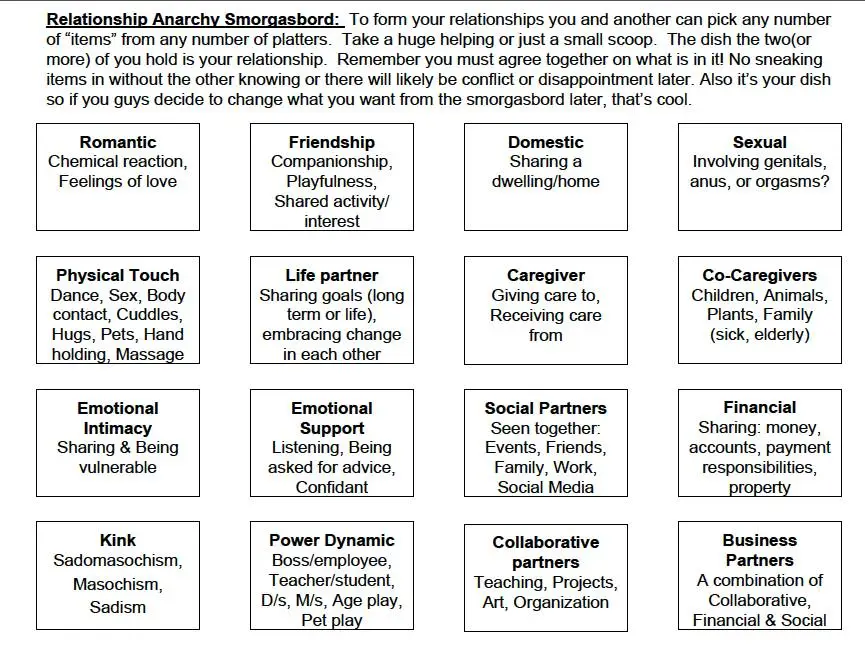
and what do those terms mean to us? And so on. Tools like the <em>relationship
smorgasbord</em> can help with this:</p>
<p><img src="/images/relationship-smorgasbord.webp"


	loading="lazy"
	
		alt="A graphic explaining the &ldquo;relationship smorgasbord&rdquo; concept"
	
	
></p>
<details>
<summary>Image Transcript</summary>
<p><strong>Relationship Anarchy Smorgasbord:</strong></p>
<p>
To form your relationships you and another can pick any number of "items" from
any number of platters. Take a huge helping or just a small scoop. The dish the
two (or more) of you hold is your relationship. Remember you must agree together
on what is in it! No sneaking items in without the other knowing or there will
likely be conflict or disappointment later. Also it's your dish so if you guys
decide to change what you want from the smorgasbord later, that's cool.
</p>
<ul>
<li>
<strong>Romantic</strong>
<p>Chemical reaction, Feelings of love</p>
</li>
<li>
<strong>Friendship</strong>
<p>Companionship, Playfulness, Shared activity/interest</p>
</li>
<li>
<strong>Domestic</strong>
<p>Sharing a dwelling/home</p>
</li>
<li>
<strong>Sexual</strong>
<p>Involving genitals, anus, or orgasms?</p>
</li>
<li>
<strong>Physical Touch</strong>
<p>Dance, Sex, Body contact, Cuddles, Hugs, Pets, Hand holding, Massage</p>
</li>
<li>
<strong>Life partner</strong>
<p>Sharing goals (long term or life), embracing change in each other</p>
</li>
<li>
<strong>Caregiver</strong>
<p>Giving care to, receiving care from</p>
</li>
<li>
<strong>Co-Caregivers</strong>
<p>Children, Animals, Plants, Family (sick, elderly)</p>
</li>
<li>
<strong>Emotional Intimacy</strong>
<p>Sharing & Being vulnerable</p>
</li>
<li>
<strong>Emotional Support</strong>
<p>Listening, Being asked for advice, Confidant</p>
</li>
<li>
<strong>Social Partners</strong>
<p>Seen together: Events, Friends, Family, Work, Social Media</p>
</li>
<li>
<strong>Financial</strong>
<p>Sharing: money, accounts, payment responsibilities, property</p>
</li>
<li>
<strong>Kink</strong>
<p>Sadomasochism, Masochism, Sadism</p>
</li>
<li>
<strong>Power Dynamics</strong>
<p>Boss/employee, Teacher/student, D/s, M/s, Age play, Pet play</p>
</li>
<li>
<strong>Collaborative partners</strong>
<p>Teaching, Projects, Art, Organization</p>
</li>
<li>
<strong>Business Partners</strong>
<p>A combination of Collaborative, Financial & Social</p>
</li>
</ul>
</details>
<p>I&rsquo;ve found that often, alloromantic people come into these kinds of negotiations
with certain preconceptions of how relationships &ldquo;should&rdquo; work. They tend to
categorize their relationships as either &ldquo;romantic&rdquo; or &ldquo;platonic,&rdquo; and they have
a set of expectations for what relationships in each bucket involve. Through
this framework, the negotiation is happening implicitly; the boundaries and
expectations of the relationship are inferred from the labels. Relationship
anarchy flips that on its head; the negotiation happens explicitly and upfront,
and the labels come later. RA leans heavily on explicit communication, but for
people who are used to relationships working a certain way, it&rsquo;s very easy to
fall back on implicit communication instead.</p>
<p>In an allonormative world, when you ask someone to be your romantic partner,
there is a whole heap of implicit negotiation happening. You&rsquo;re telling them you
want your relationship to be monogamous, and assuming you&rsquo;re both on the same
page about what constitutes a violation of that exclusivity. You&rsquo;re telling them
you want to be emotionally and sexually intimate with them. You&rsquo;re telling them
you want to refer to one another using terms like &ldquo;boyfriend&rdquo; or &ldquo;girlfriend&rdquo; or
&ldquo;partner.&rdquo; You&rsquo;re telling them that you eventually plan to cohabitate with them.
The list goes on.</p>
<p>The problem with negotiating a romantic relationship implicitly like this is
that any aspects of the relationship that aren&rsquo;t negotiated explicitly—anything
that is left unsaid—is assumed to default to this standard prototype of romantic
relationships that allo people carry around in their heads. And this is a
problem for me, because I don&rsquo;t have this intuitive sense of how relationships
are &ldquo;supposed&rdquo; to work. Something is left unnegotiated because both people
consider it &ldquo;obvious,&rdquo; and they only discover weeks or months or years down the
line that they were not on the same page at all.</p>
<p>Alloromantic people have certain expectations of what an intimate relationship
should look like, and a big part of what makes being aromantic in an
allonormative world so difficult for me is that I need to make sure the people I
bring into my life aren&rsquo;t coming into the relationship with the wrong
assumptions, or someone will get hurt.</p>
<p>Lately, I&rsquo;ve been tackling this problem by avoiding &ldquo;dating&rdquo; and just
negotiating the relationship in my life as friendships instead. I&rsquo;ve found it&rsquo;s
often easier to say, &ldquo;I want a friendship, but with <em>xyz</em>&rdquo; than &ldquo;I want a
romantic relationships, but without <em>xyz</em>.&rdquo; The distinction is unimportant to
me, but it <em>is</em> important to many alloromantic people, and I&rsquo;ve found that using
the label &ldquo;friends, but…&rdquo; helps keep expectations in check.</p>
<p>There&rsquo;s also something delightfully subversive about calling the intimate and
affectionate relationships in my life friendships. I love my friends, and I love
being affectionate with my friends, and I think that should be normalized. I
don&rsquo;t think these things need be reserved for &ldquo;romantic&rdquo; relationships.</p>
<p>I enjoy many of the things &ldquo;romance&rdquo; is considered to entail—terms of endearment
and physical affection and going on dates—but I&rsquo;ve never related to the concept
of &ldquo;romantic attraction.&rdquo; I still don&rsquo;t have a complete picture of how allo
people experience the thing they call romance, but I can tell that it&rsquo;s very
different from how I experience it, and I don&rsquo;t want that mismatch to result in
hurt feelings and disappointment. So for now, I&rsquo;m done trying to make &ldquo;romantic&rdquo;
relationships work. And I think I&rsquo;ll be content without them, because I have my
friends ❤</p>
<div class="footnotes" role="doc-endnotes">
<hr>
<ol>
<li id="fn:1">
<p>If you&rsquo;re not familiar with relationship anarchy, I highly recommend <a class="link" href="https://theanarchistlibrary.org/library/andie-nordgren-the-short-instructional-manifesto-for-relationship-anarchy"  target="_blank" rel="noopener"
    >this
essay</a>
as an introduction.&#160;<a href="#fnref:1" class="footnote-backref" role="doc-backlink">&#x21a9;&#xfe0e;</a></p>
</li>
</ol>
</div>
]]>
    </content>
    <link rel="alternate" type="text/html" href="https://nothingradical.blog/2023/06/23/managing-expectations-in-an-allonormative-world/" hreflang="en-us"/>
    <summary xml:lang="en-us">
      For me, one of the hardest parts about being aromantic is managing the expectations of alloromantic people in relationships

    </summary>
    <category term="orientation" label="Sexuality and Orientation"/>
    <published>2023-06-23T18:23:00Z</published>
    <rights>© 2020–2024 Frawley CC BY-NC-SA 4.0</rights>
  </entry>
  <entry>
    <id>urn:uuid:b1f15d41-218f-44c1-ae2e-13e6e578ec90</id>
    <title>How Society Delegitimizes Aromantic Family</title>
    <updated>2023-04-23T19:52:00Z</updated>
    <author>
      <name>Frawley</name>
      <email>frawley@nothingradical.blog</email>
    </author>
    <content xml:lang="en-us" type="html">
      <![CDATA[<p><em>This post was written for the <a class="link" href="https://tabby-shieldmaiden.tumblr.com/post/713444296272101376/april-2023-carnival-of-aros-call-for-submissions"  target="_blank" rel="noopener"
    >April 2023 Carnival of
Aros</a>,
where the theme is “Family.”</em></p>
<p>In the US, our traditional model of family is the <em>nuclear family</em>: a husband
and a wife and some number of children. Any other configuration—single parents,
same-gender couples, childfree couples, multigenerational households (despite
being the norm throughout much of the world)—we call &ldquo;non-traditional.&rdquo; But even
among these &ldquo;non-traditional&rdquo; family archetypes, there are still certain
commonalities. Even &ldquo;non-traditional&rdquo; families must align closely enough with
prevailing social norms for us to consider them &ldquo;families&rdquo; at all.</p>
<p>Conventional narratives about family prescribe a rigid progression of life
milestones people are expected to follow as they transition from being solely a
member of their family of origin to having a family of their own: having a
sexual and romantic partner, cohabitating, getting married, having children, and
so on. Once you deviate far enough from this script, society stops seeing the
people you surround yourself with as a &ldquo;family&rdquo;; they&rsquo;re downgraded to &ldquo;friends&rdquo;
or &ldquo;roommates&rdquo; instead.</p>
<p>There are allowances for &ldquo;non-traditional&rdquo; paths to family—being queer, being
divorced, being childfree—but these are always framed as deviations from the
prototypical nuclear family ideal. Exceptions to to the rule. The fact that we
consider these circumstances &ldquo;non-traditional&rdquo; in the first place demonstrates
the primacy of the nuclear family in our social fabric.</p>
<p>This strict progression that we&rsquo;re expected to follow in order for our families
to be considered legitimate in the eyes of society is closely aligned with the
&ldquo;relationship escalator&rdquo; concept from polyamory discourse: the observation that
in conventional romantic relationships, the relationship is expected to progress
monotonically through a series of stages that represent increasing levels of
commitment. Couples are expected to &ldquo;ride the escalator&rdquo; all the way to the top:
marriage.</p>
<p>In this way, we can see how the concept of the nuclear family is closely aligned
with conventional attitudes toward romantic relationships: society prescribes
rigid rules detailing what makes a family or a relationship legitimate. The idea
that marriage is a prerequisite to family, or that partners must cohabitate, or
that partners must be sexually and romantically intimate are examples of how
amatonormative social rules dictate the terms of our families.</p>
<p>This assumption that family is built around a romantic relationship leaves
aromantic people, who often defy conventional relationship norms in their
interpersonal relationships, without a clear path to having a socially
recognized family of their own.</p>
<p>I think a lot about what my home life might look like in the future—that phase
of life where you&rsquo;re expected to &ldquo;settle down.&rdquo; For me, part of coming out as
aro was realizing that <em>I</em> get to choose what this stage of my life looks like,
without bowing to the &ldquo;traditional&rdquo; notions of family I was socialized with.
That realization was freeing. But there&rsquo;s also a certain comfort in the nuclear
family archetype, in having a roadmap laid out for you to plan your life by. And
conversely, there&rsquo;s uncertainty and terror in having no well-trodden path to
follow as you navigate major life decisions.</p>
<p>Society is so prescriptive about what defines a family that unlearning those
narratives has been a journey for me. For a long time, &ldquo;family&rdquo; was an
unappealing prospect because society had constrained my understanding of what a
family can be, teaching me that monogamous romantic relationships are central to
the concept. This made &ldquo;family&rdquo; feel like something society would one day impose
on me rather that something I would actively seek out for myself.</p>
<p>Society fails aromantic people by teaching us that families must look a certain
way and by delegitimizing the family structures we choose for ourselves. Even
the assumption that &ldquo;family&rdquo; is a universally shared goal undermines aromantic
people who don&rsquo;t want or need certain kinds of interpersonal connection. Family
is integral to society, but conventional notions of family marginalize people
who don&rsquo;t fit its assumptions.</p>
]]>
    </content>
    <link rel="alternate" type="text/html" href="https://nothingradical.blog/2023/04/23/how-society-delegitimizes-aromantic-family/" hreflang="en-us"/>
    <summary xml:lang="en-us">
      I&#39;ve been thinking a lot lately about what &#34;family&#34; means as an aromantic person, especially when family is so fundamentally tied to the concept of romantic relationships.

    </summary>
    <category term="orientation" label="Sexuality and Orientation"/>
    <published>2023-04-23T19:52:00Z</published>
    <rights>© 2020–2024 Frawley CC BY-NC-SA 4.0</rights>
  </entry>
  <entry>
    <id>urn:uuid:c8ebc274-b4ff-4bf1-a30a-97e58f29d887</id>
    <title>Amatonormativity as a Media Trope</title>
    <updated>2023-02-04T16:45:00Z</updated>
    <author>
      <name>Frawley</name>
      <email>frawley@nothingradical.blog</email>
    </author>
    <content xml:lang="en-us" type="html">
      <![CDATA[<p><em>This post was written for the <a class="link" href="https://www.writingforlife.net/index.php/2023/02/01/call-for-submissions-february-carnival-of-aces/"  target="_blank" rel="noopener"
    >February 2023 Carnival of
Aces</a>,
where the theme is “Representation in Fiction.”</em></p>
<p>Folks tend to assume that explicit representation—the kind where you have an
explicitly queer character and make their queerness a plot point—is how
representation should be done.</p>
<p>Honestly? I&rsquo;m sometimes inclined to disagree.</p>
<p>Like, I&rsquo;m as tired as anyone of &ldquo;representation&rdquo; being two women holding hands
in the background of a shot for 0.4 seconds. I&rsquo;m tired of companies censoring
their writers trying to write queer characters. I&rsquo;m tired of queerbaiting.</p>
<p>But I&rsquo;m also tired of explicit queer representation that&rsquo;s just terrible coming
out stories written by and for cishet people.</p>
<p>Aces get <em>real</em> excited on the rare occasion we get explicit representation in
media, and for good reason. We&rsquo;re invisible. Light bends around us like a
gravitational anomaly such that most people don&rsquo;t know we exist.</p>
<p>I remember ace Reddit being <em>hyped</em> when that episode of <em>Sex Education</em> came
out in 2020 with an explicitly asexual character. And while I haven&rsquo;t watched
the show, it really seems like they did their ace character right.</p>
<p>But you know what I crave more than that kind of explicit representation? Media
that casually bucks amatonormative and allonormative social norms.</p>
<p>Y&rsquo;all remember when <em>Shang-Chi</em> came out in 2021 and a bunch of aros were
talking about Shaun and Katy&rsquo;s relationship? There was nothing queer or even
particularly subversive about it—they were just a male and female lead who
didn&rsquo;t have a romance subplot. And that was so incredibly refreshing to see.
Just two close friends without any romantic interest or sexual tension.</p>
<p>And that got me thinking about how amatonormativity in media is so pervasive
that it feels like a tired trope the world won&rsquo;t let go of.</p>
<p>So many films and TV shows would be just as good—maybe better—without the
corporate-mandated romance subplot. As cool as it would be to see more explicit
aro and ace representation, what I think I want even more is more media that
eschews common romance tropes in favor of nontraditional relationships. Romantic
relationships that are non-sexual. Queerplatonic relationships—even if they&rsquo;re
not called that. People who are sensually intimate without sexual tension.
Ambiguous relationships. Weirdly close roommates. Found families. Platonic
friends who mean the world to each other.</p>
<p>From the perspective of asexual visibility and education, I feel like more
nontraditional relationships in media would be helpful, maybe even more so than
just teaching people the label.</p>
<p>Sure, you can teach people what &ldquo;asexual&rdquo; means and give them the whole lecture,
and then what? They tell you you&rsquo;re broken, they tell you you have a hormone
problem, they tell you it&rsquo;s &ldquo;not possible,&rdquo; etc. These people don&rsquo;t have a
conceptual framework with which to understand asexuality, and sometimes I wonder
if what they need is to be deprogrammed of the amatonormativity and
allonormativity they were socialized with.</p>
<p>Back in the mid aughts, David Jay went on a media tour for AVEN. He did
interviews on <a class="link" href="https://acearchive.lgbt/artifacts/david-jay-the-view/"  target="_blank" rel="noopener"
    >ABC&rsquo;s <em>The
View</em></a> and <a class="link" href="https://acearchive.lgbt/artifacts/david-jay-tucker/"  target="_blank" rel="noopener"
    >MSNBC&rsquo;s
<em>Tucker</em></a>, and to this day
I haven&rsquo;t been able to watch either of them in their entirety on account of the
acephobia. The folks interviewing him are <em>brutal</em> to him, while all he&rsquo;s trying
to do is patiently explain asexuality and his organization. Explicit
representation relies on people being willing to change their understanding of
the world.</p>
<p>Another reasons I like the concept of portraying nontraditional relationships in
media outside of an explicitly queer context because I think amatonormativity
harms everyone—not just aspec people. I&rsquo;ve met non-queer folks who have what I
would describe as a queerplatonic relationship<sup id="fnref:1"><a href="#fn:1" class="footnote-ref" role="doc-noteref">1</a></sup>, for example. I think a lot
of folks could benefit from the assurance that things like intimacy and
commitment can exist outside the context of a romantic and sexual relationship.</p>
<p>I guess we&rsquo;re all looking for the same thing: to normalize asexuality. But
lately, I&rsquo;ve been thinking maybe it&rsquo;s better to go about it by <em>showing</em> what
asexuality is rather than telling.</p>
<div class="footnotes" role="doc-endnotes">
<hr>
<ol>
<li id="fn:1">
<p><a class="link" href="https://acearchive.lgbt/artifacts/meloukhia-word-of-the-day-queerplatonic/"  target="_blank" rel="noopener"
    >From its
inception</a>,
the term &ldquo;queerplatonic&rdquo; has never been exclusive to queer folks.&#160;<a href="#fnref:1" class="footnote-backref" role="doc-backlink">&#x21a9;&#xfe0e;</a></p>
</li>
</ol>
</div>
]]>
    </content>
    <link rel="alternate" type="text/html" href="https://nothingradical.blog/2023/02/04/amatonormativity-as-a-media-trope/" hreflang="en-us"/>
    <summary xml:lang="en-us">
      The level of amatonormativity in media is exhausting—it feels like a tired trope that the world won&#39;t let go of.

    </summary>
    <category term="orientation" label="Sexuality and Orientation"/>
    <published>2023-02-04T16:45:00Z</published>
    <rights>© 2020–2024 Frawley CC BY-NC-SA 4.0</rights>
  </entry>
  <entry>
    <id>urn:uuid:bae18215-89b0-42df-a32d-1e9ecb0a2ecc</id>
    <title>Navigating Generational Rifts in Queer Communities</title>
    <updated>2022-12-18T03:51:01Z</updated>
    <author>
      <name>Frawley</name>
      <email>frawley@nothingradical.blog</email>
    </author>
    <content xml:lang="en-us" type="html">
      <![CDATA[<p><em>This post was written for the <a class="link" href="https://roboticanary.wordpress.com/2022/11/30/december-2020-carnival-of-aros-getting-old-call-for-submissions/"  target="_blank" rel="noopener"
    >December 2022 Carnival of
Aros</a>,
where the theme is &ldquo;Getting Old.&rdquo;</em></p>
<p>This is one of two submissions I&rsquo;m writing for the Carnival this month; the
other one is <a class="link" href="https://nothingradical.blog/2022/12/18/growing-old-and-finding-my-people/" >&ldquo;Growing Old and Finding My People&rdquo;</a>.</p>
<hr>
<p>Participating in different aro communities and actually meeting fellow aros in
meatspace has made me realize some things I didn&rsquo;t realize when I first came
out.</p>
<p>There are generational differences within the aro community. Which is obvious
in hindsight, but is easy to miss when you&rsquo;re a young aro who only talks with
other young aros (which is easy to do, since the age distribution in many
popular online aro communities tends to skew right).</p>
<p>I had this realization a little over a year ago when talking with an aro/ace
friend about the aro communities on TikTok and Reddit. The Reddit aro community
was pretty instrumental to me coming out, but I realized that I don&rsquo;t really
participate in that community anymore, and the main reason is that I think I&rsquo;ve
grown out of it.</p>
<p>That&rsquo;s not a problem with the community itself per se—I just realized I was no
longer in the average age range of the popular subreddits, and the content
didn&rsquo;t really feel as relevant to me anymore.</p>
<p>Meanwhile there are folks who have been participating in the aro/ace
blogospheres for some 10 years or longer, and it&rsquo;s a very different vibe here.</p>
<p>I&rsquo;ve noticed this with the trans community too—realizing I feel somewhat
disconnected from both trans folks significantly older and younger than me.</p>
<p>This has all had me thinking about how my place in the broader aro community
will change as I get older.</p>
<p>I see a lot of infighting among queer communities between older and younger
folks—problems like older queer folks using terms or conceptual models that
younger queer folks find problematic or dated, because those <em>were</em> the
preferred terms at the time. Older trans folks who call themselves
&ldquo;transsexual&rdquo; and non-binary folks who came out before the term &ldquo;non-binary&rdquo;
was in common usage are examples that come to mind.</p>
<p>I guess there&rsquo;s a sort of persistent existential dread that <em>I</em> will become one
of these &ldquo;problematic&rdquo; queers someday.</p>
<p>Conventional cultural notions of gender and sexuality have been shifting a lot
in recent times. Like, the term &ldquo;aromantic&rdquo; is a <a class="link" href="https://acearchive.lgbt/artifacts/hha-maxnova100-feelings-when-dating/"  target="_blank" rel="noopener"
    >fairly modern
invention</a>
in its contemporary/queer sense, even if the underlying orientation is as old
as humans.</p>
<p>So what happens if I fall out of touch when I&rsquo;m older? I think about how
impossible it is to explain being aro to most folks over 50, and then I
remember that <em>I</em> will be 50 someday.</p>
<p>There&rsquo;s a general sentiment among folks in my age group that people over a
certain age are permanently and irreparably poisoned by the cultural norms they
grew up with, but folks don&rsquo;t always acknowledge that <em>we too</em> will be &ldquo;old&rdquo;
someday.</p>
<p>Does the fact that I&rsquo;m thinking about this now inoculate me against it actually
happening to me when I&rsquo;m older? Or is failing to adapt to cultural shifts as
you age just part of being human?</p>
]]>
    </content>
    <link rel="alternate" type="text/html" href="https://nothingradical.blog/2022/12/18/navigating-generational-rifts-in-queer-communities/" hreflang="en-us"/>
    <summary xml:lang="en-us">
      I reflect on generational rifts in queer communities and my fears of someday becoming one of the &#34;problematic&#34; queer folks.

    </summary>
    <category term="community" label="Community"/>
    <published>2022-12-18T03:51:01Z</published>
    <rights>© 2020–2024 Frawley CC BY-NC-SA 4.0</rights>
  </entry>
  <entry>
    <id>urn:uuid:643b503d-b0ee-4bd9-9a9e-98ab51a71da8</id>
    <title>Growing Old and Finding My People</title>
    <updated>2022-12-18T03:51:00Z</updated>
    <author>
      <name>Frawley</name>
      <email>frawley@nothingradical.blog</email>
    </author>
    <content xml:lang="en-us" type="html">
      <![CDATA[<p><em>This post was written for the <a class="link" href="https://roboticanary.wordpress.com/2022/11/30/december-2020-carnival-of-aros-getting-old-call-for-submissions/"  target="_blank" rel="noopener"
    >December 2022 Carnival of
Aros</a>,
where the theme is &ldquo;Getting Old.&rdquo;</em></p>
<p>Hey! I haven&rsquo;t posted on this blog or written for a carnival in a while, mostly
because I&rsquo;ve been busy with <a class="link" href="https://acearchive.lgbt"  target="_blank" rel="noopener"
    >other projects</a>.</p>
<p>I think I want to experiment with the format of this blog a bit, so we&rsquo;ll see
how this goes.</p>
<p>This is one of two submissions I&rsquo;m writing for the Carnival this month; the
other one is <a class="link" href="https://nothingradical.blog/2022/12/18/navigating-generational-rifts-in-queer-communities/" >&ldquo;Navigating Generational Rifts in Queer Communities&rdquo;</a>.</p>
<hr>
<p>A lot of aros talk about the logistical challenges of not having a person who
fulfills the roles a romantic partner is expected to fulfill: someone to be
your emergency contact, someone to split rent or domestic duties with, someone
to take care of you when you&rsquo;re sick, etc.</p>
<p>That was a huge existential fear of mine for the first few years after coming
out as aro. What happens when all my friends inevitably find exclusive romantic
partners, &ldquo;settle down,&rdquo; and forget about me?</p>
<p>Lately, that anxiety has actually started to disappear. These days, most of my
friends are non-monogamous, and even the ones who aren&rsquo;t still have fairly
non-normative attitudes toward relationships. And the interconnectedness and
level of mutual support in my relationship network has been nothing short of
amazing—friends and partners and not-partners and metamours and roommates all
looking out for each other.</p>
<p>When my close friend of several years started dating someone, it made us
<em>closer</em>, not more distant like I had feared.</p>
<p>This friend and I even managed to fall into the classic aro trope of realizing
that what we have is basically a QPR.</p>
<p>So yeah, that long-standing dread of being alone as I get older has started to
disappear. It won&rsquo;t be like this forever—friends will come and go as they
always do—but I&rsquo;ve gained a lot more confidence that among the queer and polyam
community, I&rsquo;ll always be able to find people who don&rsquo;t treat me as secondary
to their romantic partner(s).</p>
<p>I&rsquo;ve also started to grow more comfortable with the idea that I don&rsquo;t need to
be a main character in all of my friends&rsquo; lives. Realizing that I have friends
to whom I&rsquo;m mostly a side character—and being okay with that.</p>
<p>I have friends who I only catch up with every couple weeks—or even months—but
that doesn&rsquo;t make them less important to me. I still treasure the time we spend
together.</p>
<p>So yeah, amatonormativity still sucks, but I&rsquo;m having far more success
navigating life as an aro person than I ever expected, and that&rsquo;s been pretty
great.</p>
]]>
    </content>
    <link rel="alternate" type="text/html" href="https://nothingradical.blog/2022/12/18/growing-old-and-finding-my-people/" hreflang="en-us"/>
    <summary xml:lang="en-us">
      I reflect on some long-held existential fears of being abandoned by my friends as I grow older.

    </summary>
    <category term="community" label="Community"/>
    <published>2022-12-18T03:51:00Z</published>
    <rights>© 2020–2024 Frawley CC BY-NC-SA 4.0</rights>
  </entry>
  <entry>
    <id>urn:uuid:44b96cd8-e64a-442e-80d2-95265991a527</id>
    <title>The Space Between My Neurodiversity and My Romantic Orientation</title>
    <updated>2022-01-22T22:06:00Z</updated>
    <author>
      <name>Frawley</name>
      <email>frawley@nothingradical.blog</email>
    </author>
    <content xml:lang="en-us" type="html">
      <![CDATA[<p><em>This post was written for the <a class="link" href="https://aspecofstardust.wordpress.com/2021/12/31/call-for-submissions-january-2022-in-between-spaces/"  target="_blank" rel="noopener"
    >January 2022 Carnival of
Aros</a>,
where the theme is &ldquo;In-Between Spaces.&rdquo;</em></p>
<p>I talk a lot about neurodiversity and queer stuff on this blog, but something I
haven&rsquo;t had the opportunity to talk about yet is just how interconnected those
aspects of my identity are. For me, being autistic actually has a lot to do
with me being aromantic/quoiromantic. This is something I tend to avoid telling
non-queer and neurotypical people in order to avoid feeding harmful stereotypes
that equate queerness with mental health conditions, but I do feel in my case
that there&rsquo;s a connection.</p>
<p>I talk in my submission for this month&rsquo;s Carnival of Aces, <a class="link" href="https://nothingradical.blog/2022/01/18/plotting-my-queer-identity-on-the-convergence-divergence-spectrum/"  target="_blank" rel="noopener"
    >&ldquo;Plotting My Queer
Identity on the Convergence-Divergence
Spectrum&rdquo;</a>,
about how my romantic orientation (as well as how I practice polyamory) largely
comes down to me not identifying with the norms and social scripts our society
has built around romance and relationships. I generally don&rsquo;t think of my
romantic orientation as &ldquo;I don&rsquo;t have the ability to experience romantic
attraction&rdquo; so much as &ldquo;for me, the conventional distinction between romantic
relationships and platonic relationships isn&rsquo;t really applicable.&rdquo; And I feel
like my neurodivergence plays a significant role in that.</p>
<p>Autistic people often talk about our &ldquo;superpowers&rdquo;—things we feel we can do
<em>better</em> because of our autism. For some autistic people, that might manifest
as incredibly deep knowledge about a particular topic (what we call a <em>special
interest</em>). For others, it might be an aptitude for problem-solving and
rational decision-making. I consider one of my biggest superpowers to be an
ability to look at social norms through an objective lens and to deconstruct
and question them rather than taking them for granted.</p>
<p>Most of the social norms of the culture we grow up in we internalize as we
develop, so they become obvious and intuitive for us. That never really
happened to me. Every day I learn more and more about my own culture—things
most of my peers never have to think about. My friends and I sometimes joke
that I&rsquo;m actually an alien sent from outer space to observe and learn about
human culture, and it certainly feels that way sometimes. While this particular
aspect of being autistic certainly bites me in the ass sometimes—particularly
when I commit a faux pas because I don&rsquo;t know any better—I still consider it a
superpower.</p>
<p>Being able to look at social norms through an objective lens means that I&rsquo;m not
bound by them in the way most people are; I&rsquo;m free to challenge and question
social norms in a way many people aren&rsquo;t, which can be incredibly freeing. I
feel like this has a lot to do with my romantic orientation because being
autistic means that I&rsquo;m not bound by the social norms that govern how most
people go about relationships. Looking at the courtship rituals and
<a class="link" href="https://offescalator.com/what-escalator/"  target="_blank" rel="noopener"
    >relationship escalators</a> that our
society expects us to follow—governing everything from how we&rsquo;re supposed to
feel to how we&rsquo;re supposed to structure our life—the way most people practice
relationships feels incredibly prescriptive to me.</p>
<p>The idea that you&rsquo;re supposed to strictly categorize all the relationships in
your life as either platonic or romantic feels very limiting to me. Most people
would consider the way I practice relationships to be radical, but I personally
don&rsquo;t see how else I would go about it. The social scripts our society has
built around interpersonal relationships don&rsquo;t make much sense to me, so I
simply don&rsquo;t subscribe to them. And I feel like my autism makes this much
easier for me than it might be if I was allistic.</p>
<p>As a non-binary person, I can&rsquo;t help but go on a tangent to point out the
growing body of evidence<sup id="fnref:1"><a href="#fn:1" class="footnote-ref" role="doc-noteref">1</a></sup> for a link between autism and gender variance.
There are lots of theories as to why this link exists, but the reason why I
personally consider my gender identity to be related to my neurodivergence
again has to deal with how I don&rsquo;t internalize social scripts in the way most
people do. <a class="link" href="https://nothingradical.blog/2020/10/07/the-cultural-model-of-gender/"  target="_blank" rel="noopener"
    >As I&rsquo;ve talked about
previously</a>,
gender is largely influenced by the culture we live in, and being someone who
is less susceptible to those kinds of cultural influences, I feel less
compelled to identify with the gender binary prescribed by my culture.</p>
<p>I really appreciate this month&rsquo;s prompts for both the Carnival of Aros and the
Carnival of Aces, as I feel like they&rsquo;ve given me the opportunity to talk about
the weird ways in which my identities overlap and intersect. I sometimes feel
like acknowledging these overlaps is taboo considering how hard queer people
have to fight to dismiss myths about our identities being &ldquo;mental illnesses,&rdquo;
and I&rsquo;m happy to have a space where I feel like it&rsquo;s safe to acknowledge that
my neurodivergence and my queerness really are related.</p>
<div class="footnotes" role="doc-endnotes">
<hr>
<ol>
<li id="fn:1">
<p>Sources: <a class="link" href="https://pubmed.ncbi.nlm.nih.gov/32770077/"  target="_blank" rel="noopener"
    >1</a>,
<a class="link" href="https://pubmed.ncbi.nlm.nih.gov/30392631/"  target="_blank" rel="noopener"
    >2</a>,
<a class="link" href="https://pubmed.ncbi.nlm.nih.gov/30062396/"  target="_blank" rel="noopener"
    >3</a>,
<a class="link" href="https://pubmed.ncbi.nlm.nih.gov/28597143/"  target="_blank" rel="noopener"
    >4</a>,
<a class="link" href="https://pubmed.ncbi.nlm.nih.gov/24619651/"  target="_blank" rel="noopener"
    >5</a>,
<a class="link" href="https://pubmed.ncbi.nlm.nih.gov/28914080/"  target="_blank" rel="noopener"
    >6</a>&#160;<a href="#fnref:1" class="footnote-backref" role="doc-backlink">&#x21a9;&#xfe0e;</a></p>
</li>
</ol>
</div>
]]>
    </content>
    <link rel="alternate" type="text/html" href="https://nothingradical.blog/2022/01/22/the-space-between-my-neurodiversity-and-my-romantic-orientation/" hreflang="en-us"/>
    <summary xml:lang="en-us">
      I talk about the &#34;in-between spaces&#34; between my neurodiversity and my romantic orientation and just how interconnected those aspects of my identity are

    </summary>
    <category term="neurodiversity" label="Neurodiversity"/>
    <category term="orientation" label="Sexuality and Orientation"/>
    <published>2022-01-22T22:06:00Z</published>
    <rights>© 2020–2024 Frawley CC BY-NC-SA 4.0</rights>
  </entry>
  <entry>
    <id>urn:uuid:8d60e612-1268-41c7-87d8-a75bbb570e58</id>
    <title>Plotting My Queer Identity on the Convergence-Divergence Spectrum</title>
    <updated>2022-01-18T00:50:00Z</updated>
    <author>
      <name>Frawley</name>
      <email>frawley@nothingradical.blog</email>
    </author>
    <content xml:lang="en-us" type="html">
      <![CDATA[<p><em>This post was written for the <a class="link" href="https://bringonthepigeons.wordpress.com/2022/01/05/january-2022-carnival-of-aces-divergence-vs-convergence/"  target="_blank" rel="noopener"
    >January 2022 Carnival of
Aces</a>,
where the theme is &ldquo;Divergence vs. Convergence.&rdquo;</em></p>
<p>This month&rsquo;s prompt got me thinking again about my queer identity—not just my
romantic and sexual orientation, but how they relate to the very queer way I go
about relationships. Coyote&rsquo;s concept of a divergent-convergent spectrum for
understanding queer identities introduces some new language to describe
feelings I&rsquo;ve been trying to piece together for a while: how there are some
aspects of my orientation that I consider completely independent and others
that I feel can&rsquo;t be meaningfully separated from one another.</p>
<p>I talked in <a class="link" href="https://nothingradical.blog/2021/09/16/confessions-of-a-former-sam-aro/"  target="_blank" rel="noopener"
    >&ldquo;Confessions of a Former &lsquo;SAM
Aro&rsquo;&rdquo;</a>
about how I don&rsquo;t really identify with the concept of a romantic orientation in
the way it&rsquo;s prescribed by the ubiquitous split-attraction model; the whole
concept of &ldquo;romantic attraction&rdquo; isn&rsquo;t really intuitive to me, and I don&rsquo;t find
it a useful conceptualization for modeling my identity. Instead, I prefer to
use the term &ldquo;aro&rdquo; to mean that I don&rsquo;t do romance and relationships in a
conventional way. I use many labels to describe my approach to romance and
relationships—aromantic, quoiromantic, polyamorous, relationship anarchist—and
to me, these concepts are so intertwined that they&rsquo;re difficult to meaningfully
separate.</p>
<p>Most people would consider terms like &ldquo;aromantic&rdquo; and &ldquo;quoiromantic&rdquo; to
describe a romantic orientation (or lack of romantic orientation or
disidentification with the concept) and terms like &ldquo;polyamorous&rdquo; and
&ldquo;relationship anarchist&rdquo; to describe a <em>relationship style</em>. These things are
typically considered to be separate, unrelated concepts, to such an extent that
having a non-hetero romantic orientation is typically considered queer, while
having a non-monogamous relationship style, on its own, is typically not.</p>
<p>However, for me, these facets of my identity are actually fairly
interconnected. They all boil down to the fact that I don&rsquo;t distinguish
platonic feelings and relationships from romantic feelings and relationships—at
least not in a conventional way. I have lots of different kinds of
interpersonal relationships in my life, and I&rsquo;m not really comfortable strictly
classifying them as either &ldquo;romantic&rdquo; or &ldquo;platonic.&rdquo;</p>
<p>This manifests as me being aromantic because it means that a lot of the social
scripts and courtship rituals associated with romance don&rsquo;t really make sense
for me. If I don&rsquo;t distinguish between romantic and platonic relationships,
what does it mean for me to date someone? To be partners with someone? To be
&ldquo;in love&rdquo; with someone? That&rsquo;s not to say that I won&rsquo;t consider someone a
partner or describe our relationship as dating or participate in romance-coded
activities, but I certainly don&rsquo;t seem to understand these concepts in the same
way an alloromantic person does.</p>
<p>I also consider myself aro because I don&rsquo;t relate to the concept of
<a class="link" href="https://en.wikipedia.org/wiki/Limerence"  target="_blank" rel="noopener"
    >limerence</a>. Since limerence is, as I
understand it, a large part of what differentiates romantic feelings from
platonic feelings among alloromantic people, I consider my disidentification
with the romantic/platonic binary to be intrinsically related with my lack of
experience with limerence and my aromanticism.</p>
<p>My approach to romance and relationships also manifests as me being
polyamorous. I don&rsquo;t see the sense in my intimate and affectionate
relationships being exclusive in much the same way most people don&rsquo;t see the
sense in their platonic friendships being exclusive. Typically romance is the
metric which determines whether a relationship is exclusive, but since I don&rsquo;t
make that distinction, it&rsquo;s not really obvious for me when a relationship is
&ldquo;supposed&rdquo; to be exclusive by normative standards.</p>
<p>I consider myself a relationship anarchist for the same reason; even other
polyamorous people tend to distinguish between friends and partners by the
presence of romance, but since I don&rsquo;t strictly classify my relationships as
romantic or non-romantic, the distinction between friends and partners is fuzzy
at best.<sup id="fnref:1"><a href="#fn:1" class="footnote-ref" role="doc-noteref">1</a></sup> A consequence of this is that I have relationships I call
friendships that most people would describe as romantic relationships, and I
have relationships I call partnerships that most people would describe as
friendships.</p>
<p>Because they all largely boil down to my disidentification with the
romantic/platonic binary, I consider my romantic orientation (or lack thereof)
and my relationship style to be <em>convergent</em> identities; they&rsquo;re so intertwined
that they&rsquo;re difficult to meaningfully separate, and often when I talk about
one, I&rsquo;m also implicitly talking about the other. One thing Em mentions in the
call for submissions is that the convergence-divergence spectrum is more
complicated than just &ldquo;do your romantic and sexual orientations match,&rdquo; and I
think my experience is a great example of that. However, I wouldn&rsquo;t necessarily
classify myself as a &ldquo;convergent queer,&rdquo; because there are also aspects of my
identity that I consider more divergent.</p>
<p>Specifically, I consider my sexual orientation to be divergent from the
composite of my romantic orientation and relationship style. While my
relationship with the term &ldquo;aromantic&rdquo; is fairly complicated, my relationship
with my ace identity is actually fairly simple: I just don&rsquo;t relate to the
experience allosexual people call &ldquo;sexual attraction.&rdquo; I consider this part of
my identity to be fairly independent of my approach to romance and
relationships; sex and sexual attraction just don&rsquo;t really have much bearing on
how I go about relationships.</p>
<p>So, in summary, I would consider my romantic orientation and relationship style
to be convergent identities, while my sexual orientation is divergent from both
of them. &ldquo;Convergent&rdquo; and &ldquo;divergent&rdquo; are probably not terms I will use often
when explaining my identity to others; they&rsquo;re esoteric enough that, for me at
least, they&rsquo;ll probably remain relegated to niche ontological discussions in
the ace blogosphere. This is much like how &ldquo;quoiromantic&rdquo; is the term that
<em>technically</em> describes my romantic orientation (or rather lack of romantic
orientation) the best, but I tend to stick with &ldquo;aro&rdquo; for the sake of
convenience. Still, I&rsquo;m glad the terms exist, and I definitely feel that they
fill an important lexical gap.</p>
<div class="footnotes" role="doc-endnotes">
<hr>
<ol>
<li id="fn:1">
<p>I do want to acknowledge that queerplatonic relationships exist and
platonic partnerships are valid, but <a class="link" href="https://nothingradical.blog/2021/10/06/a-relationship-anarchist-perspective-on-qprs-and-friendship/"  target="_blank" rel="noopener"
    >I&rsquo;ve written
before</a>
about how QPRs aren&rsquo;t really a concept I personally find very useful these
days.&#160;<a href="#fnref:1" class="footnote-backref" role="doc-backlink">&#x21a9;&#xfe0e;</a></p>
</li>
</ol>
</div>
]]>
    </content>
    <link rel="alternate" type="text/html" href="https://nothingradical.blog/2022/01/18/plotting-my-queer-identity-on-the-convergence-divergence-spectrum/" hreflang="en-us"/>
    <summary xml:lang="en-us">
      I use Coyote&#39;s concept of a convergent-divergent spectrum to describe some feelings about my identity I&#39;ve been trying to piece together for a while.

    </summary>
    <category term="language" label="Language and Conceptualization"/>
    <category term="orientation" label="Sexuality and Orientation"/>
    <published>2022-01-18T00:50:00Z</published>
    <rights>© 2020–2024 Frawley CC BY-NC-SA 4.0</rights>
  </entry>
  <entry>
    <id>urn:uuid:29ecc264-6c26-4b44-8d63-383017171da7</id>
    <title>A Relationship Anarchist Perspective on QPRs and Friendship</title>
    <updated>2021-10-06T20:52:00Z</updated>
    <author>
      <name>Frawley</name>
      <email>frawley@nothingradical.blog</email>
    </author>
    <content xml:lang="en-us" type="html">
      <![CDATA[<p><em>This post was written for the <a class="link" href="https://violetemeraldx.wordpress.com/2021/10/01/carnival-of-aros-october-2021-call-for-submissions-friendship/"  target="_blank" rel="noopener"
    >October 2021 Carnival of
Aros</a>,
where the theme is &ldquo;Friendship.&rdquo;</em></p>
<p>Early on in my journey to understand my aspec identity, I came across the
concept of queerplatonic relationships. As a baby aro, I found the concept of a
relationship that is committed and intimate while also being wholly platonic
incredibly liberating. Because of social programming, the thought that I could
have intimacy and affection in a relationship without romance and sex had never
occurred to me. I immediately knew that a QPR is something I wanted, and this
started the long process of unlearning many of the social scripts I grew up
with. As this process of deprogramming progressed and I opened my mind to what
an interpersonal relationship is and what it can be, I eventually settled on
relationship anarchy as the primary conceptualization scheme through which I
understand the relationships in my life. However, as I began navigating
relationships through the lens of relationship anarchy, the concept of a
queerplatonic relationship started to become less and less intuitive to me, and
I began to realize that the concept doesn&rsquo;t necessarily map well to my
conceptual model of relationships.</p>
<p>Many relationship anarchists choose to eschew labels in their relationships, as
they consider labels to be a form of classification and classification a form
of hierarchy. My approach to relationship anarchy has always been that I&rsquo;m fine
with labels as long as they&rsquo;re <em>descriptive</em> as opposed to <em>prescriptive</em>,
meaning that the label should describe the relationship rather than determine
the boundaries and expectation of the relationship. Traditionally, people
choose how they want to classify their relationship first and allow society to
prescribe what relationships of that type should entail. I prefer to pick and
choose what I want my relationships to entail independent of existing social
scripts—using tools like the <em>relationship smorgasbord</em>—and <em>then</em> choose how
we want to label it.</p>
<p>One would think that the concept of a queerplatonic relationship would be
well-suited to this style of relationship anarchy; QPRs don&rsquo;t really have any
social scripts associated with them, both because the concept isn&rsquo;t
particularly mainstream and because the definition is vague and fuzzy by
design. This means that &ldquo;queerplatonic&rdquo; can be adopted as a label for a
relationship under relationship anarchy without prescribing anything about the
nature of the relationship, and it can potentially be applicable to a wide
variety of non-normative relationship styles. Despite this, lately I&rsquo;ve been
finding that &ldquo;queerplatonic&rdquo;—even as a descriptive label—isn&rsquo;t as helpful of a
conceptualization for me as it once was.</p>
<p>Since I don&rsquo;t limit the amount of intimacy or kinds of commitments which are
included in a relationship by how I classify it, the only concrete
differentiator for me is the label we use to describe it. Still, for me,
determining whether to label a relationship as a friendship or a QPR can become
a sticking point because it&rsquo;s hard to escape the notion that there&rsquo;s some form
of hierarchy there. While people in aspec communities do generally make an
effort to clarify that a QPR isn&rsquo;t necessarily &ldquo;more than&rdquo; a friendship and
&ldquo;less than&rdquo; a romantic relationship, it&rsquo;s difficult to completely escape this
narrative when queerplatonic relationships are typically defined in terms of
what they include that a friendship doesn&rsquo;t and what they do not include which
a romantic relationship does. There&rsquo;s also generally an understanding that QPRs
progress <em>from</em> close friendships, implying that it&rsquo;s a sort of evolution or
progression from a &ldquo;standard&rdquo; friendship. I always see QPRs defined as
&ldquo;transcending&rdquo; friendship or going &ldquo;beyond&rdquo; friendship and usually as having
<em>more</em> of something—like intimacy or commitment—than a friendship. It&rsquo;s
incredibly difficult for me to determine exactly when a friendship should be
&ldquo;upgraded&rdquo; to a QPR, because I don&rsquo;t measure the relationships in my life on a
linear scale of &ldquo;closeness,&rdquo; and to me, there are many different kinds of
intimacy and commitment.</p>
<p>One appeal of the &ldquo;queerplatonic&rdquo; label for me—along with terms like
&ldquo;partner&rdquo;—is that it provides some social legitimacy for the relationship.
Something I&rsquo;ve found I enjoy in relationships is presenting as someone&rsquo;s
partner in a social sense—having our relationship recognized and fulfilling the
social role of a partner. I want the depth of my relationships to be recognized
by others, and calling someone my &ldquo;friend&rdquo; generally causes people to assume
there&rsquo;s an upper limit to how deep and intimate the relationship can be. Even
though the term &ldquo;queerplatonic&rdquo; isn&rsquo;t commonly understood outside queer
communities, having a formal label for the relationship and distinct language
for how I refer to that person goes a long way toward giving my relationship
social legitimacy. My thinking is that if I can&rsquo;t make other people understand
the nuanced and unique relationships I have with each of the people in my life,
I can at least pander to the rigid classification system they do understand to
gain some social recognition.</p>
<p>Still, I feel like this approach of pandering to relationship hierarchies isn&rsquo;t
how I want to go about relationships. If we go back to <a class="link" href="https://kaz.dreamwidth.org/238564.html"  target="_blank" rel="noopener"
    >the post where the term
&ldquo;queerplatonic&rdquo; was first proposed</a>,
Kaz talks about eir feelings toward relationship hierarchies:</p>
<blockquote>
<p>ALSO, I worry that by calling my relationship and desired relationship &ldquo;in
between friendship and romance&rdquo; (which again feels a bit like I&rsquo;m boxing it
in) I&rsquo;m trying to get relationship points from the hierarchy - that because I
don&rsquo;t want what I have with my not!GF to be dismissed as &ldquo;just&rdquo; friendship
I&rsquo;m calling it sort of romantic ish in a way in order to get some of the
importance that gets accorded to romantic relationships in our society - when
really I should be trying to break down the hierarchy altogether, point out
that friendship doesn&rsquo;t have to be &ldquo;just&rdquo;, and that there are more options
than friendship or romance.</p>
</blockquote>
<p>This stance really resonates with me; using &ldquo;queerplatonic&rdquo; to legitimize my
relationships feels like what Kaz describes as &ldquo;trying to get relationship
points from the hierarchy.&rdquo; I want people to recognize that my relationships
are valuable to me, but I don&rsquo;t want to have to impose a hierarchy them to do
it. Unlike Kaz, however, I don&rsquo;t think &ldquo;queerplatonic&rdquo; solves this problem for
me. To me, labeling a relationship as &ldquo;queerplatonic&rdquo; kinda <em>does</em> feel like
saying it&rsquo;s &ldquo;in between&rdquo; friendship and romance. As much as aspec people insist
that this isn&rsquo;t the case, the common messaging around &ldquo;queerplatonic&rdquo; still
gives me the impression that a QPR is in some way &ldquo;more than&rdquo; a friendship.
Even if I could conceptualize QPRs as a distinct relationship category with no
implied hierarchy, I&rsquo;m still not sure &ldquo;queerplatonic&rdquo; would be a useful concept
for me; my relationships are too varied and nuanced to fit into a binary, so
trying to fit them into a ternary isn&rsquo;t really much easier.</p>
<p>I&rsquo;ve always hated the notion that friendship is inherently less valuable than
other kinds of relationships, which is why I dislike phrases like &ldquo;just
friends&rdquo; and &ldquo;only friends.&rdquo; Instead of using &ldquo;queerplatonic&rdquo; to legitimize my
friendships, maybe I should focus more on defending the validity of intimate
and committed friendships. Because to me, friendship is something special.
There&rsquo;s something delightfully subversive about labeling my intimate and
committed relationships as friendships, like I&rsquo;m challenging the commonly held
notions of what a friendship is and what it can be. It almost feels like I&rsquo;m
reappropriating &ldquo;friendship&rdquo; from an amatonormative society to mean what <em>I</em>
want it to mean.</p>
<p>None of this is intended to be a criticism of relationship hierarchies or the
concept of queerplatonic relationships. Rather, this is more of a personal
reflection on my struggle to reconcile &ldquo;queerplatonic&rdquo;—a concept I once found
incredibly useful—with my tendencies toward relationship anarchy. I don&rsquo;t think
&ldquo;queerplatonic&rdquo; is necessarily incompatible with relationship anarchy or that
relationship anarchy is necessarily a better approach to relationships than any
other, and I do think that the existence of the term is a net positive. I just
feel like as my personal attitudes toward relationships have evolved, I&rsquo;m
moving past the need for &ldquo;queerplatonic.&rdquo;</p>
<p>At one point, the concept of queerplatonic relationships was incredibly useful
for expanding my conceptual model of relationships; &ldquo;queerplatonic&rdquo; gave me
permission to seek out the kinds of relationships I&rsquo;ve always wanted but never
thought I could have. However, in retrospect, I was just trading one
hierarchical classification system for a slightly less restrictive one. I now
realize that I don&rsquo;t need to classify my friendships as queerplatonic for them
to be intimate and committed, and all the term did for me was force me to
impose a binary on my platonic relationships where there didn&rsquo;t need to be one.
I do see appeal in the term for socially legitimizing my relationships, but
lately my attitude has been that I would prefer to challenge the concept of
relationship hierarchies rather than pander to them. I&rsquo;m glad the term exists
and that people find value in it, but I think I might let go of this
conceptualization scheme moving forwards.</p>
]]>
    </content>
    <link rel="alternate" type="text/html" href="https://nothingradical.blog/2021/10/06/a-relationship-anarchist-perspective-on-qprs-and-friendship/" hreflang="en-us"/>
    <summary xml:lang="en-us">
      Where I talk about QPRs, relationship anarchy, how I personally find QPRs less useful of a concept than I used to.

    </summary>
    <category term="language" label="Language and Conceptualization"/>
    <published>2021-10-06T20:52:00Z</published>
    <rights>© 2020–2024 Frawley CC BY-NC-SA 4.0</rights>
  </entry>
  <entry>
    <id>urn:uuid:67d19737-a85f-437d-8121-91e28d9a3cbd</id>
    <title>Confessions of a Former &#34;SAM Aro&#34;</title>
    <updated>2021-09-16T01:03:00Z</updated>
    <author>
      <name>Frawley</name>
      <email>frawley@nothingradical.blog</email>
    </author>
    <content xml:lang="en-us" type="html">
      <![CDATA[<p><em>This post was written for the <a class="link" href="https://arias-hollow.dreamwidth.org/15328.html"  target="_blank" rel="noopener"
    >September 2021 Carnival of
Aros</a>, where the theme is
“Language.”</em></p>
<p>In the aspec communities I&rsquo;m originally from (mostly Reddit) and in the vast
majority of the educational material I read when first discovering aspec
identities, the &ldquo;split-attraction model&rdquo; (SAM) is the predominant
conceptualization scheme for explaining aspec identities, and its use is
largely uncontested. It&rsquo;s for this reason that I was incredibly surprised when
I first came across the ace blogosphere and discovered the many objections some
aces have towards it, including the way <a class="link" href="https://theacetheist.wordpress.com/2021/03/29/irony-of-the-sam-failed-critique/"  target="_blank" rel="noopener"
    >it reinforces essentialism and
identity
prescriptivism</a>
and <a class="link" href="https://theacetheist.wordpress.com/2020/05/18/history-term-split-attraction-model/"  target="_blank" rel="noopener"
    >its anti-bi and anti-ace
origins</a>.</p>
<p>As an aro/ace who at one point identified with the SAM and considered
themselves a &ldquo;SAM aro,&rdquo; I want to explain my experience with this
conceptualization scheme and why I no longer find it useful. Rather than rehash
what&rsquo;s already been said about why &ldquo;the SAM&rdquo; can be a harmful concept, my goal
is to use the SAM as an example to illustrate the problems with identity
prescriptivism and why it&rsquo;s so harmful to people trying to learn about
themselves and explore their identity.</p>
<p>For the purposes of this essay, I&rsquo;m going to use the phrase &ldquo;the SAM&rdquo; to refer
to the conceptualization scheme which asserts that &ldquo;attraction&rdquo; is the sole
determinant of orientation and that attraction can be broken down into roughly
half a dozen specific types<sup id="fnref:1"><a href="#fn:1" class="footnote-ref" role="doc-noteref">1</a></sup>. I&rsquo;m not going to try and claim that &ldquo;the SAM&rdquo;
is a well-defined or cohesive concept, as it actually conflates and
oversimplifies many different and more nuanced concepts, so I&rsquo;m only going to
use &ldquo;the SAM&rdquo; to refer to what I personally understood it to mean when coming
to terms with my identity<sup id="fnref:2"><a href="#fn:2" class="footnote-ref" role="doc-noteref">2</a></sup>.</p>
<p>When I first started coming to terms with my aspec identity, I found the SAM
incredibly helpful for expanding my understanding of sexuality and orientation.
Before the concept of differentiating attraction was introduced to me, I didn&rsquo;t
have a conceptual framework to understand my orientation because I didn&rsquo;t know
that things like sexuality, sensuality, and aesthetics could be decoupled from
one another. This was one of the major conceptual hurdles I had to overcome in
order to start to understand my identity.</p>
<p>Obviously there are other conceptualization schemes built around the concept of
differentiating attraction, like the <a class="link" href="https://en.wikipedia.org/wiki/Greek_words_for_love"  target="_blank" rel="noopener"
    >Greek words for
love</a>, the
primary/secondary/tertiary attraction model, and the <a class="link" href="https://en.wikipedia.org/wiki/Triangular_theory_of_love"  target="_blank" rel="noopener"
    >triangular theory of
love</a>, but the
ubiquity of the SAM prevented me from seeing any of these conceptualization
schemes as serious alternatives, and I instead only considered them so far as I
thought they could be mapped to the types of attraction prescribed by the SAM.
I saw the SAM as the &ldquo;canonical&rdquo; conceptualization scheme for aspec identities
and tried to employ tortured logic to determine whether tertiary attraction is
the same as sensual attraction or <em>philía</em> is the same as platonic attraction.</p>
<p>Any time I encountered a case where the SAM failed to account for someone&rsquo;s
experiences—of which there were obviously many—I performed feats of mental
gymnastics to rationalize the infallibility of the SAM in my mind. I was so
desperate to cling to the SAM as my Theory of Everything that I didn&rsquo;t just try
to use it to explain my own experiences, but to universalize about everyone.
The thought that maybe some experiences might be better explained using a
different conceptualization scheme never even occurred to me.</p>
<p>I was confused when I first saw some aro people claim to not use the SAM, since
nearly all of the aspec educational material I had read—including common
definitions of asexuality and aromanticism—were so deeply predicated upon it.
If being aro means not experiencing romantic attraction, how could you be aro
without a concept of romantic attraction? As a baby aro, I couldn&rsquo;t
conceptualize aromanticism outside the context of the SAM because aromanticism
had only ever been explained to me in terms of the SAM. In my mind, being aspec
and using the SAM were synonymous.</p>
<p>After initially coming out as aro, I spent considerable time questioning where
on the aromantic spectrum I fall. I agonized over the question of whether I had
ever experienced romantic attraction—specifically whether emotions I&rsquo;ve felt
were best categorized as platonic attraction or romantic attraction. It never
occurred to me that I don&rsquo;t <em>need</em> to categorize my feelings this way or that
this strict romantic-platonic dichotomy might not be the best way for me to
understand my identity. I had been taught that romantic attraction is a
universally understood concept, even by those who don&rsquo;t experience it, so I
assumed that it must be possible for me to frame my experiences through the
lens of romantic attraction. As a result of trying to shoehorn my experiences
into the boxes prescribed by the SAM like this, I struggled to understand my
identity for a long time.</p>
<p>Once I accepted that the SAM doesn&rsquo;t fit my conceptual model of relationships,
I grew to realize that the whole concept of &ldquo;attraction&rdquo; and the idea that
attraction is the sole determinant of orientation doesn&rsquo;t make much intuitive
sense to me either. While I do distinguish between things like sexuality,
sensuality, and aesthetics, I don&rsquo;t necessarily think of all these things as
&ldquo;types of attraction.&rdquo; In fact, I find the whole concept of &ldquo;attraction&rdquo; to be
very messy and ill-defined, and predicating my identity on it doesn&rsquo;t really
make much sense to me in hindsight. I used to spend a lot of time agonizing
over whether I could label certain emotions towards other people as
&ldquo;attraction,&rdquo; because that would determine my identity. Understanding my
identity became much easier once I realized that I don&rsquo;t <em>need</em> to define it in
terms of the nebulous language of &ldquo;attraction.&rdquo;</p>
<p>These days I understand my aromantic identity as a rejection of prescriptive
relationship norms rather than using any specific conceptualization scheme.
Rather than try to shoehorn my experiences into a strict taxonomical identity
framework, I&rsquo;ve sort of a adopted the label &ldquo;aromantic&rdquo; to mean that I don&rsquo;t
approach relationships in a conventional way. I&rsquo;ve found <a class="link" href="https://nothingradical.blog/2020/06/14/what-is-relationship-anarchy/"  target="_blank" rel="noopener"
    >relationship
anarchy</a>
to be a compelling framework for understanding my identity because it is itself
a rejection of prescriptivism in relationships. I also identify with the label
<em>quoiromantic</em> as a rejection of the concept of romantic attraction<sup id="fnref:3"><a href="#fn:3" class="footnote-ref" role="doc-noteref">3</a></sup>,
although I tend to not use it much because of the practicality issues involved
in using esoteric identity language outside of queer communities.</p>
<p>While the prescriptive nature of the SAM is exactly why many aspec people take
issue with it, I also think that&rsquo;s why I found it so appealing for so long. As
I was trying to come to terms with my queerness and navigate my newfound sense
of identity in an amatonormative world, the structure and rigidity of the SAM
gave me comfort. Rather than have to confront and unpack a complicated mess of
emotions—a challenging prospect for an autistic person—I could simply refer to
this model to tell me how to understand my identity.</p>
<p>I personally don&rsquo;t have a problem with the collection of conceptualization
schemes people collectively refer to as &ldquo;the SAM,&rdquo; and if a lot of people find
this collection of concepts to be a useful identity framework for them, I&rsquo;m not
opposed to it having a name. My main gripe with &ldquo;the SAM&rdquo; is the way it&rsquo;s
presented as <em>the</em> conceptualization scheme for aspec folks rather than one of
many. Even among communities that acknowledge that other conceptualization
schemes exist, &ldquo;the SAM&rdquo; is presented as one monolithic framework that you must
either accept or reject rather than a collection of concepts you may choose
from individually<sup id="fnref:4"><a href="#fn:4" class="footnote-ref" role="doc-noteref">4</a></sup>. As I hope my experience shows, I think the prescriptive
nature of &ldquo;the SAM&rdquo; is harmful to people trying to explore their identity, as
it forces people to try and understand their identity through a framework that
may not suit their experiences. I think this phenomenon is especially worrying
considering that aspec communities were originally built around the concept of
rejecting the prescriptive identity models that don&rsquo;t leave room for people
like us. It shouldn&rsquo;t be particularly radical of me to say that people should
be free to decide their own identity and not have it decided for them.</p>
<div class="footnotes" role="doc-endnotes">
<hr>
<ol>
<li id="fn:1">
<p>Under the SAM, I most often see attraction decomposed into &ldquo;sexual,&rdquo;
&ldquo;romantic,&rdquo; &ldquo;sensual,&rdquo; and &ldquo;aesthetic&rdquo; types, with &ldquo;platonic,&rdquo;
&ldquo;queerplatonic,&rdquo; and &ldquo;alterous&rdquo; sometimes also being included.&#160;<a href="#fnref:1" class="footnote-backref" role="doc-backlink">&#x21a9;&#xfe0e;</a></p>
</li>
<li id="fn:2">
<p>Some aces object to using the phrase &ldquo;the SAM&rdquo; unironically, which is why
I want to clarify that I&rsquo;m only speaking to my personal understanding of the
term from the time during which I identified with it.&#160;<a href="#fnref:2" class="footnote-backref" role="doc-backlink">&#x21a9;&#xfe0e;</a></p>
</li>
<li id="fn:3">
<p>I identify with this label as it was originally defined by the coiner
rather than as it has been erroneously redefined to mean not being able to
distinguish between romantic and platonic attraction. To me, the latter
definition implies that the romantic-platonic dichotomy is a universally
understood concept, when I don&rsquo;t find it applicable in my case. If you&rsquo;re
interested, Coyote wrote a timeline of the origins of this label
<a class="link" href="https://theacetheist.wordpress.com/2019/01/04/quoiro-wtfromantic-a-brief-timeline-of-disidentification-with-personal-rejection-of-romantic-orientation/"  target="_blank" rel="noopener"
    >here</a>.&#160;<a href="#fnref:3" class="footnote-backref" role="doc-backlink">&#x21a9;&#xfe0e;</a></p>
</li>
<li id="fn:4">
<p>See <a class="link" href="https://asexualagenda.wordpress.com/2019/04/02/splitting-the-split-attraction-model/"  target="_blank" rel="noopener"
    >this
post</a>
by Siggy where he explains the problems inherent in classifying people as
&ldquo;SAM&rdquo; people or &ldquo;non-SAM&rdquo; people.&#160;<a href="#fnref:4" class="footnote-backref" role="doc-backlink">&#x21a9;&#xfe0e;</a></p>
</li>
</ol>
</div>
]]>
    </content>
    <link rel="alternate" type="text/html" href="https://nothingradical.blog/2021/09/16/confessions-of-a-former-sam-aro/" hreflang="en-us"/>
    <summary xml:lang="en-us">
      I used to use the split-attraction model to conceptualize my romantic and orientation. Here&#39;s why I don&#39;t anymore, why the SAM never really made sense for me in the first place, and where I think the SAM fails a lot of aro folks.

    </summary>
    <category term="language" label="Language and Conceptualization"/>
    <published>2021-09-16T01:03:00Z</published>
    <rights>© 2020–2024 Frawley CC BY-NC-SA 4.0</rights>
  </entry>
  <entry>
    <id>urn:uuid:a310da24-f586-499b-83f1-5d823aaacde9</id>
    <title>Being an Ambassador to the Queer Hive Mind</title>
    <updated>2021-09-11T00:23:00Z</updated>
    <author>
      <name>Frawley</name>
      <email>frawley@nothingradical.blog</email>
    </author>
    <content xml:lang="en-us" type="html">
      <![CDATA[<p><em>This post was written for the <a class="link" href="https://acefilmreviews.wordpress.com/2021/09/01/carnival-of-aces-call-for-submissions-september-2021/"  target="_blank" rel="noopener"
    >September 2021 Carnival of
Aces</a>,
where the theme is &ldquo;The &lsquo;We&rsquo; of Me.&rdquo;</em></p>
<p>In minority communities, we tend to use language like, &ldquo;the asexual community&rdquo;
or &ldquo;the trans community&rdquo; to refer to the set of people in a particular identity
group. And while my queer and neurodivergent identities do give me a sense of
community and solidarity with other people like me, I find labeling identity
groups as &ldquo;communities&rdquo; to be somewhat disingenuous, as these groups are so
large and diverse that it&rsquo;s impossible to make generalizations about them. Even
when I do find myself talking about concepts like &ldquo;the asexual community,&rdquo; what
I&rsquo;m really referring to is the set of specific asexual communities I regularly
interact with, like the ace blogosphere, the ace communities on sites like
Reddit and Tumblr, and asexual people I personally know. It would be unfair of
me to assume that these specific communities are representative of the global
asexual population, so when I talk about &ldquo;the ace community,&rdquo; what I really
mean is <em>my</em> ace community.</p>
<p>I often use language like &ldquo;we&rdquo; or &ldquo;us&rdquo; to refer to the groups I&rsquo;m a part of as
a way of signaling my membership in those groups. But what exactly I mean by
&ldquo;we&rdquo; in these cases can be complicated and context-dependent, particularly when
I&rsquo;m talking to people outside those communities. When I signal my group
membership to someone outside that group, I am implicitly nominating myself as
an ambassador to that community and electing to carrying the burden of
representing it. This is a challenging prospect, because I can only speak for
<em>my</em> ace community, but the person I&rsquo;m talking to is likely to assume I&rsquo;m
speaking for <em>all</em> ace communities. In my experience, people who aren&rsquo;t a
member of a minority community often have a bad habit of assuming that we&rsquo;re a
hive mind—that we all share the same thoughts, opinions, and perspectives. A
consequence of this is that when I&rsquo;m acting as an ambassador to one of my
communities, who I include in my &ldquo;we&rdquo; influences how outsiders see and
understand it.</p>
<p>Being an ambassador means representing the vast diversity of opinions and
perspectives held by people within your community, some of which you are likely
to personally disagree with. For example, there are some autistic people who
have different perspectives about advocacy than I do, polyamorous people who
practice polyamory in different ways than I do, and aspec people who use
different conceptualization schemes than I do. While I might think differently
than these people, they have as much a right to an opinion as I do. What should
I do in these cases? Is it fair of me to only represent the perspectives I
personally agree with? What should I do in the case of an opinion that I don&rsquo;t
just respectfully disagree with, but consider harmful? Does my responsibility
change when I hold a minority opinion compared to the rest of the community?
While I can always explain that I don&rsquo;t agree with a particular opinion, do I
have a responsibility to at least acknowledge it? Is it irresponsible to allow
someone outside my community to assume my opinions are shared universally?</p>
<p>Oftentimes, when I use &ldquo;we&rdquo; to refer to one of my identity groups, I&rsquo;m really
only referring to the subset of that group that feels the same way I do. This
subset might be a majority within the communities I&rsquo;m a member of, but it would
be selection bias to assume that it&rsquo;s representative of the identity group as a
whole. I think sometimes there can be social pressure to actively dissociate
yourself from the members of your identity group that you disagree with on
important issues—an aversion to identifying with <em>those</em> people, the &ldquo;bad&rdquo;
ones. However, in doing this, I think it&rsquo;s easy to end up committing a No True
Scotsman fallacy: &ldquo;They&rsquo;re not <em>really</em> a member of the neurodiversity
community if they support Autism Speaks&rdquo; or &ldquo;They&rsquo;re not <em>really</em> polyamorous
if they practice Don&rsquo;t Ask Don&rsquo;t Tell.&rdquo; I often wonder if I&rsquo;m justified in
disidentifying with certain subsets of my communities like this, particularly
when acting as an ambassador. Do I have a responsibility to represent
perspectives I disagree with? Is dissociating myself from parts of my
communities destroying the cohesiveness of the communities as a whole?</p>
<p>I think there are certain inherent dangers in distancing yourself from certain
subsets of your communities, one of which is succumbing to respectability
politics as a mechanism for gaining social acceptance. A great example of this
is the relationship between the trans community and the otherkin community.
Many trans people—non-binary people in particular—really dislike the otherkin
community and make a concerted effort to ensure cis people don&rsquo;t associate the
two. Otherkin folks draw a lot of ire from the trans community for eroding the
credibility of the trans rights movement; what trans person hasn&rsquo;t been called
an attack helicopter by some transphobic asshole? We&rsquo;ve worked hard for decades
to be taken seriously and have our gender identities respected, and in the
minds of many trans people, the otherkin community is undoing all that hard
work. The problem with this attitude is that it&rsquo;s an example of respectability
politics—the idea that the only way to gain social acceptance is to prove that
we&rsquo;re not so different from the rest of society. This means conforming to
patriarchal norms to make ourselves palatable to cis people, which isn&rsquo;t the
right way of going about gaining rights.</p>
<p><a class="link" href="https://nothingradical.blog/2021/05/11/white-lies-and-approximate-definitions/"  target="_blank" rel="noopener"
    >I&rsquo;ve talked in the
past</a>
about how I often have to misrepresent my identity or my communities to make
coming out to people easier, and I think this concept applies not just to the
definitions I give or the labels I use when explaining my identity, but also to
how I represent the attitudes and perspectives held by the communities I&rsquo;m a
part of. When my personal perspectives differ from the prevailing attitudes of
my communities, I&rsquo;m sometimes stuck between accurately representing myself and
accurately representing my community. For example, the conceptualization
schemes that are most commonly used in the aspec communities I&rsquo;m originally
from and in aspec educational material aren&rsquo;t the conceptualization schemes
that I personally find most useful. Most aro people in my communities explain
their identity in terms of differentiating between romantic and platonic
attraction, but this dichotomy—and even the nebulous concept of &ldquo;attraction&rdquo; as
a whole—isn&rsquo;t how I understand my identity. So when I&rsquo;m tasked with explaining
my orientation to people outside the community, I have to decide whether to
explain my identity in the way I personally understand it or to use the
language they are more likely to see when interacting with other aspec people.
As I explained in <a class="link" href="https://nothingradical.blog/2021/05/08/the-layer-cake-of-my-identity/"  target="_blank" rel="noopener"
    >another
essay</a>,
I typically just avoid this problem by labeling myself as &ldquo;asexual&rdquo; and leaving
it at that. This is a great example of how deciding who is included in my &ldquo;we&rdquo;
can be complicated when I&rsquo;m acting as an ambassador to one of my communities.</p>
<p>I don&rsquo;t believe that I—or any member of a minority group—have a responsibility
to educate people about my communities; people have a responsibility to be
respectful towards others, even towards groups they don&rsquo;t understand. However,
when I do choose to educate someone about one of my communities, I do feel like
I have a responsibility to represent my community fairly, because that person
may assume that I speak for all people in my community, and I may be their only
exposure to it. This isn&rsquo;t a responsibility to the person I&rsquo;m educating, but a
responsibility to my community. But who exactly is included in &ldquo;my community&rdquo;
and whose opinions and perspectives I choose to represent can be complicated.
When my perspectives differ from those of other members of my communities—which
can range from understanding my identity in a slightly different way to
actively dissociating with those whose opinions I find harmful—how far this
responsibility extends isn&rsquo;t always clear. Maybe I have no responsibility to
represent anyone but myself; after all, all of our experiences are unique.</p>
<p>Let me know what you feel your responsibility is to your community when it
comes to representing dissenting opinions.</p>
]]>
    </content>
    <link rel="alternate" type="text/html" href="https://nothingradical.blog/2021/09/11/being-an-ambassador-to-the-queer-hive-mind/" hreflang="en-us"/>
    <summary xml:lang="en-us">
      When I talk about my identity to someone outside one of my communities, I&#39;m implicitly nominating myself as an ambassador to that community. What are my responsibilities when representing the communities I&#39;m a part of? What about when some people in that community disagree with me?

    </summary>
    <category term="community" label="Community"/>
    <published>2021-09-11T00:23:00Z</published>
    <rights>© 2020–2024 Frawley CC BY-NC-SA 4.0</rights>
  </entry>
  <entry>
    <id>urn:uuid:279fd7e9-eecd-4cb1-899e-bf21914c4d02</id>
    <title>Accommodating My Disability Is Not &#34;Giving Up&#34;</title>
    <updated>2021-09-05T15:15:00Z</updated>
    <author>
      <name>Frawley</name>
      <email>frawley@nothingradical.blog</email>
    </author>
    <content xml:lang="en-us" type="html">
      <![CDATA[<p>I’m autistic, and I consider my autism to be a disability. Not all autistic
people consider themselves to be disabled, and that’s valid, but I do; I have
differences that society is not accommodating of. Something I noticed when I
started being more open with friends and family about my disability is that a
lot of neurotypical people seem to be uncomfortable with me openly and proudly
labeling myself as autistic; well-meaning friends, family, and even healthcare
providers warn me not to “define myself” by my autism and insist that I’m “more
than” my autism. When people give me this sort of advice, there are three
implicit messages they’re conveying:</p>
<ol>
<li>They think my autism is something I should be ashamed of.</li>
<li>They see my autism as a defect rather than a natural variation of humanity.</li>
<li>They see my autism as something to be overcome.</li>
</ol>
<p>While the advice I get from neurotypical people is often well-intentioned, it
indicates some deeply ableist attitudes towards autism and neurodivergence as a
whole. These people see my autism as a problem with <em>me</em> rather than a problem
with society. It’s easy for me to recognize these kinds of ableist attitudes in
other people because I had to work hard to overcome them myself; I dealt with
deep-seated shame and internalized ableism for years after receiving my
diagnosis. Underlying many of these ableist attitudes towards autism is what I
consider to be a fundamental misunderstanding of what it means to live with a
chronic disability—the idea that by accepting and accommodating my disability,
I’m somehow “giving up.”</p>
<p>I often have to explain to neurotypical people that there are some things that
I can’t do, can’t do as easily, or need to do differently because of my
disability. Often, these people express concern that I’m going to fall into a
self-destructive pattern of telling myself I can’t do things because I’m
autistic and then not even trying—basically, that I’m “giving up.” While I
appreciate the concern for my well-being, this is common form of ableism that
people with invisible disabilities face—not being believed when we explain how
our disability affects us. People like this see my autism as something that can
be “overcome” through hard work, which is ableist both because it frames
disability as a defect with the individual rather than a problem with society
and because it implies that the only reason why I’m disabled is because I’m
somehow not trying hard enough.</p>
<p>There’s immense power in knowing what I can do, what I can’t do, and what I
need to do differently, and recognizing this has improved my quality of life
dramatically. Far from throwing my hands in the air and accepting defeat,
recognizing where my limits are allows me to ask for help when I need it, find
alternative solutions or approaches, and grant myself accommodations. Whereas I
used to try and force myself to do things that are naturally difficult for me,
knowing where my limits are allows me to play to my strengths and accommodate
my differences. As a result, I can do many <em>more</em> things than I could do before I
accepted my disability. Even so, people equate accommodating my disability to
giving up, insisting that I don’t let my autism “hold me back” when I try to
explain that I can’t do something in the same way an allistic person can. This
is ableist because it assumes that the way I might do something is inherently
inferior to the way an allistic person might do something, even if the end
result is the same. This would be like telling a wheelchair user that using a
wheelchair is somehow giving in to their disability, when for many people,
assistive devices like wheelchairs grant them independence they might not
otherwise have.</p>
<p>Even though accommodating my differences helps me to be successful and
independent, people are often insistent that I do things the same way an
allistic person might, even if doing things an alternative way might be
significantly easier. Disabled people often face an impossibly high bar for
“how disabled” they must be before society will permit them to have an
accommodation. For example, many people with chronic pain or nerve conditions
that make walking painful or difficult for them use wheelchairs to make getting
around easier, but these people often face scorn from bystanders for using an
assistive device when, “They can walk just fine!” Non-disabled people are often
quick to judge disabled people for using an accommodation when they “don’t
really need it,” and of course it’s never left up to the disabled person to
determine whether they qualify. Oftentimes, bystanders will make this
determination by whether they believe it’s possible for the person to survive
without the accommodation—not by how much it increases their quality of life.
People often tell me something along the lines of, “it won’t kill you” when I
explain that I can’t do something fairly common because of my disability. And
while they are technically correct, no attention is paid to how difficult doing
that thing might be for me or how easy it would be to accomplish the same goal
a different way. When people insist that I’m “giving up” by accommodating my
disability, it’s because they don’t believe that I need accommodation in the
first place.</p>
<p>A lot of parents and even medical providers are against formal psychiatric
diagnoses or “labeling” their children/patients because they’re afraid of them
“giving in” to their disability. For me, pretending to be neurotypical actively
made my life more difficult, and learning that I’m autistic helped me to better
understand where my limits are and how I can accommodate my differences. You
might not think that learning how to accommodate your differences requires a
label, and I agree that it <em>shouldn’t</em>, but unfortunately, years of
internalized ableism made me avoid seeking accommodations out of shame. It took
finding communities of people like me to accept that my brain works differently
than an allistic person’s and to realize that there’s nothing wrong with that.
In my case, people’s aversion to labels and unwillingness to call me autistic
even after receiving my diagnosis contributed significantly to the shame I felt
about my neurodivergence, making it much harder for me to permit myself to seek
accommodation.</p>
<p>Acknowledging that I have a chronic disability means acknowledging that there
are some things about myself that I can’t change, and instead of wasting time
trying to change them or waiting for them to change, I can make lifestyle
changes to accommodate my differences. An example of this is that I can’t drive
safely because of my disability; I tried for years to learn how to drive, and
it never got any easier. Rather than continue to put myself and others at risk
by trying to drive, I moved to a large city with good public transportation
infrastructure so I don’t need to drive to be independent. By accepting that
driving is something my disability doesn’t permit me to do—at least for the
time being—I was able to work the problem and find a solution that allows me to
still have my independence. Accepting my disability isn’t “holding me back”
from driving; I wasn’t able to drive in the first place. Accepting my
disability empowered me find an accommodation that helped me achieve the same
goals.</p>
<p>The way society frames my autism as something I need to fight to overcome
rather than accept as a core component of my identity is ableist and actively
makes my life more difficult. Accepting that there are some things I can’t do
or need to do differently has significantly improved my quality of life,
because it has empowered me to accommodate my differences instead of fighting
against them. If I can’t attend certain kinds of events for sensory reasons,
I’ll find other activities that are more sensory-friendly. If I have trouble
making phone calls, I’ll find services that offer alternative communication
options. If I get anxious in social settings, I’ll bring some stim toys. There
are lots of simple ways I can accommodate my differences to make life easier,
but society is insistent that I do things the same way allistic people do and
that doing otherwise means “giving in” to my disability. I am not “more than”
my autism; my autism is part of who I am. And there’s nothing wrong with that.</p>
]]>
    </content>
    <link rel="alternate" type="text/html" href="https://nothingradical.blog/2021/09/05/accommodating-my-disability-is-not-giving-up/" hreflang="en-us"/>
    <summary xml:lang="en-us">
      I&#39;ve noticed a pattern in a lot of the &#34;supportive&#34; messaging I recieve from neurotypical people as an autistic person. It&#39;s genuinely well-intentioned, but also deeply ableist. They think autism is an obstacle to be overcome, not who I am.

    </summary>
    <category term="neurodiversity" label="Neurodiversity"/>
    <published>2021-09-05T15:15:00Z</published>
    <rights>© 2020–2024 Frawley CC BY-NC-SA 4.0</rights>
  </entry>
  <entry>
    <id>urn:uuid:0ca84404-755f-4ab5-ba6b-97c07d8e1ef1</id>
    <title>Amatonormativity and the Future I Never Really Wanted</title>
    <updated>2021-08-29T01:56:00Z</updated>
    <author>
      <name>Frawley</name>
      <email>frawley@nothingradical.blog</email>
    </author>
    <content xml:lang="en-us" type="html">
      <![CDATA[<p><em>This post was written for the <a class="link" href="https://graces-of-luck.tumblr.com/post/658317862647332864/well-being-and-amatonormativity-call-for"  target="_blank" rel="noopener"
    >August 2021 Carnival of
Aros</a>,
where the theme is “Well-being and Amatonormativity.”</em></p>
<p>People in aspec communities talk a lot about the day-to-day challenges
amatonormativity imposes on their lives. For this month&rsquo;s carnival, I want to
talk a bit about how amatonormativity harmed me before I realized I&rsquo;m aro and
ace, especially in regards to my mental health. I&rsquo;ll talk about how
amatonormativity impacted my outlook on the future, my sense of self-worth, and
my relationships growing up and during my early adulthood, as well as how
things improved once I came to terms with my identity and was able to start the
process of unlearning the lies amatonormativity made me internalize.</p>
<h1 id="the-future-i-never-really-wanted">The Future I Never Really Wanted</h1>
<p>I don&rsquo;t think anyone ever told me growing up that I <em>must</em> have an exclusive
romantic partner—it wasn&rsquo;t put forth as a rule or requirement. Rather, there
was always an implicit expectation that it was something I wanted. The idea
that someone might not want this kind of partnership was never presented as a
possibility, barring there being something deeply wrong with them. This
expectation was so strong that I internalized it; I assumed that it must be
something I want, because how could I not? It would be like saying you don&rsquo;t
want food or water or oxygen.</p>
<p>A consequence of assuming that a romantic partner was something I wanted is
that I was never really able to imagine a future for myself growing up.
Amatonormativity had taught me that I would someday have an exclusive romantic
partner and all the structural commitments that come with riding the
<a class="link" href="https://offescalator.com/what-escalator/"  target="_blank" rel="noopener"
    >relationship escalator</a>—a house in
the suburbs, a nuclear family, and so on. So when I tried to imagine what my
future might look like, I always envisioned it through the lens of this social
script. But because I never actually wanted any of those things, this vision of
my future was always hazy at best—as if I was imagining someone <em>else&rsquo;s</em> life.
So while I had career aspirations as a kid, aspirations about my future
relationships and living situation always felt intangible. Society had given me
a blueprint of what I should expect my future to look like, but it felt wrong
in a way I wouldn&rsquo;t be able to articulate until I realized I&rsquo;m aromantic.</p>
<p>As I got older, this inability to see a future for myself manifested as a sort
of existential dread; adulthood was creeping ever closer, but I just couldn&rsquo;t
picture myself actually getting there. Rather than a promise of future
prosperity I could take comfort in, the social scripts prescribed by
amatonormativity were nothing more than an inevitability that I would someday
have to resign myself to. I was never excited by the prospect of someday
meeting The One; getting married always felt like paying taxes—one of those
cryptic things that adults do because they&rsquo;re supposed to. Not being able to
picture myself in the life society had laid out for me was incredibly
distressing as a young adult, because nobody told me that there were
alternative paths through life.</p>
<p>Learning that having an exclusive romantic partner and riding the relationship
escalator isn&rsquo;t the only path through life was an incredibly freeing
experience. Whereas I had spent my entire life up until that point distressed
by how hazy the future seemed, suddenly the possibilities had exploded and, for
the first time in my life, I could imagine a future for myself. I didn&rsquo;t have
to consign myself to a nuclear family and a white picket fence—I could have the
future <em>I</em> wanted, even if I didn&rsquo;t know exactly what that looked like yet.</p>
<h1 id="loving-myself-as-a-heartless-robot">Loving Myself as a Heartless Robot</h1>
<p>In addition to instilling a deep fear of the future, amatonormativity made it
difficult to accept myself during the period in my life where I was most
vulnerable. As with many queer kids, sometime during my teen years, the obvious
differences between me and other kids when it came to romance and attraction
had become impossible to ignore. I had never had a romantic partner or even
felt the desire to be someone&rsquo;s romantic partner, and I was reaching an age
where that made me an outlier. As much as I tried to justify to myself my lack
of attraction, I felt broken. What kind of heartless, emotionless robot doesn&rsquo;t
feel love?</p>
<p>Nobody had prepared me for the possibility that I might not share in this
supposedly universal human experience, so I continued to try and convince
myself that a romantic partner was something I wanted. And my mental health
suffered for it. The cognitive dissonance between subconsciously knowing that
an exclusive romantic partner wasn&rsquo;t what I wanted and consciously telling
myself that it was was slowly tearing me apart. If someone had just told me
that it&rsquo;s okay to not want a romantic partner—if I had just been allowed to
feel like that&rsquo;s not a freakish thing—my mental health would have been much
improved.</p>
<p>Once I learned about aromanticism, everything clicked into place. Knowing that
there are other people out there just like me—happy, successful people who also
don&rsquo;t experience romantic attraction—was incredibly reassuring. Letting go of
the self-hatred that I have felt for most of my life has been a tough journey,
but this was an important step on the path towards loving and accepting myself.</p>
<h1 id="breaking-down-emotional-barriers">Breaking Down Emotional Barriers</h1>
<p>Amatonormativity also hurt me by making it difficult for me to open myself up
emotionally. Before coming to terms with my aromanticism, I tended to keep
friends at an arms length because I was always paralyzed by the fear that they
might become romantically attracted to me, or worse, that they might think I&rsquo;m
romantically attracted to them. The customs and conventions surrounding
courtship rituals have always eluded me, and so a persistent fear of giving
people the wrong idea prevented me from forming close emotional bonds. A
consequence of this is that I had to go through some of the worst years of my
life without a support system of close friends who I could turn to.</p>
<p>In addition to being closed off emotionally, until I came to terms with my
aromanticism and asexuality, I was closed off to intimacy and affection.
Because of amatonormativity, I had always associated intimacy and affection
with romance and sex. Because I was programmed to believe that these things
can&rsquo;t be separated, or shared in a platonic context, I never imagined that
intimacy and affection were something I could have. And as a consequence, I
built emotional walls around myself to protect myself, not realizing how much
damage I was actually doing.</p>
<p>When I explain to people what it means to be aromantic and asexual, they always
seem concerned that I&rsquo;m going to live a miserable, lonely life devoid of
emotional connection. Living authentically and being out as aro/ace has
actually helped me to build genuine emotional connections for the first time in
my life. I was a lonely kid growing up, but now I have the intimate and
affectionate platonic connections I never thought I could have. Contrary to
what most allo people expect, I&rsquo;m far less lonely now than I was before I came
to terms with my identity.</p>
<h1 id="conclusion">Conclusion</h1>
<p>While amatonormativity still impacts me today—as it does all aro people—I think
the worst damage it inflicted on my life happened before I came to terms with
my identity, when I didn&rsquo;t yet understand how harmful a lot of the social
programming I had grown up with really is. I think understanding
amatonormativity gives it significantly less power over me; I can recognize now
that just because an idea is conventional and widely accepted doesn&rsquo;t mean it&rsquo;s
true.</p>
<p>Being neurodivergent, I struggled a lot with mental health issues growing up.
While it wasn&rsquo;t the only contributing factor to my mental health,
amatonormativity exacerbated those issues in ways I wouldn&rsquo;t understand until
much later. I think it&rsquo;s important to talk about the intersection of
amatonormativity and mental health, because while amatonormativity is obviously
detrimental to aspec people like me, I also believe it&rsquo;s is harmful to
everyone, in much the same way systems like toxic masculinity and  the
patriarchy don&rsquo;t just harm gender minorities. Hopefully someday discussions
about amatonormativity aren&rsquo;t just relegated to aspec circles and can be
discussed more broadly.</p>
]]>
    </content>
    <link rel="alternate" type="text/html" href="https://nothingradical.blog/2021/08/29/amatonormativity-and-the-future-i-never-really-wanted/" hreflang="en-us"/>
    <summary xml:lang="en-us">
      The worst damage amatonormativity inflicted on my life happened before I came to terms with my aro identity. Amatonormativity prescribed a future for me that always felt intangible, because it was never really what I wanted in the first place.

    </summary>
    <category term="orientation" label="Sexuality and Orientation"/>
    <published>2021-08-29T01:56:00Z</published>
    <rights>© 2020–2024 Frawley CC BY-NC-SA 4.0</rights>
  </entry>
  <entry>
    <id>urn:uuid:ccbdf3be-8d79-4073-ad16-30cfb003fb25</id>
    <title>White Lies and Approximate Definitions</title>
    <updated>2021-05-11T22:07:00Z</updated>
    <author>
      <name>Frawley</name>
      <email>frawley@nothingradical.blog</email>
    </author>
    <content xml:lang="en-us" type="html">
      <![CDATA[<p><em>This post was written for the <a class="link" href="https://bringonthepigeons.wordpress.com/2021/05/05/carnival-of-aces-call-for-submissions-may-2021-word-and-conceptualizations/"  target="_blank" rel="noopener"
    >May 2021 Carnival of
Aces</a>,
where the theme is &ldquo;Words and Conceptualizations.&rdquo;</em></p>
<p>You know how sometimes you tell those little white lies because the truth is
just too complicated to explain? You don&rsquo;t intent to mislead anyone, but
telling the full story would take too long, so you just say something that&rsquo;s
not quite true and not quite false so you can get the point across. Sometimes
coming out as queer can feel like that. Previously, I wrote about <a class="link" href="https://nothingradical.blog/2021/05/08/the-layer-cake-of-my-identity/"  target="_blank" rel="noopener"
    >the many
layers of my
identity</a>,
where I explain the different sets of labels I use to describe my sexual and
romantic orientation depending on who I&rsquo;m talking to. I realized that the
circumstances under which I&rsquo;m coming out doesn&rsquo;t just affect the <em>labels</em> I
use, but also the <em>definitions</em> I use. Coming out to people sometimes requires
providing definitions, and sometimes the definitions I give aren&rsquo;t entirely
accurate—they&rsquo;re little white lies that make coming out easier.</p>
<p>The ace community typically defines &ldquo;asexual&rdquo; as &ldquo;a person who does not
experience sexual attraction.&rdquo; While the language surrounding asexuality has
changed a lot over the decades<sup id="fnref:1"><a href="#fn:1" class="footnote-ref" role="doc-noteref">1</a></sup>, this has been the definition used by most
aces since sometime in the early 2000s. One would think, then, that this would
make coming out as asexual somewhat simple. Just give them the definition! The
problem is that this concise definition requires some context to understand.
The phrase &ldquo;sexual attraction&rdquo; was chosen by the ace community to mean
something specific, but to someone outside the community, it&rsquo;s not always
immediately clear what exactly &ldquo;sexual attraction&rdquo; means or how it differs from
having a libido, having sexual experience, or experiencing other forms of
attraction. The language of &ldquo;attraction&rdquo; and the specific definition we give it
is deeply entrenched in the discourse of aspec communities, and the phrase
&ldquo;sexual attraction&rdquo; alone doesn&rsquo;t convey any information about the
conceptualization schemes needed to contextualize it.</p>
<p>When talking to someone who&rsquo;s never heard of asexuality before, I tend to shy
away from the &ldquo;official&rdquo; definition because I feel like it requires a lengthy
explanation to properly contextualize. I tend to say something less precise,
like, &ldquo;I&rsquo;m not really interested in sex.&rdquo; or &ldquo;I don&rsquo;t like boys <em>or</em> girls.&rdquo;
These are inadequate definitions because of the way the former conflates sexual
orientation with sex-favorability and the way the second is ambiguous about
what the word &ldquo;like&rdquo; entails (and assumes a gender binary). How much educating
I&rsquo;m willing to do depends on the context, but there are many cases where I&rsquo;m
okay leaving someone with an incomplete understanding of asexuality if it
satisfies their curiosity. These are the sorts of approximate definitions I
tend to give people when I&rsquo;m not in the mood to break out a projector and slide
deck but still want to answer their question truthfully.</p>
<p>I tend to use these sorts of approximate definitions when talking about my
romantic orientation as well. As I discussed in my previous post, I often avoid
discussing my romantic orientation as something distinct from my sexual
orientation when talking to someone who&rsquo;s not queer or familiar with aspec
communities. When I do feel the need to pull out the term &ldquo;aromantic&rdquo; and have
to come up with a definition for it, I tend to avoid talking about &ldquo;romantic
attraction&rdquo; for reasons similar to why I avoid defining asexuality in terms of
sexual attraction. Additionally, providing this kind of definition of
aromanticism often involves talking about the concept of <a class="link" href="https://nextstepcake.wordpress.com/2020/04/30/naming-differentiating-attraction-orientations/"  target="_blank" rel="noopener"
    >differentiated
attraction</a>,
which is a whole lesson onto itself. To avoid the need for a protracted lecture
on the topic, I might just say something like, &ldquo;I&rsquo;m not really interested in
dating.&rdquo; This is a poor definition, as many aros <em>do</em> desire romantic or
queerplatonic relationships<sup id="fnref:2"><a href="#fn:2" class="footnote-ref" role="doc-noteref">2</a></sup>, but it might get the extended family to stop
asking if you have a girlfriend at Thanksgiving.</p>
<p>Being non-binary, talking about my gender also often involves providing
definitions, and these definitions tend to be approximate rather than
comprehensive ones. I&rsquo;ll typically define my gender as being &ldquo;somewhere between
a man and a woman.&rdquo; I don&rsquo;t particularly like this definition, as I think it
implies that gender is a one-dimensional spectrum from male to female, and I
prefer to think of my gender as falling on a two-dimensional spectrum with
&ldquo;maleness&rdquo; on one axis and &ldquo;femaleness&rdquo; on the other. However, for someone who
has only ever understood gender as a binary, I think the approximate definition
is a good starting point.</p>
<p>Talking about being trans with someone who&rsquo;s not familiar with the topic
typically requires providing some background information, like explaining the
difference between sex and gender. This is a thorny one, as &ldquo;gender&rdquo; is a
somewhat nebulous concept which is understood differently by different people
and <a class="link" href="https://nothingradical.blog/2020/10/07/the-cultural-model-of-gender/"  target="_blank" rel="noopener"
    >different
cultures</a>.
If I were feeling particularly self-indulgent, I might define &ldquo;gender&rdquo; as &ldquo;a
big pile of wibbly-wobbly timey-wimey fuckshit,&rdquo; however this sort of
definition isn&rsquo;t particularly helpful for someone who&rsquo;s trying to learn.
Usually, I&rsquo;ll explain that sex is determined by biological characteristic like
hormones, chromosomes, and genitals, while gender is defined by psychological
characteristics like how you dress, how you act, and how you feel internally.
This definition is somewhat problematic in that it conflates gender identity
with gender expression, which is particularly relevant to me as a non-binary
person who doesn&rsquo;t present perfectly androgynously. Trying to explain the
concept of gender identity, however, usually involves saying things like, &ldquo;I
just <em>feel</em> non-binary,&rdquo; which is somewhat ambiguous and difficult for a cis
person to relate to. It&rsquo;s often more helpful to explain gender in terms of
things that are easier to understand, like presentation.</p>
<p>Sometimes, coming out requires telling little white lies about my identity to
make the process easier. I&rsquo;m sometimes afraid that giving these kinds of
approximate definitions amounts to a betrayal of the community, like I&rsquo;m
undoing the hard work that has been done to spread awareness and debunk myths.
I always feel that there&rsquo;s pressure to be a good ambassador to the queer
communities I represent and uphold the oath that I took on my copy of the Queer
Agenda. Because of that, I always try to lead with a disclaimer that my
experiences don&rsquo;t necessarily represent those of other queer people. As much as
I would like to educate every person I come across, I don&rsquo;t always have the
energy and patience for it, and they don&rsquo;t always actually care that much about
the specifics. Hopefully someday better public awareness of queer identities
will mean that these stopgap definitions are no longer necessary.</p>
<div class="footnotes" role="doc-endnotes">
<hr>
<ol>
<li id="fn:1">
<p>If you&rsquo;re curious about this, I wrote a history of the language of
asexuality in the decades before AVEN was founded, which you can read
<a class="link" href="https://nothingradical.blog/2021/05/04/the-language-of-asexuality-before-aven/"  target="_blank" rel="noopener"
    >here</a>.&#160;<a href="#fnref:1" class="footnote-backref" role="doc-backlink">&#x21a9;&#xfe0e;</a></p>
</li>
<li id="fn:2">
<p>Not all people in queerplatonic relationships use romance-coded language
like &ldquo;dating&rdquo; to describe their relationship. I wrote more about this issue
<a class="link" href="https://nothingradical.blog/2021/04/30/the-amatanormativity-in-romance-coded-language/"  target="_blank" rel="noopener"
    >here</a>.&#160;<a href="#fnref:2" class="footnote-backref" role="doc-backlink">&#x21a9;&#xfe0e;</a></p>
</li>
</ol>
</div>
]]>
    </content>
    <link rel="alternate" type="text/html" href="https://nothingradical.blog/2021/05/11/white-lies-and-approximate-definitions/" hreflang="en-us"/>
    <summary xml:lang="en-us">
      Sometimes explaining my identity to non-queer folks means giving definitions that aren&#39;t entirely accurate—little white lies that make coming out easier. And I sometimes wonder if these half-truths amount to a betrayal of the community.

    </summary>
    <category term="language" label="Language and Conceptualization"/>
    <category term="orientation" label="Sexuality and Orientation"/>
    <published>2021-05-11T22:07:00Z</published>
    <rights>© 2020–2024 Frawley CC BY-NC-SA 4.0</rights>
  </entry>
  <entry>
    <id>urn:uuid:ac4254d9-f7a1-44d0-9117-3421d66bd352</id>
    <title>The Layer Cake of My Identity</title>
    <updated>2021-05-08T17:24:00Z</updated>
    <author>
      <name>Frawley</name>
      <email>frawley@nothingradical.blog</email>
    </author>
    <content xml:lang="en-us" type="html">
      <![CDATA[<p><em>This post was written for the <a class="link" href="https://bringonthepigeons.wordpress.com/2021/05/05/carnival-of-aces-call-for-submissions-may-2021-word-and-conceptualizations/"  target="_blank" rel="noopener"
    >May 2021 Carnival of
Aces</a>,
where the theme is &ldquo;Words and Conceptualizations.&rdquo;</em></p>
<p>My bio on this blog currently labels me as &ldquo;an asexual, aromantic, autistic,
non-binary person.&rdquo; While this isn&rsquo;t inaccurate, it&rsquo;s more of a
context-sensitive approximation of my identity than a comprehensive examination
of it. The truth is that the language I use to describe the different
components of my identity changes based on the context; like a layer cake, I
have several &ldquo;levels&rdquo; of labels I use—particularly when it comes to my sexual
and romantic orientations—to describe my identity based on who I&rsquo;m talking to.</p>
<p>In most social situations, my sexual and romantic orientations don&rsquo;t come up in
the same way my gender identity does. There&rsquo;s really no such thing as going
stealth when you&rsquo;re openly non-binary and use they/them pronouns, so being
trans is more of a public-facing component of my identity. My sexual and
romantic orientations, on the other hand, are a more private component of my
identity. While I&rsquo;m &ldquo;out&rdquo;<sup id="fnref:1"><a href="#fn:1" class="footnote-ref" role="doc-noteref">1</a></sup>, I tend to avoid The Question when asked by
non-queer people as answering it typically transforms simple water cooler small
talk into a Socratic seminar, and I don&rsquo;t always have the
<a class="link" href="https://butyoudontlooksick.com/articles/written-by-christine/the-spoon-theory/"  target="_blank" rel="noopener"
    >spoons</a>
to devote to that.</p>
<p>There are times, however, when I want to come out to someone, and I&rsquo;ll
typically tailor the language I use to the situation. In this post, I&rsquo;ll
explain the different levels of labels I use in different situations.</p>
<p>Sometimes I get asked The Question and answering it is unavoidable. I certainly
won&rsquo;t lie and call myself straight<sup id="fnref:2"><a href="#fn:2" class="footnote-ref" role="doc-noteref">2</a></sup>, especially since it&rsquo;s somewhat unclear
what being heterosexual would even entail as a non-binary person. If I know the
person asking about my sexuality isn&rsquo;t part of the LGBTQ community, I&rsquo;ll often
describe my sexuality as &ldquo;queer.&rdquo; I do identify as queer as an umbrella term
for my non-heteroness and non-cisness, and I appreciate how generic and
non-specific the label is. The main point I want to get across by using this
label is that I&rsquo;m not straight, and what I <em>am</em> isn&rsquo;t really important. I
acknowledge that people will typically assume that &ldquo;queer&rdquo; is code for
&ldquo;homosexual&rdquo;, and I&rsquo;m fine with that. In the cases where I tend to use this
word, I don&rsquo;t really care too much what people think I am. If they want to make
assumptions about my sexuality, that&rsquo;s their problem.</p>
<p>The next level in the layer cake is dropping the a-bomb. Using The Word.
&ldquo;Asexual.&rdquo; There are cases where the people I&rsquo;m talking to aren&rsquo;t queer and
aren&rsquo;t likely to have ever heard this word before, but sharing this aspect of
my identity with them is important to me. These are cases where coming out will
often involve a brief lesson on asexuality, what it is, and what it isn&rsquo;t.
Using this label is a bit more risky of a move, because it invites the kinds of
invalidating questions that aces tend to hate. Questions like, &ldquo;How do you know
you just haven&rsquo;t met the right person yet?&rdquo; or &ldquo;Have you had your hormone
levels checked?&rdquo; (This one is somewhat ironic when you&rsquo;re also trans).</p>
<p>Something interesting to note here is that in this scenario, I&rsquo;ll often
describe myself as &ldquo;asexual&rdquo; but not &ldquo;aromantic.&rdquo; While my aroness is an
important component of my identity—one I want the people closest to me to
understand—in many cases, I just don&rsquo;t find it worth the hassle to explain. In
these cases, I use the term &ldquo;asexual&rdquo; as a sort of umbrella term for both my
sexual and romantic orientations. The main rationale behind this decision is
that most allo people conflate being asexual and being aromantic anyways, and
explaining what it means to be aromantic means explaining how that differs from
being asexual. If I choose to explaining aromanticism to them, I can&rsquo;t avoid
also explaining concepts like the split-attraction model, and by this point
we&rsquo;ve already been standing by the water cooler for an uncomfortably long time.
I don&rsquo;t find that non-queer people tend to assume I&rsquo;m alloromantic when I
explain that I&rsquo;m asexual because making that distinction never occurred to them
in the first place<sup id="fnref:3"><a href="#fn:3" class="footnote-ref" role="doc-noteref">3</a></sup>.</p>
<p>Moving down a level, I typically use both the terms &ldquo;asexual&rdquo; and &ldquo;aromantic&rdquo;
when I&rsquo;m talking to other queer people. I find this is a comfortable level of
specificity where the language is common enough to be understood by most queer
people but also specific enough that I don&rsquo;t feel like I&rsquo;m misrepresenting my
identity to them. Unless I&rsquo;m confident that they&rsquo;re somewhat knowledgeable on
the topic, I&rsquo;ll typically avoid the &ldquo;aro/ace&rdquo; shorthand when coming out. I
might come out as &ldquo;asexual&rdquo; and &ldquo;aromantic&rdquo; and then switch to the more
esoteric shorthand in the ensuing conversation, but I typically won&rsquo;t lead with
it. Even among other queer people, &ldquo;aromantic&rdquo; is a niche enough label that
they&rsquo;re not guaranteed to be familiar with it, and &ldquo;aro&rdquo; even more so.</p>
<p>The last level of terminology I&rsquo;ll use is typically reserved for the people I&rsquo;m
closest with, particularly those who are aspec or who I know are familiar with
the community. When it comes to my sexual orientation, this may involve
explaining that I&rsquo;m sex-positive and sex-averse<sup id="fnref:4"><a href="#fn:4" class="footnote-ref" role="doc-noteref">4</a></sup>. This information really
isn&rsquo;t important for most people to know, so to most people I&rsquo;m just &ldquo;asexual.&rdquo;
When it comes to my romantic orientation, I may explain my attitudes towards
romance and relationships in more detail. If I were to use a microlabel to
describe my romantic orientation, <em>quoiromantic</em> would probably fit best; I
don&rsquo;t really find the platonic-romantic dichotomy to be a useful conceptual
model for understanding attraction or relationships. I don&rsquo;t tend to use this
label to describe myself often, however, as the language of the arospec
community is esoteric enough as it is. I&rsquo;ve <a class="link" href="https://nothingradical.blog/2020/06/17/deconstructing-label-culture/"  target="_blank" rel="noopener"
    >written
before</a>
about my attitudes towards microlabels, and while I&rsquo;m not opposed to them, I
find adopting the label &ldquo;aromantic&rdquo; makes explaining my identity much easier.
While I may not be aromantic in the strictest sense of the word, I do identify
with it as an umbrella term to signify that I&rsquo;m arospec. Explaining my romantic
orientation in more detail may also involve explaining that I&rsquo;m something of a
<a class="link" href="https://nothingradical.blog/2020/06/14/what-is-relationship-anarchy/"  target="_blank" rel="noopener"
    >relationship
anarchist</a>.</p>
<p>There are many words I use to describe my identity, particularly when it comes
to my sexual and romantic orientations. Which ones I use usually comes down to
finding the balance between minimizing the amount of explanation required and
minimizing the degree to which I&rsquo;m oversimplifying or misrepresenting my
identity. I tend to make a distinction between <em>in-group</em> language and
<em>out-group</em> language when talking about my identity, where I tailor the
terminology I use to what I expect the person I&rsquo;m talking to will easily
understand. There&rsquo;s also an element of controlling how much personal
information I want to share with a given person, as my sexual and romantic
orientation aren&rsquo;t a public-facing component of my identity to the same extent
my gender is. While queer people tend to get flak from non-queer people for the
amount of esoteric identity language we use, the different layers of
terminology I use to describe my identity helps make the never-ending process
of coming out a little bit easier, and at the end of the day, the whole purpose
of language is to help communicate experiences.</p>
<div class="footnotes" role="doc-endnotes">
<hr>
<ol>
<li id="fn:1">
<p>I put &ldquo;out&rdquo; in scare quotes here because the truth is that there are many
levels of being out as a queer person, and coming out isn&rsquo;t a one-time event.
In this case, I&rsquo;m using the term to mean that I&rsquo;m out to the people who are
important to me.&#160;<a href="#fnref:1" class="footnote-backref" role="doc-backlink">&#x21a9;&#xfe0e;</a></p>
</li>
<li id="fn:2">
<p>I&rsquo;m privileged to live in an environment where I usually don&rsquo;t have to
lie about my gender or sexuality for safety reasons. Not everyone is this
fortunate, and they are valid in labeling themselves however they need to.&#160;<a href="#fnref:2" class="footnote-backref" role="doc-backlink">&#x21a9;&#xfe0e;</a></p>
</li>
<li id="fn:3">
<p>It&rsquo;s worth noting that not all aces make this distinction either; for
many aces, the concept of a romantic orientation just doesn&rsquo;t apply. Coyote
wrote <a class="link" href="https://theacetheist.wordpress.com/2021/04/15/a-quoiromantic-perspective-on-compulsory-romantic-orientation/"  target="_blank" rel="noopener"
    >a great
discussion</a>
on the problems inherent in enforcing a compulsory romantic orientation on
aces.&#160;<a href="#fnref:3" class="footnote-backref" role="doc-backlink">&#x21a9;&#xfe0e;</a></p>
</li>
<li id="fn:4">
<p>Some people conflate the term &ldquo;sex-positive&rdquo; with &ldquo;sex-favorable,&rdquo; when
they actually refer to different axes on the ace spectrum. In this case, I&rsquo;m
using the term &ldquo;sex-positive&rdquo; to refer to my attitude toward sexuality in a
broader social context, while I use the term &ldquo;sex-averse&rdquo; to describe my
attitude toward participating in sex.&#160;<a href="#fnref:4" class="footnote-backref" role="doc-backlink">&#x21a9;&#xfe0e;</a></p>
</li>
</ol>
</div>
]]>
    </content>
    <link rel="alternate" type="text/html" href="https://nothingradical.blog/2021/05/08/the-layer-cake-of-my-identity/" hreflang="en-us"/>
    <summary xml:lang="en-us">
      I find I tend to use different language to describe my identity depending on who I&#39;m talking to. There are &#34;layers&#34; of specificity and detail I will use depending on whether I&#39;m talking to another aspec person, another queer person, or a non-queer person.

    </summary>
    <category term="language" label="Language and Conceptualization"/>
    <category term="orientation" label="Sexuality and Orientation"/>
    <published>2021-05-08T17:24:00Z</published>
    <rights>© 2020–2024 Frawley CC BY-NC-SA 4.0</rights>
  </entry>
  <entry>
    <id>urn:uuid:fb54f945-7842-480b-90c7-b8b6653a6632</id>
    <title>The Language of Asexuality Before AVEN</title>
    <updated>2022-05-26T01:28:00Z</updated>
    <author>
      <name>Frawley</name>
      <email>frawley@nothingradical.blog</email>
    </author>
    <content xml:lang="en-us" type="html">
      <![CDATA[<p><em>Update (25 May 2022): While I mentioned it in passing, this essay doesn&rsquo;t
really cover the Haven for the Human Amoeba community very much, which is a
shame, because it was an important part of early ace history. Unforunately, at
the time I originally researched and wrote this, Yahoo Groups had been shut
down and the HHA archive was lost media.</em></p>
<p><em>However, since then, <a class="link" href="https://www.asexuality.org/en/topic/190662-python-coders-wanted-help-save-the-haven-for-the-human-amoeba-archives/"  target="_blank" rel="noopener"
    >with help from Sennkestra and Phoenix the
II</a>,
the archive is back! <a class="link" href="https://hha.acearchive.lgbt/"  target="_blank" rel="noopener"
    >You can browse it here on Ace
Archive</a>. Hopefully in the future I will make a
followup post talking more about that community specifically. I&rsquo;ve also updated
many of the other links in this essay to link to Ace Archive, where many of the
images and document scans have been transcribed.</em></p>
<p>The asexual community as we know it today is quite young; while the broader
LGBTQ rights movement is usually traced back to the <a class="link" href="https://en.wikipedia.org/wiki/Stonewall_riots"  target="_blank" rel="noopener"
    >Stonewall
Riots</a> of 1969, the modern
asexual community evolved much later. The founding of the <a class="link" href="https://asexuality.org/"  target="_blank" rel="noopener"
    >Asexual Visibility
and Education Network</a> (AVEN) in 2001 was an important
milestone in the asexual movement; the organization was the first to make
serious inroads promoting public awareness of asexuality and spawned one of the
first large, cohesive online communities for aces. One of the most significant
impacts the AVEN community has had is establishing and standardizing the
language of asexuality, including the term &ldquo;asexual.&rdquo; Before AVEN, people who
would come to identify as asexual went by various names, and there was not a
common understanding of what asexuality meant. Today, the organization&rsquo;s
website defines &ldquo;asexual&rdquo; as &ldquo;a person who does not experience sexual
attraction&rdquo; in a banner at the top of the page; it&rsquo;s the first thing you see
when you visit the website, and the importance of this definition can&rsquo;t be
overstated in terms of how it allowed many fractured and disparate communities
to come together under a single banner.</p>
<p>Understanding how important it was for the ace community to standardize the
language of asexuality raises the question of what this language looked like
before AVEN. In this essay, I want to trace the history of the term &ldquo;asexual&rdquo;
and the terms which preceded it, and I want to take a look at how asexuality
has been defined over the decades and how we came to our modern understanding
of it. This account will focus heavily on academic literature from the 19th and
20th centuries and how they incorporated asexuality into their typologies of
human sexuality. We&rsquo;ll also take a look at the first asexual activists and
asexual communities which emerged in the early years of the LGBTQ rights
movement. We&rsquo;ll continue chronologically from the first mentions of asexuality
in academic literature up until the founding of AVEN in 2001. Finally, we&rsquo;ll
analyze some of the trends which emerged over the history of asexuality.</p>
<p>In 1869, Karl-Maria Kertbeny <a class="link" href="https://acearchive.lgbt/artifact/kertbeny-paragraph-143/"  target="_blank" rel="noopener"
    >authored two pamphlets protesting Prussian sodomy
laws</a>. In these
writings, he famously coins the terms <em>heterosexual</em> and <em>homosexual</em>. Less
well-known is that he also coined the term <em>monosexual</em> to refer to people who
exclusively masturbate. While this isn&rsquo;t quite how we define asexuality today,
Kertbeny helped pioneer the idea that sexuality is an innate quality rather
than a choice, and this makes his writings one if the first cases where
something resembling asexuality is both recognized as a sexual orientation and
given a name.</p>
<p>Richard von Krafft-Ebing writes about asexuality in his 1886 work
<a class="link" href="https://acearchive.lgbt/artifact/krafft-ebing-psychopathia-sexualis/"  target="_blank" rel="noopener"
    ><em>Psychopathia Sexualis</em> (<em>Psychopathy of
Sex</em>)</a>.
In it, he uses the term <em>anesthesia sexual</em> to refer to people with an &ldquo;absence
of sexual feeling.&rdquo; He provides several case studies of people who he believes
fit this description, explaining, &ldquo;These functionally sexless individuals are
rare cases, and, indeed, always persons having degenerative defects, in whom
other functional cerebral disturbances, states of psychical degeneration, and
even anatomical signs of degeneration, may be observed.&rdquo; The cases described in
Krafft-Ebing&rsquo;s work describe people who clearly seem to be asexual by our
modern definition, but most of these cases don&rsquo;t mention anything of the
&ldquo;defects&rdquo; or &ldquo;degeneration&rdquo; that Krafft-Ebing insists they experience. This is
likely one of the first examples of the pathologization of asexual people which
continues to this day.</p>
<p>Another early attempt at creating a sexual typology which includes asexuality
came from German sexologist Magnus Hirschfeld. Hirschfeld is known for founding
the Scientific-Humanitarian Committee in 1897, which was the first LGBTQ rights
organization in history and campaigned against the legal persecution of sexual
and gender minorities. Later, he would go on to found the <em>Institut für
Sexualwissenschaft</em> (Institute of Sex Research) in 1919, which advocated for
sex education, contraception, treatment of STDs, and the emancipation of women.
The Institute offered marriage and sex counseling, gender-affirming
endocrinologic and surgical services for transgender patients, and
&ldquo;transvestite passes&rdquo; which allowed transgender people to present in public
without facing legal persecution. Among this long list of accomplishments,
Hirschfeld also published the pamphlet <a class="link" href="https://acearchive.lgbt/artifact/hirschfeld-sappho-und-sokrates/"  target="_blank" rel="noopener"
    ><em>Sappho und
Sokrates</em></a> in
1896, which recognizes people without any sexual desire under the label
&ldquo;anesthesia sexual&rdquo;—the same term used by Krafft-Ebing. In this work,
Hirschfeld also develops a quantitative scale for describing human sexuality
which rates the intensity of same-sex and opposite-sex attraction on separate
axes, each from 1 to 10. Many sexologists would attempt to create scales for
rating human sexuality, but this is the first I was able to find which
explicitly accounts for asexuality.</p>
<p>German sexologist Emma Trosse not only gave us a definition of asexuality, but
was openly asexual herself. Trosse was the first woman to <a class="link" href="https://acearchive.lgbt/artifact/trosse-ein-weib/"  target="_blank" rel="noopener"
    >publish a scientific
work on homosexuality in
women</a> and advocated for
legal protections for sexual minorities. In her 1897 work <em>Ein Weib?
Psychologisch-biographische: Studie über eine  Konträrsexuelle</em> (<em>A woman?
Psychological-biographical study of a contrary-sexual</em>), she gives us a
definition of asexuality under the label <em>Sinnlichkeitslosigkeit</em> (asensuality)
and says in a footnote, &ldquo;Author has the courage to admit to this category.&rdquo;</p>
<p>One of the earliest uses of the term &ldquo;asexual&rdquo; in literature I found comes from
Otto Weininger&rsquo;s misogynist diatribe <a class="link" href="https://www.google.com/books/edition/Sex_Character/pVbqiVGl6tsC"  target="_blank" rel="noopener"
    ><em>Sex and
Character</em></a>.
In it, Weininger denigrates women for sexually tempting men, asserting
confidently that it is not possible for a woman to be asexual, going as far as
to say, &ldquo;And it is clear that if only one single female creature were really
asexual, or could be shown to have a real relationship to the idea of personal
moral worth, everything that I have said about woman, its general value as
psychically characteristic of the sex, would be irretrievably demolished, and
the whole position which this book has taken up would be shattered at one
blow.&rdquo;</p>
<p>In 1916, 1918, and 1920, Hirschfeld published <a class="link" href="https://acearchive.lgbt/artifact/hirschfeld-sexualpathologie/"  target="_blank" rel="noopener"
    ><em>Sexualpathologie Teil I–III</em>
(<em>Sexual Pathology Part
I–III</em>)</a>. In
these later works, he uses the terms <em>asexual</em> and <em>anerotic</em> to refer to
people with no sexual drive and speculates about what could cause people to be
this way. He considers that it could be a case of
<a class="link" href="https://en.wikipedia.org/wiki/Sublimation_%28psychology%29"  target="_blank" rel="noopener"
    >sublimation</a>—where
people are too devoted to their hobby or occupation to devote time or energy to
sex, exposure to anti-erotic literature, or low levels of sex hormones. While
this is the first usage of the term &ldquo;asexual&rdquo; to refer to human sexuality I was
able to find in scientific literature, Hirschfeld&rsquo;s analysis is incredibly
pathologizing and does not recognize asexuality as a sexual orientation in the
same way we do today. Hirschfeld also coins the term <em>automonosexual</em> to refer
to people who are sexually attracted to themselves. Unlike later works which
would make a distinction in their typology between asexual people with a libido
and those without, Hirschfeld seems to use this term specifically to refer to
people who are sexually excited by their own body, even going as far as to
compare one patient to Narcissus from Greek mythology. Hirschfeld talks at
length about automonosexualism in his transgender patients—his thoughts on this
topic seem to mirror those of Ray Blanchard, who would later coin the term
<em>autogynephilia</em> to describe a similar phenomenon<sup id="fnref:1"><a href="#fn:1" class="footnote-ref" role="doc-noteref">1</a></sup>.</p>
<p>Another early usage of the term &ldquo;asexual&rdquo; comes from the 1933 work <em>The Sexual
Urge: How It Grows or Wanes</em> by Charles Samson Féré. However, this usage of the
term does not refer to a lack of libido or sexual attraction, but instead to
non-sexual motivations for jealousy in interpersonal relationships. An example
of this is the jealousy a child might feel when a parent&rsquo;s attention is focused
elsewhere. Féré writes, &ldquo;The asexual nature of jealousy-psychosis shoes itself
in particular when it has regard to persons who have nothing to do with sexual
competition, e.g., the parents of those who excite the jealousy.&rdquo;</p>
<p>In another attempt to come up with a scientific explanation for asexuality,
Clifford Allen writes in his 1940 work <em>The Sexual Perversions and
Abnormalities</em> about asexuality as a form of sublimation. Unlike Hirschfeld&rsquo;s
theory about sublimation, Allen posits that asexuality is a defense mechanism
employed by people with &ldquo;abnormal&rdquo; sexual preferences (such as homosexuality or
paraphilias) in order to avoid those desires and replace them with non-sexual
ones. He writes, &ldquo;By sublimation we mean the more or less conscious inhibition
of the abnormal instinctual object with the substitution of an asexual object.&rdquo;
This problematic attitude towards asexuality persists to this day with the
common myths that aces are &ldquo;homosexuals in denial&rdquo; or secretly pedophiles.</p>
<p>A more recognizable scientific work recognizing asexuality comes from American
biologist and sexologist Alfred Kinsey. Widely considered the father of the
sexual revolution in the US, Kinsey is most well-known for publishing the
Kinsey Reports in 1948 and 1953. In these works, he argues that humans cannot
be exclusively categorized as heterosexual or homosexual, and develops a scale
to rate human sexuality on a range from 0, meaning &ldquo;exclusively heterosexual,&rdquo;
to 6, meaning &ldquo;exclusively homosexual.&rdquo; The scale also included an additional
&ldquo;X&rdquo; classification for people with &ldquo;no socio-sexual contacts or reactions.&rdquo;
This report gives us some of the first demographic data on the prevalence of
asexuality, with 1.5% of adult male subjects and 19% of adult female subjects
falling into the &ldquo;X&rdquo; category. It&rsquo;s important to note, however, that the Kinsey
Scale was based on sexual <em>experiences</em> and not sexual attraction or
self-identity. This means his scale cannot distinguish between people who lack
sexual attraction and allosexual people who just lack sexual experience.
Additionally, the Kinsey Scale is a one-dimensional scale, which is a step
backwards in terms of accounting for asexual people when compared to the scale
developed by Hirschfeld in <em>Sappho und Sokrates</em>.</p>
<p>In the Kinsey Reports, Kinsey does not use the term &ldquo;asexual&rdquo; to refer to
people who fall into his &ldquo;X&rdquo; classification. Instead, in males<sup id="fnref:2"><a href="#fn:2" class="footnote-ref" role="doc-noteref">2</a></sup>, Kinsey
talks about &ldquo;apathy&rdquo; towards sex, describing such individual as &ldquo;low in sex
drive.&rdquo; Unlike Hirschfeld, Kinsey does not attempt to speculate on the causes
of asexuality, stating, &ldquo;Whether the factors are biologic, psychologic, or
social, it is certain that such persons exist.&rdquo; Kinsey also rejects the idea
that asexuality is a form of sublimation, stating, &ldquo;But such inactivity is no
more sublimation of sex drive than blindness or deafness or other perceptive
defects are sublimation of those capacities.&rdquo; Kinsey also takes a stance
against the notion that asexuality is a condition requiring treatment, saying,
&ldquo;Considerable psychiatric therapy can be wasted on persons (especially females)
who are misjudged to be cases of repression when, in actuality, at least some
of them never were equipped to respond erotically.&rdquo; While Kinsey somewhat
misses the mark in defining asexuality, his work does make strides in
countering the pathologization of asexuals in scientific literature.</p>
<p>One of the first appearances of the term &ldquo;asexual&rdquo; in literature outside of
scientific publications comes from Anton Szandor LaVey&rsquo;s 1969 work <em>The Satanic
Bible</em>. Modern Satanism is an ideological movement which uses Satan as a
metaphor to promote personal autonomy, rationality, and pragmatic
skepticism<sup id="fnref:3"><a href="#fn:3" class="footnote-ref" role="doc-noteref">3</a></sup>. Satanists are nontheistic, and don&rsquo;t actually believe in Satan.
Rather, they reappropriate Satanic imagery from Christian theology to promote
causes like egalitarianism, social justice, and separation of church and state.
LaVey writes, &ldquo;Satanism condones any type of sexual activity which properly
satisfies your individual desires—be it heterosexual, homosexual, bisexual, or
even asexual, if you choose.&rdquo; In line with other Satanist thinkers, LaVey&rsquo;s
attitudes toward sexuality were remarkably progressive for the time. However,
his understanding of asexuality is still incomplete. He also writes:</p>
<blockquote>
<p>Asexuals are invariably sexually sublimated by their jobs or hobbies. All the
energy and driving interest which would normally be devoted to sexual
activity is channelled into other pastimes or into their chosen occupations.
If a person favors other interests over sexual activity, it is his right, and
no one is justified in condemning him for it. However, the person should at
least recognize the fact that this is a sexual sublimation.</p>
</blockquote>
<p>Like Hirschfeld, LaVey frames asexuality as a choice borne out of being too
caught up with one&rsquo;s hobbies and occupation to focus on sex. While this work is
one of the first to use the term &ldquo;asexual&rdquo; in a positive—or at least
neutral—tone instead of as a pathology or a pejorative, he fails to recognize
that one can lack sexual attraction.</p>
<p>In 1972, <a class="link" href="https://acearchive.lgbt/artifact/orlando-the-asexual-manifesto/"  target="_blank" rel="noopener"
    ><em>The Asexual
Manifesto</em></a>
was written by Lisa Orlando and published by the New York Radical
Feminists<sup id="fnref:4"><a href="#fn:4" class="footnote-ref" role="doc-noteref">4</a></sup>. In this work, Orlando gives us a clear definition of asexuality
through a feminist lens, describing it as &ldquo;relating sexually to no one.&rdquo; While
Orlando doesn&rsquo;t use the language of &ldquo;sexual attraction&rdquo; standardized by the
AVEN community, her work is one of the first to acknowledge a distinction
between libido and a desire to have sex with others; she explains, &ldquo;if one has
sexual feelings they do not require another person for their expression.&rdquo;
Orlando is clear that asexuals can still desire nonsexual physical affection
and intimacy and rejects the common notion that sexual relationships are the
only way to achieve them. This is somewhat indicative of how later asexuals
would differentiate between sexual and sensual attraction.</p>
<p><em>The Asexual Manifesto</em> is clearly a product of the feminism of the 1970s<sup id="fnref:5"><a href="#fn:5" class="footnote-ref" role="doc-noteref">5</a></sup>;
Orlando frames asexuality as a form of protest against the patriarchal norm
that women exist for the sexual gratification of men, and she devotes
significant portions of it to talking about the sexual objectification of
women. However, she does point out that her caucus chose to reject the label
&ldquo;anti-sexual,&rdquo; as they wanted to avoid the connotation that sexuality is
&ldquo;degrading or somehow inherently bad.&rdquo; Unlike our modern understanding of
asexuality as a sexual orientation, Orlando&rsquo;s <em>Manifesto</em> frames asexuality as
a choice, and an inherently political one at that. Overall, this work is
notable for being one of the first pieces of literature written by asexuals for
the purpose of defining asexuality.</p>
<p>Lisa Orlando&rsquo;s <em>The Asexual Manifesto</em> was referenced in the <a class="link" href="https://acearchive.lgbt/artifact/off-our-backs-vol-3-no-5/"  target="_blank" rel="noopener"
    >January 1973
issue</a> of the
feminist news journal <em>Off Our Backs</em>, where the author mentions attending a
workshop on asexuality led by Barbara Getz—another member of the asexuality
caucus of the New York Radical Feminists. The article summarizes asexuality as,
&ldquo;an orientation that regards a partner as nonessential to sex, and sex as
nonessential to a satisfying relationship.&rdquo; <a class="link" href="https://acearchive.lgbt/artifact/choose-your-label-barnard-college/"  target="_blank" rel="noopener"
    >The next issue of <em>Off Our
Backs</em></a>
included a photo of activists at Barnard College with a sign that reads, &ldquo;This
is a chance to choose your own label instead of having someone else do it for
you.&rdquo; followed by a list of labels including &ldquo;asexual.&rdquo;</p>
<p><img src="https://files.acearchive.lgbt/artifacts/choose-your-label-barnard-college/choose-your-label.png"


	loading="lazy"
	
		alt="A photo of activists at Barnard College with a sign advocating to &ldquo;chooseyour ownlabel&rdquo;"
	
	
></p>
<p><em>You can find a full transcript of the image and accompanying article
<a class="link" href="https://files.acearchive.lgbt/artifacts/choose-your-label-barnard-college/choose-your-label-transcript/"  target="_blank" rel="noopener"
    >here</a>.</em></p>
<p>Myra Johnson wrote <a class="link" href="https://acearchive.lgbt/artifact/johnson-asexual-and-autoerotic-women/"  target="_blank" rel="noopener"
    >one of the first academic papers about
asexuality</a>
in 1977, which was published as part of the book <em>The Sexually Oppressed</em>. In
the paper, Johnson distinguishes between people who are <em>asexual</em> and people
who are <em>autoerotic</em>. The former group consists of people who have no libido,
while the latter group consists of people who have a libido but have no desire
to have sex with others. The fact that she makes this distinction in her
typology is interesting, because while there is discourse about libido in the
modern asexual community—which has spawned microlabels like <em>autochorisexual</em>
and <em>aegosexual</em>—aces today generally define asexuality by attraction alone,
and the modern language of &ldquo;sexual attraction&rdquo; is absent in her writing. Still,
her paper is one of the first to call attention to the systemic social
oppression that asexual people face. She mentions how asexual people are
oppressed by their invisibility and the general consensus that they don&rsquo;t
exist, and she talks about how asexuality is commonly construed as being either
a religious obligation or a psychological problem, with no room for people who
don&rsquo;t feel sexual desire. Additionally, she is critical of the feminist
movements of the 1960s and 1970s—particularly how the sexual revolution fails
asexual and autoerotic women by glorifying the importance of sexual
availability and sexual desire. While this paper&rsquo;s typology and terminology
still differs from that which the asexual community would eventually settle on,
she is one of the first to bring attention to the social issues asexual people
face—issues which are still relevant today.</p>
<p>In 1979, sexologist Michael Storms <a class="link" href="https://acearchive.lgbt/artifact/storms-sexual-orientation-self-perception/"  target="_blank" rel="noopener"
    >published a
study</a>
creating a new scale for describing human sexuality. The <em>Erotic Response and
Orientation Scale</em> aims to explicitly include asexuality by mapping human
sexuality on two axes instead of the one axis used by the Kinsey Scale. The
purpose of this scale was to address the Kinsey Scale&rsquo;s inability to
distinguish between asexuality and bisexuality.  While this scale was a step in
the right direction in terms of accounting for asexuality, it still does not
account for aces who differentiate between different types of attraction; many
of the criteria used to place respondents on the scale refer to what some aces
would classify as sensual or romantic attraction rather than sexual attraction.</p>
<p>While at this point in history the use of the term &ldquo;asexual&rdquo; to refer to a
sexual orientation was starting to become more common, that doesn&rsquo;t mean there
wasn&rsquo;t significant confusion surrounding the term. In 1989, American talk show
host Sally Jesse Raphael
<a class="link" href="https://acearchive.lgbt/artifact/toby-on-sally/"  target="_blank" rel="noopener"
    >interviewed</a> autism rights
activist Jim Sinclair under the alias Toby. Jim is intersex, a self-described
neuter<sup id="fnref:6"><a href="#fn:6" class="footnote-ref" role="doc-noteref">6</a></sup> person, and asexual<sup id="fnref:7"><a href="#fn:7" class="footnote-ref" role="doc-noteref">7</a></sup>. This interview was the first time most
audience members had been introduced to these concepts, and it made such a
profound impact that many people confused being intersex, being neuter, and
being asexual for years after. In literature, the term <em>asexual</em> was often used
to refer to Jim&rsquo;s anatomy instead of <em>intersex</em>. An example of this is the 2004
book, <a class="link" href="https://acearchive.lgbt/artifact/carroll-toby-an-asexual-person/"  target="_blank" rel="noopener"
    ><em>Sexuality Now: Embracing
Diversity</em></a>.</p>
<p><img src="https://files.acearchive.lgbt/artifacts/carroll-toby-an-asexual-person/toby-an-asexual-person.png"


	loading="lazy"
	
		alt="An excerpt from the book Sexuality Now: Embracing Diversity describing Jimas &ldquo;an asexual person&rdquo; to refer to xirsanatomy"
	
	
></p>
<p><em>You can find a full transcript of the article
<a class="link" href="https://files.acearchive.lgbt/artifacts/carroll-toby-an-asexual-person/toby-an-asexual-person-transcript/"  target="_blank" rel="noopener"
    >here</a>.</em></p>
<p>In another example of scientific literature which gave credibility to the term
&ldquo;asexual&rdquo;, Anthony Bogaert published <a class="link" href="https://acearchive.lgbt/artifact/bogaert-asexuality-prevalence/"  target="_blank" rel="noopener"
    >a
study</a> on the
prevalence of asexuality in 2004 in <em>The Journal of Sex Research</em>. In this
study, Bogaert defines asexuality as &ldquo;the state of having no sexual attraction
for either sex,&rdquo; which is remarkably similar to the definition used by the AVEN
community. Bogaert also contrasts asexuality with sexual aversion disorder and
hypoactive sexual desire disorder<sup id="fnref:8"><a href="#fn:8" class="footnote-ref" role="doc-noteref">8</a></sup>, making this an early example of a study
on asexuality which does not pathologize it. A major leap that this study makes
over previous research, such as the Kinsey Reports, is specifically defining
asexuality as the lack of sexual attraction and not a lack of sexual behavior
or self-identification as asexual. As a result, this study was the first to
give us a reliable estimate of the prevalence of asexuality without including
allosexual people who lack sexual experience or excluding asexual people who
have never heard the term before. Bogaert&rsquo;s study concludes that approximately
1% of people are asexual, which is a statistic that is still cited in ace
communities to this day.</p>
<p>At this point, some of the first online communities dedicated to asexuality
have started to emerge. In 1997, Zoe O&rsquo;Reilly published a blog post titled <a class="link" href="https://acearchive.lgbt/artifact/oreilly-my-life-as-an-amoeba/"  target="_blank" rel="noopener"
    >&ldquo;My
life as an
amoeba&rdquo;</a>.  In
the post, O&rsquo;Reilly describes herself as asexual and talks about her experience
coming out to friends and family. While the term &ldquo;asexual&rdquo; was in more common
use at this point, this is the first instance of the term &ldquo;amoeba&rdquo; being used
as a tongue-in-cheek label for asexual people, which was popular in the late
1990s and early 2000s. After this, in 2000, a Yahoo group for asexuals called
the <a class="link" href="https://acearchive.lgbt/artifact/haven-for-the-human-amoeba/"  target="_blank" rel="noopener"
    >Haven for the Human
Amoeba</a> was
formed. This group was organized as a single email thread, and this structure
quickly became unwieldy as the community grew. The need for an online community
of asexuals with support for threaded discussions was quickly becoming
apparent.</p>
<p>Finally, in 2001, AVEN was founded by David Jay with the goals of promoting
public acceptance of asexuality and facilitating the growth of an asexual
community. Without a doubt, the organization has been the first to make serious
progress towards achieving those two goals.</p>
<p>The language of asexuality has a complicated history, and this account is by no
means exhaustive. Asexuality has gone by many different names and been defined
in many different ways over the decades, and it took until the early 21st
century for consensus among the community to emerge. Looking back over the
history of asexuality, a few general conclusions can be made. First, asexuality
was &ldquo;discovered&rdquo; and named independently several times by scientists and
activists going back to at least the mid 19th century, and it took until at
least the mid-to-late 20th century for the term &ldquo;asexual&rdquo; to become the
predominant label. Second, many of the people to first talk about asexuality,
especially in academic literature, were not themselves asexual. Third,
asexuality has been defined in many different ways over the decades; while some
historical definitions of asexuality do approximate the commonly understood
definition we use today, others have defined it as a lack of libido, a lack of
sexual experience, a lack of time and energy to devote to sex, a psychological
defense mechanism, and even a political ideology. Fourth, for much of the
history of sexology, asexuality has been pathologized in scientific literature,
with many scientists attempting to devise scientific explanations for its
causes.</p>
<p>All of this raises the question of why asexuality took so long to be understood
and develop a community when compared to other sexual and gender minorities. Of
course, the LGBTQ movement as a whole has had to fight tooth and nail to
develop a community and gain public recognition, but those things came later
for asexuals than for most other people in the community. Is the issue one of
demographics—that there aren&rsquo;t as many of us? Or is the story of asexuality a
testament to how deeply rooted allonormativity is in our society? Whatever the
case, with how quickly the ace community has grown in recent years, only good
things can come.</p>
<div class="footnotes" role="doc-endnotes">
<hr>
<ol>
<li id="fn:1">
<p><a class="link" href="https://en.wikipedia.org/wiki/Blanchard%27s_transsexualism_typology"  target="_blank" rel="noopener"
    >Autogynephilia</a>
is a now-discredited theory which attempts to explain sexuality in
transgender women. His findings have been rejected by the
<a class="link" href="https://en.wikipedia.org/wiki/World_Professional_Association_for_Transgender_Health"  target="_blank" rel="noopener"
    >WPATH</a>
as lacking empirical evidence.&#160;<a href="#fnref:1" class="footnote-backref" role="doc-backlink">&#x21a9;&#xfe0e;</a></p>
</li>
<li id="fn:2">
<p>The Kinsey Reports consist of two works: &ldquo;Sexual Behavior in the Human
Male&rdquo; and &ldquo;Sexual Behavior in the Human Female.&rdquo; As a result, Kinsey analyzes
the sexuality of men and women separately.&#160;<a href="#fnref:2" class="footnote-backref" role="doc-backlink">&#x21a9;&#xfe0e;</a></p>
</li>
<li id="fn:3">
<p>For an example of a contemporary Satanist organization, see <a class="link" href="https://thesatanictemple.com/"  target="_blank" rel="noopener"
    >The Satanic
Temple</a>.&#160;<a href="#fnref:3" class="footnote-backref" role="doc-backlink">&#x21a9;&#xfe0e;</a></p>
</li>
<li id="fn:4">
<p>For more background on the context behind <em>The Asexual Manifesto</em> and
Lisa Orlando, see <a class="link" href="https://asexualagenda.wordpress.com/2019/08/01/lisa-orlando-author-of-the-asexual-manifesto-1972/"  target="_blank" rel="noopener"
    >this blog
post</a>
by Siggy where he interviews Orlando.&#160;<a href="#fnref:4" class="footnote-backref" role="doc-backlink">&#x21a9;&#xfe0e;</a></p>
</li>
<li id="fn:5">
<p>For more background information on the history of asexuality and celibacy
in early radical feminism, see <a class="link" href="https://asexualagenda.wordpress.com/2018/08/29/asexuality-in-early-radical-feminism-part-1/"  target="_blank" rel="noopener"
    >this blog
post</a>
by Siggy.&#160;<a href="#fnref:5" class="footnote-backref" role="doc-backlink">&#x21a9;&#xfe0e;</a></p>
</li>
<li id="fn:6">
<p>Jim uses the term &ldquo;neuter&rdquo; to describe xir gender identity and expression
in much the same way the term &ldquo;non-binary&rdquo; is used today.&#160;<a href="#fnref:6" class="footnote-backref" role="doc-backlink">&#x21a9;&#xfe0e;</a></p>
</li>
<li id="fn:7">
<p>Jim doesn&rsquo;t use the term &ldquo;asexual&rdquo; in the interview, but xe does describe
xirself as asexual in an essay xe wrote titled <a class="link" href="https://web.archive.org/web/20090206234438/http://web.syr.edu:80/~jisincla/definitions.htm"  target="_blank" rel="noopener"
    >&ldquo;Personal Definitions of
Sexuality&rdquo;</a>.&#160;<a href="#fnref:7" class="footnote-backref" role="doc-backlink">&#x21a9;&#xfe0e;</a></p>
</li>
<li id="fn:8">
<p>The <a class="link" href="https://en.wikipedia.org/wiki/DSM-5"  target="_blank" rel="noopener"
    >DSM-5</a> would later clarify that
this disorder does not apply to asexual people.&#160;<a href="#fnref:8" class="footnote-backref" role="doc-backlink">&#x21a9;&#xfe0e;</a></p>
</li>
</ol>
</div>
]]>
    </content>
    <link rel="alternate" type="text/html" href="https://nothingradical.blog/2021/05/04/the-language-of-asexuality-before-aven/" hreflang="en-us"/>
    <summary xml:lang="en-us">
      It&#39;s hard to understate how pivotal the Asexual Visibility and Education Network was in shaping the modern asexual community, including much of the language aces use to describe their identity. But what about before AVEN? What did it mean to be asexual? This essay is my attempt at tracing the history of the usage of the term &#34;asexual.&#34;

    </summary>
    <category term="language" label="Language and Conceptualization"/>
    <published>2021-05-04T23:05:00Z</published>
    <rights>© 2020–2024 Frawley CC BY-NC-SA 4.0</rights>
  </entry>
  <entry>
    <id>urn:uuid:ba7ca327-59fc-4cb6-bf76-65b48dd04753</id>
    <title>The Amatonormativity in Romance-Coded Language</title>
    <updated>2021-05-01T00:05:00Z</updated>
    <author>
      <name>Frawley</name>
      <email>frawley@nothingradical.blog</email>
    </author>
    <content xml:lang="en-us" type="html">
      <![CDATA[<p>Much of the language we use to talk about relationships is steeped in
amatonormativity. Even the term &ldquo;relationship&rdquo; is often assumed to be short for
&ldquo;romantic relationship,&rdquo; when many aspec people prefer to use the term
&ldquo;relationship&rdquo; <a class="link" href="https://theacetheist.wordpress.com/2019/08/11/relationship-partnership/"  target="_blank" rel="noopener"
    >in its more broad
sense</a>.
In particular, the language we use to talk about partnerships tends to assume
that all partnerships are monogamous and romantic, which can cause problems for
people whose partnerships fall outside these lines. The way that this language
is romance-coded can make it difficult for people in non-traditional
partnerships to talk about their relationships without delving into lengthy
explanations. I&rsquo;ll provide some examples of ways this often plays out,
particularly among polyamorous and aromantic people.</p>
<p>The question &ldquo;Are you single?&rdquo; can be difficult to answer for people in
polyamorous relationships. This question is deceptive because it&rsquo;s actually two
questions disguised as one. This question could mean either &ldquo;Are you currently
unpartnered?&rdquo; or &ldquo;Are you romantically available?&rdquo; which is tricky for people
in polyamorous relationships because those two questions might have different
answers; one can be partnered and also available. Aromantic people who aren&rsquo;t
interested in romantic relationships also often struggle with this question,
because revealing that they&rsquo;re unpartnered implies that they&rsquo;re romantically
available, which may not be the case.</p>
<p>The question &ldquo;Are you dating?&rdquo; and even the term &ldquo;dating&rdquo; can be problematic
for people in queerplatonic relationships. This terminology is typically
reserved for romantic relationships, and it implies the existence of a strict
platonic-romantic dichotomy. Many QPRs (and even many friendships) outwardly
present as romantic relationships, especially when the people in them
participate in traditionally romantic activities or fulfill the social roles of
a partner (such as a &ldquo;plus-one&rdquo; at gatherings). This is where questions like
&ldquo;Are you dating?&rdquo; can become problematic. Many people in a QPR would answer
&ldquo;yes&rdquo; to this question because they want to signify that their relationship
with their queerplatonic partner is a form of partnership distinct from a
friendship, and many would answer &ldquo;no&rdquo; because they don&rsquo;t want their
partnership to be seen as romantic. Either way, a simple answer to this
question often requires misrepresenting the nature of the relationship.</p>
<p>All of these problems stem from the amatonormative misconception that all
intimate partnerships are monogamous and romantic. The language we use to talk
about relationships reinforces these narratives, and makes discussing
non-traditional partnerships difficult without resorting to the more esoteric
language adopted by aromantic, polyamorous, and other communities.</p>
<p>The inherent problems with romance-coded language leave people in
non-traditional partnerships in the awkward position of having to choose
between giving a lengthy educational lecture or misrepresenting their
relationships every time the topic comes up. For people in QPRs, it&rsquo;s often
much easier to tell a stranger that they&rsquo;re dating or they&rsquo;re &ldquo;just friends&rdquo;
rather than explain what a QPR is and what that entails. Polyamorous and
aromantic people are often pressured to pass as monogamous and alloromantic
because the kinds of lengthy explanations required to do otherwise can quickly
become exhausting. What makes romance-coded language so insidious is that it
pressures the people who are <em>victims</em> of amatonormativity to acquiesce to
amatonormative narratives. Most poly and aro people would love for their
partnerships to be more broadly recognized, but that&rsquo;s a difficult milestone to
reach when the commonly understood language for talking about relationships is
so amatonormative.</p>
<p>Obviously, the solution to this problem is better education about
non-traditional relationships. This can include dismantling commonly held
assumptions about partnerships and normalizing the currently esoteric language
used by aro, poly, and other communities. However, the nature of the problem
means that this responsibility typically falls on people who really have no
obligation to educate others. Unfortunately, there can sometimes be pressure
from the community to educate at every opportunity, and acquiescing to
amatonormative language can be seen as a betrayal of that community.</p>
<p>Ultimately, we should support people who choose the take the opportunity to
educate, and we should support people who accept the convenience of
amatonormative language. And maybe we can hope that better public understanding
comes with time.</p>
]]>
    </content>
    <link rel="alternate" type="text/html" href="https://nothingradical.blog/2021/05/01/the-amatonormativity-in-romance-coded-language/" hreflang="en-us"/>
    <summary xml:lang="en-us">
      The language we use to talk about relationships is steeped in amatonormativity, and that can makes it difficult for some of us to find the words to describe our relationships without using the esoteric language of aspec communities.

    </summary>
    <category term="language" label="Language and Conceptualization"/>
    <published>2021-05-01T00:05:00Z</published>
    <rights>© 2020–2024 Frawley CC BY-NC-SA 4.0</rights>
  </entry>
  <entry>
    <id>urn:uuid:5aa53a6e-a346-4a48-ae96-5c73eded1d47</id>
    <title>Spoons are Expensive</title>
    <updated>2021-03-10T00:10:00Z</updated>
    <author>
      <name>Frawley</name>
      <email>frawley@nothingradical.blog</email>
    </author>
    <content xml:lang="en-us" type="html">
      <![CDATA[<p>It&rsquo;s no surprise that living with a chronic illness or disability in the US can
be expensive given the current state of the US healthcare system. People in the
neurodiversity community often joke that &ldquo;mental health is for the rich&rdquo; given
the prohibitive costs associated with mental healthcare. However, the financial
problems faced by neurodivergent people aren&rsquo;t limited to the costs associated
with receiving healthcare.</p>
<p>Neurodivergent people often make financial decisions that seem irresponsible
from an outside perspective. It&rsquo;s important to note that this problem isn&rsquo;t
limited to neurodivergent people; poor people regularly face harsh judgment
from higher-income people for any purchase not deemed &ldquo;necessary,&rdquo; and
<a class="link" href="https://doi.org/10.1073/pnas.2005475117"  target="_blank" rel="noopener"
    >research has shown</a> that this is the
result of a pernicious double standard in which poor people are judged for
their purchases not because they can afford less, but because they&rsquo;re
incorrectly presumed to <em>need</em> less. This is a complex topic, but I want to
specifically focus on the reasoning that goes into many of the financial
decisions that neurodivergent people are forced to make as a result of their
neurodivergence and hopefully shed some light on why seemingly irresponsible
financial decisions are often actually a result of careful consideration and
cost-benefit analysis.</p>
<p>Neurodivergent people are used to being chided and condescended to for the
things they do as a result of their neurodivergence. People with ADHD usually
spend much of their life being called lazy and told they need to focus more.
People with depression and anxiety are often treated like a simple change in
attitude or outlook is all that&rsquo;s needed to solve their mental health problems.
This extends to the financial decisions made by many neurodivergent
people—particularly when it comes to people with disabilities that limit the
amount of mental or emotional energy they have and force them to ration their
energy to make it through the day.</p>
<p>In her formative essay, <a class="link" href="https://butyoudontlooksick.com/articles/written-by-christine/the-spoon-theory/"  target="_blank" rel="noopener"
    >The Spoon
Theory</a>,
Christine Miserandino introduces the concept of &ldquo;spoons&rdquo; as a unit of physical,
mental, or emotional energy used by people with various disabilities to explain
how their disability affects their life and causes them to have to make tough
decisions about how to ration that energy. In the essay, Christine explains to
a friend how having Lupus means she has a limited number of spoons at the start
of each day, and she has to &ldquo;spend&rdquo; them to complete even basic tasks like
getting dressed, taking a shower, or cooking dinner. Typically, this means she
has to make tough decisions on any given day about what to spend her spoons
on—something most people wouldn&rsquo;t have to think about. In this essay, Christine
uses the spoon metaphor to explain the limited physical energy she has because
of her disability, but the metaphor has been adopted by various neurodiversity
communities to explain the limited mental or emotional energy they have because
of their disability.</p>
<p>Having to ration spoons informs a lot of the financial decisions that
neurodivergent people make. Often, money can buy spoons. Or rather, not
spending money can cost spoons. What appears on the surface to be an imprudent
waste of money is often the result of a complex cost-benefit analysis between
money and spoons—a resource most people don&rsquo;t have to manage so carefully. To
illustrate, I&rsquo;ll provide some examples of ways in which this can play out in
day-to-day life.</p>
<p>Imagine that you need to buy some new clothes, but going to a clothing store
and trying them on will cost a lot of spoons. So you order them online and pay
the added cost of shipping. Then you find out the clothes don&rsquo;t fit, but going
through the process of returning them—interacting with customer support and
mailing them back—will also cost spoons, so you end up having to eat the cost
of the clothes you ordered and just order new ones in a different size.</p>
<p>Maybe the place you go to get your hair cut is really expensive, and you could
save money going somewhere cheaper. But part of the reason you go to that place
is because they accept walk-ins, saving you the spoons it would cost to call
ahead and make an appointment. This place is also not usually busy, crowded, or
noisy, which might also save spoons. You&rsquo;re also familiar with this place—you
know exactly what to expect going in. Going somewhere else where you don&rsquo;t know
what to expect will cost additional spoons. Suddenly, going somewhere else to
save money doesn&rsquo;t make much sense, because you&rsquo;ll be &ldquo;paying&rdquo; significantly
more in spoons.</p>
<p>Let&rsquo;s say you get your phone or internet bill, and there&rsquo;s a charge on it you
don&rsquo;t recognize or know shouldn&rsquo;t be there. You could probably call their
customer service line to get it removed or refunded, but that phone call will
cost spoons that you don&rsquo;t have. So you pay a little extra each month so you
don&rsquo;t have to make the call and spend those spoons.</p>
<p>Learning how to cook is a great way to get healthy and delicious food on the
cheap. But maybe you don&rsquo;t have the spoons to cook for yourself. You need those
spoons for work or school, and you&rsquo;ve got to cut <em>something</em> from the spoon
budget. So every week you load up your grocery cart with frozen microwave
meals, because that&rsquo;s all you have the spoons to prepare. They&rsquo;re bland and
unhealthy and expensive, but you just don&rsquo;t have the spoons to cook for
yourself.</p>
<p>To most people, these examples might seem silly. How hard could it possibly be
to just go to the store or make a phone call? But just like Christine&rsquo;s
disability makes tasks as simple as getting dressed or taking a shower a
challenge, being neurodivergent often means that tasks which are trivial to a
neurotypical person can be daunting.</p>
<p>People with disabilities which aren&rsquo;t obvious to the casual observer—what we
call &ldquo;invisible&rdquo; disabilities—often face judgment and discrimination from
people who don&rsquo;t understand what it&rsquo;s like to live with their disability.
People with invisible disabilities are regularly forced to justify themselves
and often aren&rsquo;t believed when they explain that their disability hinders or
prohibits them from doing something.</p>
<p>If someone tells you they can&rsquo;t do something or need to do something
differently because of their disability, believe them. Instead of demanding
justification or passing judgment, offer support and accommodation wherever you
can. That&rsquo;s what being an ally is about.</p>
]]>
    </content>
    <link rel="alternate" type="text/html" href="https://nothingradical.blog/2021/03/10/spoons-are-expensive/" hreflang="en-us"/>
    <summary xml:lang="en-us">
      Being disabled is expensive, but not just because of the state of the US healthcare system. Often money can buy spoons, but all too often the financial decisions made by disabled people who are trying to budget their spoons are condemned by non-disabled people as irresponsible.

    </summary>
    <category term="neurodiversity" label="Neurodiversity"/>
    <published>2021-03-10T00:10:00Z</published>
    <rights>© 2020–2024 Frawley CC BY-NC-SA 4.0</rights>
  </entry>
  <entry>
    <id>urn:uuid:6949c38f-218a-462e-9a9f-ea23351da7ff</id>
    <title>The Problem With Functioning Labels</title>
    <updated>2020-10-25T13:53:00Z</updated>
    <author>
      <name>Frawley</name>
      <email>frawley@nothingradical.blog</email>
    </author>
    <content xml:lang="en-us" type="html">
      <![CDATA[<p>Autism is a disorder that most people are vaguely familiar with. Unfortunately,
there are a lot of misconceptions about autism—often perpetuated by the
media—that people have taken as granted. Among these misconceptions is the idea
that people with autism can be broadly classified as &ldquo;high-functioning&rdquo; or
&ldquo;low-functioning.&rdquo; I&rsquo;m going to explain why terms like these are inaccurate at
best and ableist at worst.</p>
<h1 id="what-are-functioning-labels">What are functioning labels?</h1>
<p>What do people mean by &ldquo;high-functioning&rdquo; or &ldquo;low-functioning&rdquo; autism?
Generally, people do understand that autism exists on a spectrum; the term
&ldquo;autism spectrum&rdquo; and the euphemism &ldquo;on the spectrum&rdquo; (referring to someone who
is autistic) exist in common parlance. However, most people think of autism as
a one-dimensional spectrum ranging from &ldquo;mild&rdquo; to &ldquo;severe.&rdquo; Autistic people are
considered to be low-functioning if they fall on the &ldquo;severe&rdquo; end of the scale
and high-functioning if they fall on the &ldquo;mild&rdquo; end of the scale. This
understanding of autism isn&rsquo;t just a gross oversimplification, but can be
actively harmful to autistic people.</p>
<h1 id="whats-aspergers">What&rsquo;s Asperger&rsquo;s?</h1>
<p>As a quick aside, most people have heard the term &ldquo;asperger&rsquo;s&rdquo; and understand
that it is related to autism. What is it specifically? Generally, people
consider asperger&rsquo;s to be synonymous with &ldquo;high-functioning&rdquo; autism. The term
used to be an official diagnosis in older versions of the DSM—the official
manual used by medical providers in the US to diagnose mental disorders.
Basically, it referred to a person who meets all the criteria of autism but
doesn&rsquo;t have significant language or intellectual impairments. Since the
release of version 5 of the DSM in 2013, asperger&rsquo;s and other disorders have
been removed the only official autism diagnosis is &ldquo;autism spectrum disorder&rdquo;
(ASD). Some autistic people who were diagnosed with asperger&rsquo;s still identify
with the label, and they&rsquo;re valid in doing so. I&rsquo;ll continue to use the term
&ldquo;autism&rdquo; to refer to both ASD and older autism diagnoses.</p>
<h1 id="what-its-a-spectrum-really-means">What &ldquo;it&rsquo;s a spectrum&rdquo; really means</h1>
<p><a class="link" href="https://neuroclastic.com/author/cllynch/"  target="_blank" rel="noopener"
    >C.L. Lynch</a> wrote a fantastic
article, <a class="link" href="https://neuroclastic.com/2019/05/04/its-a-spectrum-doesnt-mean-what-you-think/"  target="_blank" rel="noopener"
    ><em>“Autism is a Spectrum” Doesn’t Mean What You
Think</em></a>,
on what autistic people really mean when they call autism a spectrum. I
encourage you to stop and read what she has to say about spectrums before
continuing.</p>
<p>To summarize, autism is a disorder that is characterized by difficulties in
multiple different areas of life, including pragmatic language, social
awareness, breadth of interests, information processing, sensory processing,
repetitive behaviors, and neuro-motor differences. When a person checks most or
all of these boxes, they are diagnosed with autism. However, not all autistic
people are equally impaired in all these areas. Different autistic people have
different strengths and weaknesses, which is why it&rsquo;s best to think of autism
as a multi-dimensional spectrum. When trying to classify an autistic person as
high-functioning or low-functioning, neurotypical people will typically fixate
on the traits that are most obvious to them, regardless of how much they
actually affect that person. In addition to being overly simplistic,
functioning labels are more a function of how neurotypical-passing an autistic
person is than how much they actually struggle integrating into society.</p>
<h1 id="why-functioning-labels-are-harmful">Why functioning labels are harmful</h1>
<p>Functioning labels are harmful in a number of ways, both to people labeled as
high-functioning and those labeled as low-functioning. For &ldquo;high-functioning&rdquo;
people, their problems often aren&rsquo;t taken seriously and they struggle to get
the support and accommodation they need because, much of the time, they&rsquo;re able
to pass as neurotypical. Some common autistic traits, such as trouble
understanding non-verbal communication and social cues, trouble assimilating
new sources of information and adapting to new situations, sensory issues, and
having a limited set of interests aren&rsquo;t as obvious to the casual observer.
Someone who struggles in these areas can often pass as &ldquo;high-functioning&rdquo;
because their challenges aren&rsquo;t as obvious in day-to-day interactions.
Regardless of how disabling their disorder may be, these people are often
labeled as attention-seekers and accused of drawing attention and resources
away from &ldquo;lower-functioning&rdquo; autistic people who are considered to need them
more.</p>
<p>Autistic people labeled as low-functioning are harmed by functioning labels as
well. These people typically have neuro-motor differences including trouble
with coordination and fine motor skills, obvious repetitive behaviors (stims),
and are often semi-verbal or non-verbal. The common thread between these
differences is that they are much more obvious to the casual observer, causing
people to label them as low-functioning. These people are often infantilized
and held back because people focus on their weaknesses and ignore their
strengths. While these differences can absolutely be disabling, many
&ldquo;low-functioning&rdquo; people are perfectly capable of living independent,
fulfilling lives with the right accommodations. Instead, they&rsquo;re often treated
like a basket case with no hope for a future. Semi-verbal and non-verbal people
in particular tend to be treated like infants, when many are perfectly capable
of following along with conversations and communicating via alternative
methods.</p>
<p>Something worth pointing out is the connection between autism and intellectual
disabilities. <a class="link" href="https://www.cdc.gov/ncbddd/autism/addm.html"  target="_blank" rel="noopener"
    >According to the
CDC</a>, approximately one-third of
autistic children in the US in 2016 also have an intellectual disability. The
correlation between these two disorders has caused people to conflate them,
when they&rsquo;re actually separate disorders that happen to commonly occur
together. Remember that one of the primary distinctions between autism and
asperger&rsquo;s in the DSM-4 was the presence of a comorbid intellectual disability.
It used to be the case that intellectual impairment was a diagnostic criteria
for autism, and people who did not meet that criteria were diagnosed with
asperger&rsquo;s instead. The reason why autism, asperger&rsquo;s, and other disorders in
the DSM-4 were consolidated into autism spectrum disorder in the DSM-5 is that
it made sense for medical providers to think of autism and intellectual
disabilities as separate; they found that providers were using the existing
diagnoses inconsistently and causing confusion.</p>
<p>This confusion surrounding intellectual disabilities and autism persists to
this day and is deeply embedded in how people apply functioning labels.
Typically, autistic people with an intellectual disability are considered to be
low-functioning regardless of how their autism affects them in day-to-day life,
and people considered to be low-functioning for other reasons are often assumed
to have an intellectual disability. This contributes significantly to the
problem of &ldquo;low-functioning&rdquo; people being infantilized.</p>
<p>Many non-autistic people consider the changes to autism diagnoses in the DSM-5
to be doing a disservice to autistic people. This is because the DSM-4 encoded
the low-functioning/high-functioning dichotomy in the official taxonomy of
mental disorders as separate diagnoses. To opponents of the change, this meant
lumping autistic people with a wide range of experiences into one category,
cutting them off from a more specific diagnosis that more accurately describes
their experience. While it is true that autistic people exist on a broad
spectrum, the dichotomy enforced by the old diagnoses is not helpful to
autistic people, which is why it was removed in the DSM-5. Instead of trying to
broadly categorize autistic people in harmful ways, we need to start
<em>listening</em> to autistic people and letting their own personal experiences
dictate what kind of support and accommodation is best for them.</p>
<h1 id="why-functioning-labels-can-be-ableist">Why functioning labels can be ableist</h1>
<p>In addition to the practical problems functioning labels cause for autistic
people, the obsession with classifying autistic people using functioning labels
is, in many cases, rooted in ableism. That&rsquo;s not to say that people who use
functioning labels never have good intentions—many parents of autistic children
cite the need for more specialized resources for their child as a rationale for
functioning labels. It&rsquo;s also worth noting that the use of these labels is
typically borne out of a lack of understanding of autism, and ignorance does
not equate to ableism. Still, there is often a hidden layer of implicit ableism
lying under the surface of otherwise innocent comments, and it&rsquo;s worth
analyzing how ableist tendencies and attitudes influence this phenomenon.</p>
<p>I&rsquo;ve already mentioned how the label autistic people are given tends to be a
function of how neurotypical-passing they are, and the inherent problem here
should be recognizable to anyone with an invisible disability. Many people with
disabilities that aren&rsquo;t obvious to the casual observer—what we commonly refer
to as &ldquo;invisible&rdquo; disabilities—face discrimination from people who equate not
being able to see a disability to it not existing. A great example is people
who use wheelchairs. If someone is paralyzed from the waist down or missing a
lower limb, most people won&rsquo;t question them if they say they need to use a
wheelchair to get around. However, people who don&rsquo;t have a visible physical
disability or are able to stand or walk on their own are often not believed
when they say they need a wheelchair. These people may have chronic pain,
weakness, or issues with their nervous system that limit their ability to stand
or walk for long durations, but people tend to assume that if they can stand,
they must not be disabled. People with invisible disabilities are often denied
necessary accommodations on the premise that they&rsquo;re faking their disability
for sympathy or attention.</p>
<p>This kind of discrimination is ableism because the people who perpetuate it
think they have the right to decide whether or not a person is disabled and
whether or not they need accommodation—without knowing anything about them.
Autistic people who are labeled as high-functioning face this same kind of
discrimination; they are denied necessary accommodation because someone who
knows nothing about them decided that they aren&rsquo;t disabled enough.</p>
<p>Another aspect of the inherent ableism in functioning labels is the way they
stigmatize autistic people. Society tends to find &ldquo;high-functioning&rdquo; autistic
people more palatable—they&rsquo;re less different, less <em>other</em>. And people tend to
use the high-functioning label as a sort of reassurance: &ldquo;They have autism, but
don&rsquo;t worry—they&rsquo;re <em>high-functioning</em>.&rdquo; It&rsquo;s implied that it&rsquo;s a <em>good</em> thing
that the person in question is high-functioning, and this in turn implies that
there&rsquo;s something wrong with being low-functioning. Autistic people are labeled
as low-functioning because their disability is more obvious to the casual
observer, and the term is used to imply that they&rsquo;re lesser people for it</p>
<p>I think even some autistic people who identify with the term &ldquo;high-functioning&rdquo;
fall into this trap. While it&rsquo;s important to support peoples&rsquo; right to choose
how they want to be labeled—especially when they&rsquo;re members of a marginalized
group—I think there&rsquo;s often a layer of repressed ableism that causes autistic
people to be overly concerned with people knowing that they&rsquo;re not one of the
&ldquo;low-functioning&rdquo; ones. There&rsquo;s often a deep-seated distaste for
&ldquo;low-functioning&rdquo; autistic people that they&rsquo;ve internalized after a lifetime of
social messaging from an ableist society. Many autistic people, especially
those diagnosed later in life, have had to contend with this sort of repressed
ableism, myself included.</p>
<p>I see these kinds of subtly ableist attitudes among parents of autistic
children as well. When asperger&rsquo;s was removed from the DSM in 2013, many
well-intentioned parents complained that they didn&rsquo;t want their
&ldquo;high-functioning&rdquo; children to be labeled as autistic and face the associated
stigma. Wanting to minimize the stigma your neurodivergent child is going to
face is understandable, but telling people that they should accept your
neurodivergent child because they&rsquo;re less disabled than someone else&rsquo;s isn&rsquo;t
helpful to autistic people and doesn&rsquo;t sent the right message to your child.</p>
<p>Not only is the false dichotomy enforced by functioning labels a wholly
inaccurate system for explaining the experiences of autistic people—it often
has nothing to do with how much an autistic person&rsquo;s condition affects their
life. What functioning labels really tell us is how neurotypical-passing an
autistic person is and how well they conform to arbitrary societal standards of
normalcy. While people claim their purpose is to ensure the right resources are
available to autistic people of different abilities, in practice, they&rsquo;re used
for othering people who don&rsquo;t fit in and reinforcing the heavy stigma
surrounding autism.</p>
<h1 id="what-terms-should-i-use-instead">What terms should I use instead?</h1>
<p>A common question people have when we talk about how functioning labels are
harmful is, &ldquo;What labels should I use instead?&rdquo; Often these people are missing
the point—the problem isn&rsquo;t with the labels themselves, but with society&rsquo;s
obsession with arbitrarily classifying autistic people and enforcing a false
dichotomy.</p>
<p>That being said, there are situations, especially in contexts where you&rsquo;re
trying to provide accommodations to autistic people, where it makes sense to
classify them based on how much or what kind of support they need. The DSM-5
has a classification system for this purpose. People diagnosed with ASD are
given a &ldquo;support level.&rdquo; This is either level 1, meaning they &ldquo;require
support,&rdquo; level 2, meaning they &ldquo;require substantial support&rdquo;, or level 3,
meaning they &ldquo;require very substantial support&rdquo;. However, these terms are not a
drop-in replacement for terms like &ldquo;high-functioning&rdquo; and &ldquo;low-functioning.&rdquo; If
you&rsquo;re asking the question of what terms you should use to classify autistic
people, you ought to ask yourself why you feel the need to classify them at
all. Is it really to help them get the accommodation they need? Even in the
case of providing accommodations, it&rsquo;s still typically more useful to ask them
or a caretaker what specific challenges they have and what specific
accommodations they need.</p>
<h1 id="conclusion">Conclusion</h1>
<p>It&rsquo;s really time we phase out functioning labels when talking about autism.
They represent a gross oversimplification of what autism is, they&rsquo;re not
representative of how much or what kinds of support an autistic person needs,
and they reinforce stigmas against &ldquo;low-functioning&rdquo; autistic people. Instead
of categorizing autistic people based on how neurotypical-passing they are, we
need to listen to them and learn what makes them different, what challenges
they have, and what they need to be successful.</p>
]]>
    </content>
    <link rel="alternate" type="text/html" href="https://nothingradical.blog/2020/10/25/the-problem-with-functioning-labels/" hreflang="en-us"/>
    <summary xml:lang="en-us">
      Neurotypical people tend to use labels like &#34;high-functioning&#34; and &#34;low-functioning&#34; to broadly classify autistic people. Here&#39;s why I think these kinds of labels are ableist.

    </summary>
    <category term="language" label="Language and Conceptualization"/>
    <category term="neurodiversity" label="Neurodiversity"/>
    <published>2020-10-25T13:53:00Z</published>
    <rights>© 2020–2024 Frawley CC BY-NC-SA 4.0</rights>
  </entry>
  <entry>
    <id>urn:uuid:79adf5c6-ca0b-47e6-a33e-4b583b654fdb</id>
    <title>The Cultural Model of Gender</title>
    <updated>2020-10-07T18:58:00Z</updated>
    <author>
      <name>Frawley</name>
      <email>frawley@nothingradical.blog</email>
    </author>
    <content xml:lang="en-us" type="html">
      <![CDATA[<p>Within the transgender community, there are different conceptual models we use
for understanding gender. These kinds of models help us answer questions like,
&ldquo;At what point is a trans woman considered a woman?&rdquo;. Is it when she begins
identifying as a woman? When other people start thinking of or referring to her
as a woman? When she reaches some milestone in her transition? Or has she
always been a woman, even from birth? The answers to these questions many vary
based on context and who you ask. Most trans people consider their gender to be
an innate part of their identity, and they don&rsquo;t think of their transition as
&ldquo;switching&rdquo; genders so much as embracing who they are. This <em>innate identity</em>
model of gender is probably the most widely accepted conceptual model of gender
among trans people in contemporary Western culture, but there are more
components to gender than just identity alone.</p>
<p>The multi-faceted nature of gender becomes evident when we take a look at the
ambiguity in the language we use to talk about gender. When people refer to
their gender, sometimes they&rsquo;re referring to the label they use to describe
themselves (&ldquo;I am a woman.&rdquo;), sometimes they&rsquo;re referring to how they act and
present themselves (&ldquo;I was in girl mode when I went to the grocery store
earlier today.&rdquo;), sometimes they&rsquo;re referring to how other people see and refer
to them (&ldquo;The cashier totally thought I was a woman!&rdquo;), sometimes they&rsquo;re
referring to their physical characteristics (&ldquo;I want to start hormones so I can
be a woman.&rdquo;), sometimes they&rsquo;re referring to their gender assigned at birth,
(&ldquo;I&rsquo;m assigned male at birth.&rdquo;), and sometimes they&rsquo;re referring to something
else entirely. Typically, people in trans communities explain gender using the
&ldquo;genderbread person&rdquo; model, where we decompose the concept of gender into a few
distinct components like identity, expression, and physiology. In this model,
we think of each component as existing on a two-axis plane, with male/masculine
on one axis and female/feminine on the other.</p>
<p>Something that isn&rsquo;t talked about often in trans communities is how culture
influences our gender identity. Cultures throughout human history have had
widely different attitudes toward gender, and it turns out that our genderbread
person model doesn&rsquo;t account for all the variations in gender that have existed
throughout history. Even this flexible model of gender provides a fairly
limited view of how humans can understand gender, and it really only represents
a contemporary, Western view.</p>
<p>For many cultures with third genders—a term anthropologists use to describe any
gender which falls outside the binary—gender has been intrinsically tied to not
just identity, expression, and physiology, but social class, occupation,
religion, sexuality, and other aspects of life. In many cultures, one&rsquo;s gender
determines their social class and occupation or vice versa; people of certain
genders hold certain positions in society and government, have certain careers,
and enjoy certain legal rights. Religion is an important part of gender in some
cultures, where people of some genders hold particular religious significance
or have certain religious duties. While we typically consider gender and
sexuality to be completely independent, in many cultures, they are
intrinsically connected—people&rsquo;s attraction is part of what determines their
gender.</p>
<p>While understanding other cultures&rsquo; attitudes toward gender can be an important
step in deconstructing toxic gender norms in our own culture, it&rsquo;s important
that we don&rsquo;t romanticize or idealize these cultures. In some cultures with
third genders, forced sterilization and castration of gender minorities is
practiced. Often third genders exist to allow women to have certain legal
rights in highly patriarchal societies. Gender minorities in some cultures are
forced into certain occupations—often sex work. Many of these cultures suffer
from systematic inequality and rigid gender roles, similar to our culture.</p>
<p>The wide variance in how humans have understood and continue to understand
gender across cultures shows that the genderbread person model of gender is an
artifact of how <em>we</em> understand gender and not what gender is or can be. Our
contemporary Western understanding of gender is deeply rooted in the gender
binary and Western gender norms. We use the term &ldquo;non-binary&rdquo; to be inclusive
of any gender identity which falls outside the binary, but most non-binary
people in our culture still define their gender in relation to the gender
binary—some combination of male and female.</p>
<p>This isn&rsquo;t to say that the genderbread person model is <em>bad</em> or that our
understanding of gender is invalid or incomplete; our culture has as much a
right to our own concepts of gender as any other. However, when having
conversations about gender, it&rsquo;s important to realize that gender is influenced
by one&rsquo;s culture as much as by innate identity. Gender identity cannot be fully
divorced from culture, because a person&rsquo;s gender can only be fully understood
in the context of the culture in which they live. Transphobic people often
decry attempts at widespread acceptance and visibility for non-binary genders
under the premise that it&rsquo;s all propaganda designed to recruit impressionable
young people to our wicked cause. While these denouncements are obviously
laughable and baseless, how trans people understand their identity is
influenced by the cultural norms of our time. In a different time and place,
that same trans person may have understood their gender identity differently.
When having conversations about what gender is and what it can be, I think a
more culturally aware understanding of gender would be beneficial to all of us.</p>
]]>
    </content>
    <link rel="alternate" type="text/html" href="https://nothingradical.blog/2020/10/07/the-cultural-model-of-gender/" hreflang="en-us"/>
    <summary xml:lang="en-us">
      Trans folks talk a lot about how we conceptualize gender, but I don&#39;t think enough attention is paid to how gender is influenced by the culture we&#39;re brought up in. We generally think of gender as an innate identity independent of external factors, but the basic premise of what gender is varies widely between human cultures.

    </summary>
    <category term="gender" label="Gender"/>
    <published>2020-10-07T18:58:00Z</published>
    <rights>© 2020–2024 Frawley CC BY-NC-SA 4.0</rights>
  </entry>
  <entry>
    <id>urn:uuid:26f7c53a-8b72-4b42-81e5-16695643ccf4</id>
    <title>Deconstructing Label Culture</title>
    <updated>2020-06-17T21:25:00Z</updated>
    <author>
      <name>Frawley</name>
      <email>frawley@nothingradical.blog</email>
    </author>
    <content xml:lang="en-us" type="html">
      <![CDATA[<p>While most people are familiar with the most common labels queer people use to
describe their identities, there are a number of microlabels used by specific
subsets of the community that rarely see use outside them. Most people have
heard the terms <em>lesbian</em>, <em>gay</em>, <em>bisexual</em>, and <em>transgender</em>, but most
people have not heard of terms like <em>demisexual</em>, <em>omnisexual</em>, <em>quoiromantic</em>,
or <em>bigender</em>. The purpose of labels like these is to describe specific
identities and orientations which aren&rsquo;t explicitly covered by more common
labels, and over the past few decades, especially as online communities have
grown, the number of microlabels used by queer communities has exploded. This
obsession with forming a comprehensive taxonomy of orientation and identity
labels has spawned a sort of label culture, one which has become a source of
contention both inside and outside the LGBTQ+ community. Many cishet (cisgender
heterosexual) people make fun of the ever-expanding LGBTQ+ initialism and how
it represents, in their eyes, an epidemic of excessive sensitivity and
political correctness. Many queer people criticize label culture for eroding
the credibility of the movement—making people take queers less seriously.
Despite these misgivings—many of which are valid criticisms—labels do serve a
purpose in the community. The question to be answered is whether label culture
does more harm than good.</p>
<p>Identity labels are incredibly useful to queer communities because they provide
language with with which to discuss common experiences. The explosion of new
identity labels over the past few decades is largely a product of our
understanding of queer identities expanding and becoming more nuanced. Over
time, we&rsquo;ve realized that not everyone&rsquo;s experiences can be categorized neatly
into a half dozen or so labels, and identity is a spectrum with many
dimensions. It turns out that sexuality is more complicated than &ldquo;men, women,
or both,&rdquo; sexual and romantic orientations don&rsquo;t always match, gender is not a
binary, sex is not a binary, and identities can be fluid and change over time.
Identity is complicated, and we can&rsquo;t discuss and further our understanding of
it without the necessary language.</p>
<p>Having a robust vocabulary with which to discuss queer identities isn&rsquo;t just
useful from an academic standpoint—it&rsquo;s also beneficial to closeted and
questioning people. Labels help those who are questioning their identity to
find a community of people like them—a critical step for many queer people in
the process in coming out and accepting themselves. Finding a label that
describes their experiences even helps a lot of closeted people start the
questioning process by showing them that their experiences are not unique. Many
people go through life feeling broken because they don&rsquo;t realize that there are
other people out there like them (something that doesn&rsquo;t just apply to queer
communities), and discovering their identity can be an affirming and liberating
experience.</p>
<p>Identity labels also serve as a source of pride for many queer people. In the
face of systemic oppression, it can be hard for queer people to be proud of
their identity. Pride parades aren&rsquo;t just for visibility; they&rsquo;re a public
celebration of the identities which people have long been made to feel ashamed
of. Pride is important to queer people, and identity labels are a part of that.
Even if someone describes their identity using microlabels which aren&rsquo;t likely
to be understood outside of a small community, those labels are still
meaningful to them.</p>
<p>For all the good identity labels do, they also do harm. For one thing, labels
divide communities. What we call &ldquo;the LGBTQ+ community&rdquo; is really a collection
of many communities, most of which are built around different queer identities.
As we continue to subdivide these identities with increasing granularity, the
communities become fragmented. There is a tremendous amount of infighting
between queer communities—more than most cishet people realize—and while most
queer people are campaigning for the same rights, liberties, and freedoms,
constant infighting sabotages this effort. Fragmenting communities only
exacerbates this issue, creating more boundaries and walls. It&rsquo;s important that
people be able to find groups of people like them to share experiences with,
but the LGBTQ+ community needs unity, and fragmentation is antithetical to that
goal.</p>
<p>Another problem with label culture is the way it polices identity. While the
intention behind more specific labels is to expand our understanding of queer
identities, in practice, labels artificially limit how people can identity and
are used to gatekeep. Queer people often use the concept of <em>spectrums</em> to
explain and understand queer identities; sexual orientation, romantic
orientation, gender, and sex all exist on multidimensional spectrums. Labels
are incompatible with the concept of spectrums—they are inherently discrete,
whereas spectrums are continuous. No matter how many labels are created, people
will always exist in the spaces between them. Every queer experience is unique,
and trying to force people to choose a label only limits their understanding of
themself. Labels are also used by communities, both intentionally and
unintentionally, to gatekeep. People who don&rsquo;t meet a community&rsquo;s strict
definition of a given label are often barred from membership in that community,
and people whose identity isn&rsquo;t neatly described by any existing labels are
left without one. The purpose of labels is supposed to be to aid inclusivity,
but instead they&rsquo;re being used to do the opposite.</p>
<p>Cishet people often ask, &ldquo;Why do you need all these labels? Why can&rsquo;t people
just be people?&rdquo; This idea of a post-label society in which people can just be
themselves and feel comfortable in their identities without the need to label
them is attractive for many queer people, and it avoids many of the problems
label culture creates. However, in a cisnormative and heteronormative society
where people are taught that they are cisgender and heterosexual until proven
otherwise, we need a common language to share our experiences so that closeted
queer people can find communities, learn to accept themselves, and not have to
go through life feeling broken. Still, that doesn&rsquo;t meant that some of the
problems of label culture can&rsquo;t be addressed. There are identity frameworks,
such as <a class="link" href="https://nothingradical.blog/2020/06/14/what-is-relationship-anarchy/"  target="_blank" rel="noopener"
    >relationship
anarchy</a>, which
seek to obviate the need for labels by taking a descriptive rather than a
prescriptive approach to identity. The idea is that people can focus on what
their identity and orientation mean to them and how they affect their life, and
either choose a label which they think fits that or eschew labels entirely. We
shouldn&rsquo;t be too quick to cancel labels, because they are still useful to a lot
of people. However, we need to normalize the act of going without labels,
because not everyone wants or needs them.</p>
]]>
    </content>
    <link rel="alternate" type="text/html" href="https://nothingradical.blog/2020/06/17/deconstructing-label-culture/" hreflang="en-us"/>
    <summary xml:lang="en-us">
      There&#39;s a lot of discourse both inside and outside of queer communities about microlabels. To many non-queer people, they represent an epidemic of excessive sensitivity and political correctness, but many queer folks also have misgivings about microlabels. This is my attempt at parsing out the good and bad of label culture.

    </summary>
    <category term="language" label="Language and Conceptualization"/>
    <published>2020-06-17T21:25:00Z</published>
    <rights>© 2020–2024 Frawley CC BY-NC-SA 4.0</rights>
  </entry>
  <entry>
    <id>urn:uuid:5608aab0-465e-49ce-8a5b-a00d9b8c5dd9</id>
    <title>When Does a Difference Become a Disorder?</title>
    <updated>2020-06-14T18:46:00Z</updated>
    <author>
      <name>Frawley</name>
      <email>frawley@nothingradical.blog</email>
    </author>
    <content xml:lang="en-us" type="html">
      <![CDATA[<p>A common form of hate minority communities face is people pathologizing their
differences—telling them that they have a disorder, that they&rsquo;re mentally ill,
that they need treatment, etc. Queer deal with this a lot; people tell them
that their sexuality or gender identity is an illness that needs to be &ldquo;cured.&rdquo;
Far from good-faith attempts to advocate for the health of neurodivergent
people, these remarks are typically malicious in nature. The goal is to
disparage queer people by associating them with something even worse:
neurodivergent people.</p>
<p>When psychiatric diagnoses are slung as insults, this raises the question of
what that says about people who actually have diagnosable mental disorders.
Even people within neurodiversity communities sometimes dislike disorder labels
when used outside of a medical context because of the terrible stigma of having
a mental disorder. Generations of hate against neurodivergent people means that
even medically accurate terminology comes with a lot of baggage and loaded
meaning. Disorder labels can perpetuate stigma against people who are different
and can be used to exclude people who aren&rsquo;t able to pursue an official
diagnosis from neurodiversity communities. So what differentiates a disorder
from any other kind of difference? What purpose do diagnoses serve in our
culture other than to perpetuate prejudice and gatekeeping?</p>
<p>Of the queerphobic people who acknowledge that being queer is more than just a
lifestyle choice, many try to argue that being queer is a mental disorder. And,
in fact, homosexuality was officially classified as such in the US by the
Diagnostic and Statistical Manual of Mental Disorders (DSM) until 1973. Most
queer people have to deal with these sort of attacks, but asexual people are a
special case. A lot of well-meaning people who consider themselves to be LGBT
allies insist that asexuality is a mental disorder. In this case, however, it&rsquo;s
typically out of genuine concern rather than malice. There are a few reasons
why people think this. First, most people don&rsquo;t know that asexuals exist. Even
if they&rsquo;ve wrapped their head around the idea that people can be non-straight,
they might not understand that it&rsquo;s possible for someone to not feel sexual
attraction. Second, a drop in libido can be indicative of an underlying medical
condition in some cases—a fact these people use to support their convictions.
Of course, plenty of asexual people do have a libido, and many of those who
don&rsquo;t never had one to begin with, but obviously these people don&rsquo;t know that.</p>
<p>Rather than defend acephobic people, the point of bringing this up is to
demonstrate that pathologizing others&rsquo; differences doesn&rsquo;t just happen when
people are looking for a cheap insult. Given the way mental health is
stigmatized in the US, it isn&rsquo;t hard to understand why using disorders as
insults is as common as it is. It is interesting, though, that even people with
good intentions love to give armchair diagnoses. In this case, the purpose of
the &ldquo;diagnosis&rdquo; is to encourage the person to seek help. But help for what?
Most asexual people will tell you that they are perfectly content being
asexual, something the acephobe in this scenario rarely has a sensible answer
for. Why diagnose someone with a mental disorder if there&rsquo;s nothing that needs
fixing? This reveals something fundamental about how mental disorders are
viewed in American culture. People don&rsquo;t think of the disorder as a label for
an underlying issue; they think of the disorder as an issue in and of itself.
People aren&rsquo;t diagnosed with disorders because they need help; people need help
because they have a disorder.</p>
<p>The attitude that disorders are inherently bad has given rise to discussion
about the language surrounding disorders and disability. Some people propose we
replace the term &ldquo;disabled&rdquo; with &ldquo;differently abled&rdquo; to remove the negative
connotation and emphasize that a disability is just a difference. Others have
popularized the concept of &ldquo;person-first&rdquo; language which favors terms like
&ldquo;person with autism&rdquo; or &ldquo;person who is blind&rdquo; over &ldquo;autistic person&rdquo; or &ldquo;blind
person.&rdquo; The idea here is that people should not be defined by their diagnoses,
but rather be considered people above all else. Person-first language actually
receives a lot of criticism from neurodiversity communities, the autism
community in particular. To autistic people, their autism is a fundamental part
of who they are, and person-first language erases that by making it something
they <em>have</em> rather than something they <em>are</em>. Additionally, the motivation
behind person-first language—the idea that people should not be defined by
their disorder—implies that it is something wrong with having a disorder, an
attitude many autistic people consider ableist.</p>
<p>Discussions like these are important because language is an incredibly
impactful tool for fighting ableism. The problems with these discussions is
that disabled people are often left out. Autistic people are regularly talked
over and excluded from discussions about autism, which has bred resentment
within the community. Many autistic people dislike the organization Autism
Speaks because, among other reasons, they claim to speak for autistic people
despite having few if any autistic people in leadership positions. Part of the
reason why some disabled people oppose these attempts at language reform is
that they tend to happen without their input. These are discussions primarily
led by parents, families, educators, and healthcare providers, and they&rsquo;re
often viewed by disabled people as a cheap grab for allyship points rather than
something that they actually asked for.</p>
<p>In many cases, diagnoses are used to exclude others. Some neurodivergent people
feel that self-diagnosed individuals should not be welcome in their
communities. They argue that self-diagnosed individuals don&rsquo;t really have the
condition they claim to—otherwise they would have been officially diagnosed—and
that this is harmful to the community as a whole because it invalidates the
hardship and oppression that &ldquo;real&rdquo; neurodivergent people face. A similar issue
exists in the transgender community, where some trans people—often referred to
as transmedicalists—exclude trans people who don&rsquo;t have an official diagnosis
of gender dysphoria and don&rsquo;t medically transition to an extent deemed
acceptable to the transmedicalist. They argue that these so-called
&ldquo;transtrenders&rdquo; harm the community by making people take the &ldquo;real&rdquo; trans
people less seriously.</p>
<p>This phenomenon of excluding people without an official diagnosis is harmful
because not everyone has the time, money, or opportunity to pursue one. It&rsquo;s a
long, expensive process that&rsquo;s out of reach for some people, and just not
necessary for others. If a person doesn&rsquo;t need access to resources which are
gated behind an official diagnosis, there&rsquo;s no reasons to pursue one other than
personal validation. Just because someone doesn&rsquo;t have an official diagnosis
doesn&rsquo;t mean they don&rsquo;t need a supportive community of people like them, and
even if they conclude that they aren&rsquo;t autistic or transgender, finding and
engaging with these communities is still a critical step in reaching that
conclusion.</p>
<p>While the neurodiversity community is by and large accepting of people without
an official diagnoses, disorder language and official diagnoses are still
important to the community. Often, neurodivergent people who weren&rsquo;t diagnosed
in childhood have to discover on their own what makes them different, and
finding a disorder label that resonates with them helps connect them to
supportive communities of people like them where they can learn more. For many
neurodivergent people, receiving an official diagnosis, especially later in
life, is an incredibly validating experience. It allows them to prove to
themselves that they&rsquo;re not broken—just different. Now, whether this a valid
argument for official diagnoses or indicative of a larger problem that makes
people with differences feel like they need someone else to tell them that
they&rsquo;re not broken is hard to pin down. When our society teaches people that
they are cisgender, heterosexual, neurotypical, etc. until proven otherwise,
people with differences go through all sorts of mental gymnastics in the
process of trying to accept themselves, and this typically involves seeking
external validation to confirm their suspicions. Any trans person who has
googled &ldquo;Am I transgender?&rdquo; can relate to this.</p>
<p>Despite how important official diagnoses are to many neurodivergent people, the
neurodiversity movement prefers to think of mental disorders as differences,
not medical conditions. This isn&rsquo;t so much a rejection of the concept of a
diagnosis as it is a method of distancing neurodivergent people from the
harmful stereotypes and prejudices surrounding mental disorders. Our society
treats disorders as something inherently bad that needs fixing, and it doesn&rsquo;t
help that organizations like Autism Speaks push the harmful rhetoric that
mental disorders are a disease and a plague upon society. Many neurodivergent
people, while they may consider themselves to be disabled because of their
differences, don&rsquo;t consider there to be anything wrong with them. A lot of the
prejudice neurodivergent people face is this cultural attitude that disorders
and disabilities are inherently bad, but there are other ways of thinking about
disability that don&rsquo;t push this harmful attitude.</p>
<p>The social model of disability is a popular concept in neurodiversity
communities and disability communities as a whole. The social model of
disability teaches that people aren&rsquo;t disabled because there&rsquo;s something wrong
with them, but because society isn&rsquo;t accommodating of their differences. Blind
people are disabled because the world was built for sighted people. People who
use wheelchairs are disabled because the world was built for people who don&rsquo;t
use them. This goes for neurodivergent people too. For many autistic people,
the strength of their support network is what determines how disabling their
condition is.</p>
<p>We still haven&rsquo;t addressed the core question of what differentiates a
difference from a disorder and what purpose diagnoses serve. In a medical
context, diagnoses help ensure that support and accommodation is available to
those who need it and that these resources aren&rsquo;t abused by those who don&rsquo;t.
However, diagnoses and disorder labels also serve a much broader cultural
purpose. On the one hand, they help neurodivergent people find supportive
communities and accept their differences. On the other hand, they make
neurodivergent people targets for prejudice and they&rsquo;re used to gatekeep people
from communities and support networks. And ultimately, when it comes to talking
about the issues surrounding the language of mental health, neurodivergent
people are left out of the discussion. It&rsquo;s easy to say that society needs to
unlearn generations of hate and stop viewing disorders as defects, but
practically, I think a label-focused and disorder-focused attitude toward
mental health exacerbates the problem. We don&rsquo;t need to abandon disorder labels
entirely, especially since they form an important part of many people&rsquo;s
identities and are useful in medical contexts. What we need is to adopt a
mentality closer to the social model of disability; we need to accept people as
they are and provide the accommodation they deserve. No diagnoses. No
disorders. Just people.</p>
]]>
    </content>
    <link rel="alternate" type="text/html" href="https://nothingradical.blog/2020/06/14/when-does-a-difference-become-a-disorder/" hreflang="en-us"/>
    <summary xml:lang="en-us">
      The common messaging among neurotypical people is that a disorder is an abnormality, a disease. Most neurodivergent folks, however, perfer to think of their neurodivergence as natural variation of human developemnt. So what is a disorder, and what purpose do disorder labels serve if not to other neurodivergent folks?

    </summary>
    <category term="neurodiversity" label="Neurodiversity"/>
    <published>2020-06-14T18:46:00Z</published>
    <rights>© 2020–2024 Frawley CC BY-NC-SA 4.0</rights>
  </entry>
  <entry>
    <id>urn:uuid:80dc4057-3b08-4829-9322-90846e54e971</id>
    <title>Are the Straights Okay?</title>
    <updated>2020-06-14T18:44:00Z</updated>
    <author>
      <name>Frawley</name>
      <email>frawley@nothingradical.blog</email>
    </author>
    <content xml:lang="en-us" type="html">
      <![CDATA[<p>There&rsquo;s a lot of contempt for cisgender heterosexual (cishet) people in queer
communities. Queer people regularly face  discrimination from cishet people,
and they tend to feel safer in queer spaces where they can be surrounded by
people like them who &ldquo;get it.&rdquo; These are spaces where queer people can vent
about the discrimination, erasure, invalidation, and exclusion they&rsquo;ve faced,
typically at the hands of cishet people. These spaces—especially the more
exclusive ones which are less accepting of outsiders—can often become echo
chambers where &ldquo;the cis&rdquo; and &ldquo;the straights&rdquo; are demonized.</p>
<p>In response, a lot of cishet people feel like they&rsquo;re being unfairly attacked.
People who consider themselves to be allies of—or at least indifferent
toward—the LGBT movement argue that they&rsquo;re being undeservedly roped in with
transphobes and homophobes. Some feel like they&rsquo;re being attacked for their
orientation, complaining that they&rsquo;re being made to feel like it&rsquo;s &ldquo;not okay&rdquo;
to be cisgender or heterosexual. This reaction isn&rsquo;t completely unjustified.
When someone is at least making an effort to be inclusive and accepting, it can
be frustrating to be generalized about like this. Also, this reaction puts all
the blame on cishet people specifically, when much of the discrimination and
erasure queer people face comes from <em>other queer people</em>.</p>
<p>This response, in turn, prompts <em>more</em> ridicule from queer communities. When
cishet people complain that not all cishets are homophobic or transphobic, it
really annoys queer people for a couple of reasons. First, <em>they already know
this</em>. Most queers don&rsquo;t actually believe that all cishets are evil. Second,
this kind of rebuttal derails the conversation. It comes across as cishet
people trying to make the conversation about them, when these exchanges
typically happen in the context of conversations about the marginalization of
queer people. Third, people in positions of privilege victimizing themselves is
a really tone-deaf response. Even when these people do have a leg to stand on
(which I think they do in this case), complaining to a group of marginalized
minorities about how you feel discriminated against for being in a privileged
majority typically isn&rsquo;t going to be well-received. #NotAllMen is an example of
this phenomenon; it started as a criticism of feminists who make
generalizations about men, and was later reappropriated by feminists to mock
men to try to derail conversations about misogyny and sexism.</p>
<p>A lot of the animosity between queer and non-queer people comes down to a few
rotten eggs. There are cishet people who hate queer people (obviously), and
there are queer people who hate cishet people. This causes problems because
people conflate the voices of a small, vocal minority with those of an entire
group. Many people have a bad habit of treating other demographics like a
hivemind; one person says something out of line and everyone assumes they speak
for their entire group. A lot of the arguing follows the back-and-forth pattern
outlined above; Homophobes and transphobes oppress queer people, queer people
protest (rightfully), cishet allies (who are not the subject of their protest)
get defensive, and queer people mock them for it. It&rsquo;s a terrible routine that
repeats itself constantly and does nothing to help build bridges between the
groups.</p>
<p>This sort of mutual misunderstanding is exemplified by a common joke in queer
communities: <em>&ldquo;Are the straights okay?&rdquo;</em>. This meme is a good case study on how
animosity grows between communities where there should be none—in this case,
between queer people and their allies. The meme is often interpreted by people
outside the community as an attack on cishet people (&ldquo;What&rsquo;s wrong with
straight people?&rdquo;), when it&rsquo;s actually intended as a show of genuine concern
(&ldquo;Are straight people doing alright?&rdquo;).</p>
<p>The concern comes from the belief that cishet people are more vulnerable to
toxic heteronormativity, and the meme is used to point out examples of toxic
heteronormativity and sympathize with the cishet people who have fallen victim
to it. Toxic heteronormativity can take many forms, but often involves
enforcing traditional gender roles and sexist attitudes toward love and
romance. The question &ldquo;Are the straights okay?&rdquo; isn&rsquo;t intended to make fun of
cishet people or blame them for these problems, but to express sympathy for the
people who have to live with these toxic attitudes.</p>
<p>Now obviously queer people aren&rsquo;t immune to toxic behavior in their
relationships. There is a common belief within the community, however, that
they&rsquo;re less prone to it. The rationale is that queer people have already had
to let go of these societally imposed attitudes and the associated emotional
baggage in the process of coming out and accepting themselves. Being queer
teaches you things about gender, sexuality, and relationships that you might
not otherwise learn. More importantly, it helps you <em>unlearn</em> some of the toxic
attitudes that society teaches all of us.</p>
<p>Cishets misunderstanding the purpose of the meme &ldquo;Are the straights okay?&rdquo; is
part of a larger trend where many cishet people feel personally attacked when
queer people protest larger societal issues. Issues like toxic
heteronormativity and the patriarchy were created by cishet people, sure, but
blaming them on our cishet allies is like blaming the holocaust on Angela
Merkel. When queer people protest toxic social norms and expectations, they are
not protesting cishet allies. In fact, these issues harm cishet people as much
as they do queer people. This is similar to how many people assume that
feminism is the struggle of women against men, when feminism is actually the
struggle of people (of all genders) against the patriarchy (which harms all of
us).</p>
<p>The point here isn&rsquo;t that cishet people need to be more queer. There&rsquo;s nothing
wrong with being cisgender or heterosexual—something cishet people don&rsquo;t hear
from this community enough. Cishet people need to realize that most queer
people aren&rsquo;t <em>trying</em> to make harmful generalizations, but rather protest the
injustice they&rsquo;ve faced and the problems that plague society as a whole. Queer
people need to learn that when their protest is misconstrued as an <em>ad hominum</em>
attack, accusing cishets of derailing the conversation by complaining—even if
that is indeed what they&rsquo;re doing—isn&rsquo;t helpful. While it&rsquo;s true that these
sorts of complaints are by and large coming from positions of privilege,
dismissing and mocking them does nothing to gain public support.</p>
<p>We need to build bridges—not walls.</p>
]]>
    </content>
    <link rel="alternate" type="text/html" href="https://nothingradical.blog/2020/06/14/are-the-straights-okay/" hreflang="en-us"/>
    <summary xml:lang="en-us">
      Casual banter among queer folks complaining about systemic oppression is often interpreted by non-queer people as an attack. This kind of defensiveness is tone-deaf and derails the conversation, but it&#39;s indicative of a larger pattern of miscommunication between queer folks and allies who are theoretically on the same side.

    </summary>
    <category term="community" label="Community"/>
    <published>2020-06-14T18:44:00Z</published>
    <rights>© 2020–2024 Frawley CC BY-NC-SA 4.0</rights>
  </entry>
  <entry>
    <id>urn:uuid:41376d5a-150d-46a7-adf7-fca9a9e029b6</id>
    <title>What is Relationship Anarchy?</title>
    <updated>2020-06-14T18:43:00Z</updated>
    <author>
      <name>Frawley</name>
      <email>frawley@nothingradical.blog</email>
    </author>
    <content xml:lang="en-us" type="html">
      <![CDATA[<p>Traditionally, we categorize our relationships with labels, usually either as
<em>romantic</em> or <em>platonic</em>. These labels are <em>prescriptive</em>; they determine the
boundaries and expectations of the relationship, and not the other way around.</p>
<p>Relationships anarchy is a <em>descriptive</em> approach to relationships; labels are
chosen to suit what each person wants out of the relationships or, more
commonly, eschewed altogether. People are free to pick and choose what they
want out of the relationship instead of allowing society to choose for them.</p>
<p>There are lots of behaviors that can characterize a relationship. Relationships
may or may not involve:</p>
<ul>
<li>Emotional intimacy</li>
<li>Vulnerability</li>
<li>Affection</li>
<li>Hugging</li>
<li>Cuddling</li>
<li>Holding hands</li>
<li>Kissing</li>
<li>Sex</li>
<li>Saying that you love one another</li>
<li>Using specific terms to refer to one another (&ldquo;girlfriend,&rdquo; &ldquo;boyfriend,&rdquo;
&ldquo;partner,&rdquo; etc.)</li>
<li>Exclusivity</li>
<li>Commitment</li>
<li>Marriage</li>
<li>Shared responsibility</li>
<li>Shared finances</li>
<li>Cohabitation</li>
<li>Raising children</li>
</ul>
<p>Most of the items in this list can be categorized as either platonic or
romantic. Social norms dictate that people in platonic relationships are barred
from the behaviors deemed romantic, while people in romantic relationships are
expected to engage in all or most of them eventually. This prescriptive
relationship model doesn&rsquo;t allow for things like romantic partners who don&rsquo;t
want sex or platonic friends who want to cuddle.</p>
<p>Categorizing relationships can be toxic because it artificially limits what
constitutes a valid relationship. Some people in &ldquo;platonic&rdquo; relationships want
to enjoy things society considers to be strictly romantic, and some people in
&ldquo;romantic&rdquo; relationships don&rsquo;t want to do all the things which are expected of
them. People should be free to decide with their partner(s) what they want out
of their relationship, instead of the all-or-nothing approach enforced by the
romantic/platonic dichotomy.</p>
<p>People often have a hierarchical view of relationship categories, where they
feel like certain types of relationships are inherently more important than or
should always take precedence over others. Specifically, people tend to
prioritize romantic relationships over platonic ones. To be clear, there&rsquo;s
nothing wrong with having some relationships in your life that are more
important to you than others. Relationship anarchy doesn&rsquo;t mean giving all your
relationships equal precedence; rather, it means not considering certain
<em>categories</em> of relationships to be inherently more important than others.
Rather than following the rule that romantic relationships should always come
first, people should be free to distribute their time, energy, and affection
however they want.</p>
<p>To be clear, relationship anarchy doesn&rsquo;t necessitate that people abandon the
romantic/platonic dichotomy all together. People are still free to label their
relationships as such, and are valid in doing so <em>if that&rsquo;s what they want</em>.
The point of relationships anarchy is that people have the freedom to pursue
the types of relationships they want and aren&rsquo;t bound by arbitrary social
norms.</p>
<p>While relationship anarchy is a popular concept among polyamorous communities,
it&rsquo;s also important to understand that relationship anarchy and polyamory are
not the same thing. Wanting exclusivity in a relationship is valid, and the
point of relationship anarchy is that people should be free to define for
themselves exactly what that means for them and their partner(s).</p>
]]>
    </content>
    <link rel="alternate" type="text/html" href="https://nothingradical.blog/2020/06/14/what-is-relationship-anarchy/" hreflang="en-us"/>
    <summary xml:lang="en-us">
      This is a brief synopsis of what relationship anarchy is as I understand and practice it.

    </summary>
    <category term="language" label="Language and Conceptualization"/>
    <published>2020-06-14T18:43:00Z</published>
    <rights>© 2020–2024 Frawley CC BY-NC-SA 4.0</rights>
  </entry>
  <entry>
    <id>urn:uuid:849fce41-9b60-41a6-b6a6-158f5c3b0bb5</id>
    <title>The Power of Reappropriation Protest</title>
    <updated>2020-06-14T18:42:00Z</updated>
    <author>
      <name>Frawley</name>
      <email>frawley@nothingradical.blog</email>
    </author>
    <content xml:lang="en-us" type="html">
      <![CDATA[<p>In an increasingly progressive society, marginalized groups are more and more
being empowered to fight prejudice and hatred wherever it appears. This kind of
protest can take many forms; reappropriation is one form of protest in which
groups fight disparaging words, symbols, and narratives by adopting them for
their own use. This type of protest is powerful because it allows us to disarm
the bigoted people who would do us harm. Instead of falling victim to their
disparaging narratives, we can change their meaning—rendering them powerless.
I&rsquo;ve put together a few examples of reappropriation protest that I&rsquo;ve found,
but there are sure to be others.</p>
<h1 id="slurs-and-symbols">Slurs and symbols</h1>
<p>Degrading language and symbols are some of the most common tools used to
marginalize people, and this makes them prime candidates for reappropriation.
Nearly every marginalized group has slurs associated with it—disparaging words
used to exclude, belittle, or express contempt. Some groups have reclaimed
these slurs—adopting them for use within the community. Within the group, the
term becomes a source of pride and a part of their collective identity rather
than a slur. A notable example of this is the way &ldquo;queer&rdquo; was reclaimed by the
LGBTQ+ community. As a result of this reappropriation, its use as a slur has
fallen. Members of a group may disagree about whether or to what extent a slur
has been reclaimed, who is allowed to use it, and under what circumstances its
use is appropriate. Many believe it&rsquo;s better to let a term die out than try to
reclaim it. Still, reclaiming a slur is a powerful method of disarming people
who would otherwise use it against others.</p>
<p>Symbols can be reappropriated in much the same way slurs can. During the
Holocaust, a system of badges was used to to mark prisoners in Nazi
concentration camps, with different shapes and colors identifying why prisoners
had been placed there. There were symbols for Jewish people and people of other
religious minorities, Romani people, neurodivergent and disabled people,
political prisoners, homosexual and bisexual men and women, and other groups.
After the war, many of these symbols came to be used on memorials and monuments
honoring victims of of the Holocaust. Rather than acting as a mark of shame,
they came to represent the memory of those who had been lost. Later, in the
1970s, the pink triangle—the symbol used to distinguish gay men—became a symbol
of protest against homophobia and a symbol of pride for the LGBTQ+ movement.</p>
<h1 id="modern-day-witches">Modern-day witches</h1>
<p>Witches and witchcraft are a feature of many cultures worldwide. While cultural
attitudes toward witchcraft and the specific practices and beliefs involved
vary culture to culture, witchcraft and similar practices are condemned by all
the major Abrahamic religions. During the witch trials of the 16<sup>th</sup>,
17<sup>th</sup>, and 18<sup>th</sup> centuries, an estimated 50,000 people were
burned at the stake for practicing witchcraft. Of these victims, 80% were
women.</p>
<p>The persecution of witches is rooted in sexism as much as religion. Women were
accused of witchcraft for being childless, financially independent, assertive,
sexually progressive, and unmarried, among other reasons. In some cultures,
women were considered to have dangerous powers stemming from their ability to
give birth. Witch trials were a method by which men controlled women who
threatened the patriarchy. Independent, autonomous women challenged the status
quo, and that scared people.</p>
<p>In recent years, witchery has seen a resurgence in popular culture, with many
people self-identifying as witches. For some people, it&rsquo;s about spirituality
and neo-paganism; for others, it&rsquo;s about the witchy aesthetic and lifestyle.
Regardless of what being a witch means to them, many feminists have adopted
witch culture as a means of reappropriating the sexist narratives that have
historically been associated with it. &ldquo;Witch&rdquo; was once a label used to oppress
women. Now, many people have reclaimed the term as a symbol of female power.</p>
<h1 id="cyborgs-aliens-and-robots">Cyborgs, aliens, and robots</h1>
<p>People often dehumanize those they don&rsquo;t like, don&rsquo;t understand, or don&rsquo;t want
to understand. Sometimes this is a defense mechanism used to justify
discrimination against others; enslavers in eighteenth and nineteenth century
America justified their actions on the premise that the people they enslaved
were sub-human. Sometimes we dehumanize others to separate ourselves from
them—to renounce any possible association. Whatever the reason for it,
dehumanization is a prevalent form of discrimination.</p>
<p>Neurodivergent people have been dehumanized through much of human history, and
continue to be today. People with neurological differences are often portrayed
as ill, broken, incomplete, and, yes, subhuman. Aromantic people are another
group that is often dehumanized, although, at least in the US, they haven&rsquo;t
really seen recognition as a group until recent decades. People tell them that
romantic attraction is a fundamental human emotion and a universal part of the
human experience, implying that people who don&rsquo;t experience it aren&rsquo;t human.
Non-binary people are a third group that has to deal with dehumanization, with
many people in contemporary western culture categorizing anyone who doesn&rsquo;t fit
the gender binary as <em>other</em>. These are some common examples, but they are
absolutely not the only groups that have to deal with dehumanizing narratives.</p>
<p>In 2018, a Tumblr user started a subculture called Voidpunk, based on the idea
of renouncing one&rsquo;s humanity. Different from Otherkin, Voidpunk isn&rsquo;t about
actually identifying as non-human or believing oneself to be non-human, but
about rejecting traditional ideas of what it means to be human. Voidpunkers
take on many personas, ranging from robots to cyborgs to aliens to transhumans.
The original creator has made it clear, however, that there&rsquo;s no one way to be
Voidpunk. Voidpunk is a form of reappropriation protest because it&rsquo;s about
reclaiming the narrative that being different means being non-human. When an
autistic person is called a robot or a trans person is called a freak, many of
them choose to wear that label as a badge of honor. They take toxic insults and
roll with them. As a result, the dehumanizing narratives which are used against
them lose their power.</p>
<h1 id="nontheistic-satanists">Nontheistic Satanists</h1>
<p>Through much of the history of Christianity, Satanism has been used by
Christian groups as an accusation against ideological opponents. Groups accused
of worshiping Satan ranged from heretical Christian sects persecuted by the
Inquisition of the Catholic Church to pagan groups who were considered to be
venerating demons unknowingly. In fact, much of the iconography adopted for
Satan and demons come from figures in Classical mythology such as fauns,
satyrs, and the god Pan. During the Protestant Reformation, both Catholics and
Protestants accused one another of worshiping Satan. The public fear of
Satanism came to a head during the witch trials of the 16<sup>th</sup> to the
18<sup>th</sup> centuries.</p>
<p>More than anything, Satanism is a label used to demonize (literally) people and
groups who threaten the status quo. The moral panic surrounding Satanism isn&rsquo;t
just a relic of the medieval or early modern period, however. During the 1980s
in the US, the Parents Music Resource Center was formed to protect children
from music containing themes considered unsuitable. This is the group
responsible for the &ldquo;Parental Advisory&rdquo; stickers found on music albums. In
addition to drug use, violence, sex, and language, this group flagged music
containing references to the &ldquo;occult&rdquo;.</p>
<p>In the 20<sup>th</sup> century, Satanism started to become an ideology in its
own right. A modern example of a Satanist group is The Satanic Temple. The
Temple is a nontheistic group, meaning they don&rsquo;t actually believe in Satan as
a supernatural entity. Rather, they use Satanic imagery to promote
egalitarianism, social justice, and separation of church and state. Since Satan
has long been a symbol associated with ideological dissidents, The Temple has
reclaimed that symbol to represent rebellion against arbitrary authority and
social norms. The group uses Satan as a metaphor to promote personal autonomy,
rationality, and pragmatic skepticism. They use satire and humor in addition to
legal action and activism to achieve their mission—performing hilarious and
theatrical Satanic rituals to promote religious freedom and prompt people to
reevaluate their baseless fears. By reappropriating a symbol of otherness and
nonconformity, The Satanic Temple tries to promote civil rights.</p>
<h1 id="conclusion">Conclusion</h1>
<p>Reappropriation protest is a powerful tool for stopping the spread of hatred.
However, that doesn&rsquo;t make it appropriate for all situations. When people have
been marginalized and oppressed by a word or narrative, sometimes they don&rsquo;t
want to see it reclaimed; they want to see it gone. Words hurt, and reclaiming
those words can just be a reminder of the pain they have suffered.
Reappropriation can also cause tension between people inside and outside the
group, especially when etiquette dictates that only those inside the group are
allowed to participate. This is a common problem with the reclamation of slurs,
in which it&rsquo;s often considered distasteful or rude for someone to use a
reclaimed slur who isn&rsquo;t part of the group affected by it. Regardless, this
type of protest is a cool phenomenon that has seen use by a diverse range of
groups to great effect.</p>
]]>
    </content>
    <link rel="alternate" type="text/html" href="https://nothingradical.blog/2020/06/14/the-power-of-reappropriation-protest/" hreflang="en-us"/>
    <summary xml:lang="en-us">
      Many people are familiar with how slurs are sometimes reclaimed by the groups that they&#39;re used against, but many other kinds of symbols and narratives can be reappropriated as well. Reappropriation allows marginalized groups to disarm the people who would do us harm.

    </summary>
    <published>2020-06-14T18:42:00Z</published>
    <rights>© 2020–2024 Frawley CC BY-NC-SA 4.0</rights>
  </entry>
  <entry>
    <id>urn:uuid:6745ab5c-dd48-11ec-b7a6-17be73a06b78</id>
    <title>A Case for Representation</title>
    <updated>2020-06-10T18:40:00Z</updated>
    <author>
      <name>Frawley</name>
      <email>frawley@nothingradical.blog</email>
    </author>
    <content xml:lang="en-us" type="html">
      <![CDATA[<p>Marginalized groups have long campaigned for more equal representation in the
media; they want to see more people like them in books, movies, shows, games,
and other forms of entertainment. Many people outside those groups, however,
don&rsquo;t understand why they make such a big deal of it or why current efforts to
improve representation are not enough for them. Content creators argue that
they need to appeal to the largest market segments, that having too many
minority characters in a story is unrealistic, that representing certain groups
could be controversial, and that diversity just isn&rsquo;t as important as some
people make it out to be.</p>
<p>For people who are underrepresented or hardly represented at all in the media,
representation is crucial. Content creators often don&rsquo;t realize how much harm
they&rsquo;re doing by failing to represent certain groups. Here are some reasons why
representation is so important to the people who don&rsquo;t have it.</p>
<h1 id="people-need-heroes-who-are-like-them">People need heroes who are like them</h1>
<p>Heroes are people we aspire to be; we choose our heroes because they embody the
qualities we want to see in ourselves. When someone has a hero that looks like
them, acts like them or comes from a similar background, it’s an empowering
experience. It gives them hope that they have the potential to be the person
they want to be. When people aren&rsquo;t represented by the heroes in the media,
they don&rsquo;t have examples of people like them who achieved success. This can
make a person feel like their goals are unattainable, which is a discouraging
experience and often a self-fulfilling prophecy.</p>
<p>A pantheon of heroes that isn&rsquo;t representative of the members of a society
sends the message that only certain kinds of people qualify as heroes, no
matter how brave or selfless or caring they might be. Heroes are supposed to
tell us what we need to do to be better people, but poor representation
corrupts this purpose by telling us that heroism is something you are, not
something you do.</p>
<h1 id="people-need-to-feel-validated-and-acknowledged">People need to feel validated and acknowledged</h1>
<p>When the people in media look and act like you do—when it’s been that way your
entire life—representation feels like a given. To someone who is used to having
ample representation, it may not be obvious how many others are not being
fairly represented, and it may be hard to understand how isolating it can feel.</p>
<p>When almost nobody in the media is like you, it feels exclusionary. When the
lack of representation is so pervasive, it can feel more like a deliberate
omission than an accidental oversight. It can make minorities feel like society
doesn&rsquo;t want or value people like them—like society is trying to erase them or
pretend they don&rsquo;t exist. We all want to feel accepted, but the media
consistently tells minority groups that they are not welcome in our society.</p>
<p>For people who face adversity, having little-to-no representation in the media
can be an invalidating experience because it sends the message that their
problems are too trivial or unimportant to acknowledge—or even that they don&rsquo;t
exist. Without the affirmation that they are not alone in their struggle,
underrepresented minorities can feel isolated.</p>
<p>In some cases, poor representation can go beyond just making people feel
invisible; it can actively deny their existence. As we form new communities and
coin new terms to celebrate and understand the identities that our society has
repressed for so long, some people will always be unwilling to leave behind old
labels and assumptions. Sometimes, when people don’t understand some aspect of
a person&rsquo;s identity, instead of seeking to understand it, they will deny its
existence. This is one of the most invalidating things you can do to a
person—refusing to acknowledge their strengths, weaknesses, struggles,
differences, and defining qualities.</p>
<p>Poor or absent media representation feeds into this problem by denying minority
groups the simple acknowledgement of their existence. When a group is not just
poorly represented, but completely ignored by the media, it can leave members
of that group feeling alienated and invalidated. This form of exclusion doesn&rsquo;t
necessarily happen out of hatred or malice; it can happen even when content
creators have good intentions.</p>
<h1 id="media-influences-public-opinion">Media influences public opinion</h1>
<p>Members of marginalized minorities often struggle just to be accepted by their
peers. For many of these people, adversity and discrimination are a fact of
everyday life. Many minorities have to hide who they are just to be treated
with common dignity and respect, and many others don&rsquo;t have that option. Public
opinion influences how different minorities are treated in different parts of
the world, causing many to be seen as alien, inferior, sub-human or <em>other</em>.</p>
<p>People tend to inherit the opinions of the culture in which they grew up.
Homogeneous communities with little diversity are especially at risk of
becoming echo chambers of prejudice in which hateful attitudes are passed down
through generations and residents are never exposed to contrary views. People
in these communities can form dehumanizing narratives about other groups
because, in many cases, they don&rsquo;t know much about them. It&rsquo;s easier to hate
someone you&rsquo;ve never met because you never risk having your assumptions about
them challenged.</p>
<p>Public opinion fuels discrimination against minorities, and the media has the
power to influence public opinion. The media is a platform through which ideas
and attitudes are disseminated, and we can use it to alter the narratives
people have constructed about minorities. By giving minorities representation
in the media, we can educate members of the public about different minority
groups by disproving stereotypes and eliminating stigmas. The media can reach
homogeneous communities to combat a lack of diversity and its influence on
public opinion. Through adequate representation, we can give reaffirm the
humanity of marginalized minorities in the mind of the public by demonstrating,
through example, that they&rsquo;re people like anyone else.</p>
<h1 id="media-influences-how-we-form-our-identity">Media influences how we form our identity</h1>
<p>Much of our culture—including what actions and behaviors we consider to be
socially acceptable or appropriate—is defined through the media; the media sets
the goalposts for what we call “normal.” In this way, a society forms its own
definition of normalcy, which almost always describes that society&rsquo;s majority
demographic. “Normal” is an inherently arbitrary distinction which serves to
alienate minorities because of their differences, and the media is a tool for
enabling this discrimination. Poor representation perpetuates this exclusive
definition of “normal,” which is problematic not just because it affects how
minorities are perceived by the rest of society, but also because it can
influence how they see themselves.</p>
<p>When the media barrages us with its insular notions of normalcy, people who
don’t fit those archetypes are left without a sense of identity. When people
don&rsquo;t fit society&rsquo;s definition of “normal,” they can feel lost, like they don&rsquo;t
belong anywhere. When the media fails to represent the broad spectrum of ways
in which people can identify, it leaves minorities feeling like their identity
isn&rsquo;t valid because it doesn&rsquo;t fit neatly into the boxes prescribed by society.
For some groups, a complete absence of representation can leave them unaware
that others like them even exist.</p>
<p>The effect that poor representation has on our identity can also influence our
self-esteem. When people never seen others like them in the media, they can
feel like it&rsquo;s not okay to be who they are, like there&rsquo;s something wrong with
them, like they&rsquo;re broken. For these people, the media sends a clear message
that they are not normal and that being abnormal is not okay.</p>
<p>Having little-to-no representation in the media can also cause people to
suppress their emotions and mask their identity. When the media refuses to
represent—or even acknowledge—you, it can feel like society is denying your
existence. When society tells you that you don&rsquo;t exist, that you can&rsquo;t exist,
that you&rsquo;re an impossibility… you start to believe it. You start to question
your own identity and whether you really know who you are. You start to repress
the thoughts and feelings which don&rsquo;t conform to societal norms. No amount of
pretending can change who you are, yet many minorities repress their true
identities in a desperate attempt to fit society&rsquo;s expectations of them. For
people in this situation, their own happiness is secondary to society&rsquo;s need
for conformity; they are so worried about what society tells them they <em>should</em>
want that they are unable to pursue the things that will truly bring them
fulfillment.</p>
<h1 id="participation-isnt-the-same-as-representation">Participation isn&rsquo;t the same as representation</h1>
<p>Including minority characters in a story isn&rsquo;t the same as representing them.
Diversity in a cast doesn&rsquo;t constitute fair representation unless that
diversity extends beyond supporting roles. When minorities are relegated to
secondary roles, their representation consists of flat, token characters. This
is a problem because a simplified character gives people a simplified
understanding of the group that character represents.</p>
<p>Flat characters tend to be based on generalizations, and when these characters
are representing minority groups, they will inevitably reinforce the
stereotypes and stigmas of the culture that created them. By failing to create
complex, three-dimensional minority characters, the media homogenizes entire
demographics and promotes misunderstanding.</p>
]]>
    </content>
    <link rel="alternate" type="text/html" href="https://nothingradical.blog/2020/06/10/a-case-for-representation/" hreflang="en-us"/>
    <summary xml:lang="en-us">
      Most people understand on some surface level that representation is good, but most people who aren&#39;t part of a marginalized group don&#39;t fully understand why. It&#39;s a hard concept to grok if you haven&#39;t experienced the complete absense of representation of people like you.

    </summary>
    <published>2020-06-10T18:40:00Z</published>
    <rights>© 2020–2024 Frawley CC BY-NC-SA 4.0</rights>
  </entry>
  
</feed>